
LLM in Health Law
As an attorney, you know that the need for learning and career development never stops. The Master of Laws (LLM) in Health Law program is designed for busy attorneys like yourself who wish to develop or enhance a special expertise in health law.
This 24-credit-hour degree program is completed fully online. Your courses are led by Loyola’s nationally recognized practitioner faculty members, all of whom work in positions that require knowledge of the health care industry and the law. You’ll follow a course of study developed alongside leading health lawyers, industry professionals, and legal experts. You will be immersed in and learn the very latest legal, regulatory, political, ethical, and economic aspects of health care delivery and provider regulation.
Should you choose to focus in compliance, through our accredited program you will be eligible to receive a Certificate in Compliance, enabling you to sit for compliance industry examinations.
OUR COMMITMENT TO YOU
Upon graduation with an LLM in Health Law, you will possess the following knowledge, skills, and professional values:
Knowledge
You will be able to describe the various laws and regulations that impact the health care industry and develop the necessary skills to prepare you to meet the challenges and opportunities they pose for providers, suppliers, payors, patients, and industry partners.
Skills
Upon completion of the LLM Program, you will be able to:
- Communicate effectively and in a professional and credible manner about legal and regulatory issues impacting health care clients;
- Demonstrate a mastery of transactional skills to respond in an effective manner to all types of health care clients; and
- Demonstrate the skills and knowledge necessary to successfully pass the Compliance Certification Board Certified Healthcare Compliance (CHC) certification exam (for students enrolled in the Compliance Certificate option) or other professional certifications.
Professional Values
You will be able to anticipate clients’ needs and assist them in developing tools and procedures for ethically engaging in their health care business in full compliance with the law and in keeping with organizational goals and values. You will also be able to advocate for the changes necessary to advance social justice and equity in the health care system.
A top health law program
#4
Loyola Ranked #4 in the Country in Health Care by U.S. News & World Report
Term 1
- Introduction to Health Law & Policy and Introduction to Health Care Financing
Term 2
- Electives
Term 3
- Electives
Term 4
- Electives
Term 5
- LLM Thesis Project
Education Immersion Weekends and Networking
The Graduate and Online Programs Team annually offers an Education Immersion Weekend (EIW). EIWs offer tailored programming on a current/relevant topic of interest at the intersection of child law/compliance/health law to reinforce learning objectives, provide a venue for networking, and foster communication among students, alumni, and faculty members. EIWs are usually held at Loyola University Chicago School of Law. At this time, EIWs remain optional but strongly encouraged. For more information, please email LawOnlineAdvising@luc.edu.
Campus-based events and symposia offered through the Beazley Institute for Health Law and Policy, the ChildLaw Program, and the Journal of Compliance Studies are open to all students and alumni free of charge. Students are encouraged to regularly check their Loyola email accounts for information on upcoming events as well as follow the School of Law on social media.
Degree Requirements
To earn your degree, you must complete 24 credit hours of coursework, including a thesis project. All students are encouraged to attend Education Immersion Weekends at Loyola University Chicago’s Water Tower Campus. Visit the Office of the Registrar for a complete list of degree requirements, academic calendars, and information about the registration process. You may access full course descriptions through our student information system through guest access.
Fall Term
Application Deadline
August 1
Spring Term
Application Deadline
December 1
Summer Term
Application Deadline
April 1
Testimonials
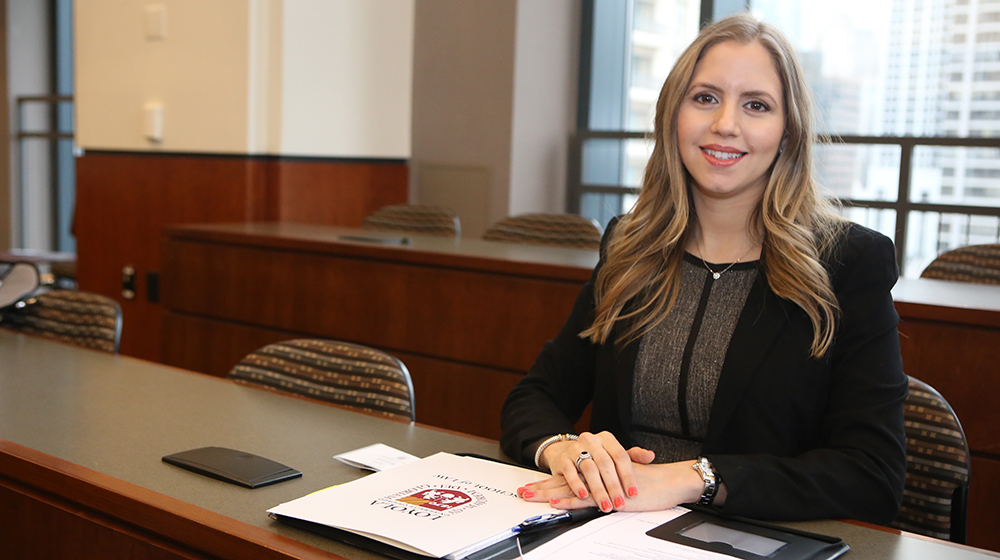
Ana Rivera-Rios, LLM ’20
Alum
“I chose Loyola University Chicago because of its excellent reputation in health care law.”

Jordan Paradise
Faculty
“The Beazley Institute for Health Law and Policy supports a vast on-campus and online curriculum.”

Sharmi Mahajan
Alumni/Adjunct
“To learn health law is to also learn about corporate, administrative, criminal and constitutional law. Not only does this make the health law field interesting and challenging, it gives me a better understanding of society’s overarching and interconnected systems and laws.”
FAQs
Do I need a JD degree and need to be a member of the Bar?
LLM applicants must possess a primary law degree. For U.S. lawyers, this is a JD degree. For international lawyers, the degree may vary per country. If you have earned a JD degree from a non-ABA accredited institution in the United States, you must also be a licensed attorney.
What can I expect from the online course experience?
The LLM program is comprised of attorneys with varying practice experience and areas of expertise. Students join the program at various points in their career and each student brings a unique background to the LLM program.
Courses are taught by full-time faculty members at Loyola as well as leading practitioners, each experts in their fields. Each course is organized to teach key substantive areas and practical skills. All courses are offered online through Loyola’s learning management system and consist of reading assignments, recorded lectures, quizzes or exams, bulletin board assignments, writing assignments, and live classes. Course materials are available 24 hours a day, 7 days a week.
Will I have access to Career Services?
Yes, you will have access to a full range of career resources provide by Loyola’s outstanding Office of Career Services.
Can I transfer credits from other schools?
Due to the unique nature of our online degrees, transfer credits are generally not accepted. Applicants or students seeking exceptions to this rule should request consideration of transfer credit in the application process.
To learn more about state and international authorization of programs, please refer to our State and International Authorization page. To learn more about the accreditation of Loyola University Chicago and its schools, as well as information about professional licensure, visit our Accreditation page.
As an attorney, you know that the need for learning and career development never stops. The Master of Laws (LLM) in Health Law program is designed for busy attorneys like yourself who wish to develop or enhance a special expertise in health law.
This 24-credit-hour degree program is completed fully online. Your courses are led by Loyola’s nationally recognized practitioner faculty members, all of whom work in positions that require knowledge of the health care industry and the law. You’ll follow a course of study developed alongside leading health lawyers, industry professionals, and legal experts. You will be immersed in and learn the very latest legal, regulatory, political, ethical, and economic aspects of health care delivery and provider regulation.
Should you choose to focus in compliance, through our accredited program you will be eligible to receive a Certificate in Compliance, enabling you to sit for compliance industry examinations.
OUR COMMITMENT TO YOU
Upon graduation with an LLM in Health Law, you will possess the following knowledge, skills, and professional values:
CURRICULUM
ONLINE PROGRAM CURRICULUM
This 24-credit-hour program is offered exclusively online and can be completed in 5 terms at the part-time rate of pursuit. The courses are primarily asynchronous—no set login times—but faculty do hold live, virtual sessions throughout the term.Degree Requirements
To earn your degree, you must complete 24 credit hours of coursework, including a thesis project. All students are encouraged to attend Education Immersion Weekends at Loyola University Chicago’s Water Tower Campus. Visit the Office of the Registrar for a complete list of degree requirements, academic calendars, and information about the registration process. You may access full course descriptions through our student information system through guest access.
Admission
To apply for the LLM Health Law program, you must possess a Juris Doctorate (JD) or an international equivalent (LLB) from an accredited college or university.
Tuition and Fees
The School of Law and Loyola's Office of Student Financial Assistance are committed to helping students secure the necessary financial resources to make their legal education at Loyola affordable.
To learn more about state and international authorization of programs, please refer to our State and International Authorization page. To learn more about the accreditation of Loyola University Chicago and its schools, as well as information about professional licensure, visit our Accreditation page.