Gene and Barbara Croisant: business school and health system
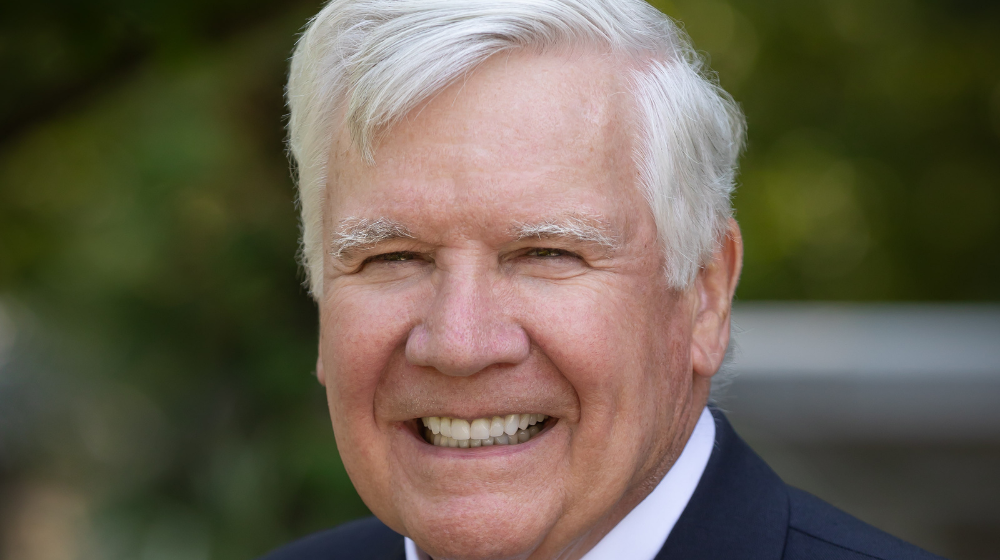
Eugene Croisant and his wife of 45 years, Barbara, have lived a good life--they have two accomplished children, Thomas and Cynthia, five grandchildren, and they have always held their Catholic faith and love of Loyola close to their hearts.
In a spirit of gratitude and with a wish to ensure others can receive Loyola's quality education and medical care, the Croisants have established a $2.4 million charitable remainder trust that will be split evenly between the School of Business Administration and Loyola University Health System.
"We believe very strongly in Loyola's Jesuit values, its commitment to ethical leadership, and its call for social justice in the world," says Croisant from his home in Arizona.
"I also support Loyola because the school is important to the city of Chicago, and I love the city of Chicago."
Gene and Barbara were the first in their families to go to college, and have four Loyola degrees between them. He received a bachelor's in commerce in 1959 and a master's in industrial relations in 1966, and she earned a bachelor's degree in psychology in 1964 and a master's in education in 1972. Their son, Thomas, followed the Jesuit tradition at Marquette because of its Navy ROTC program. Their daughter, Cynthia (Croisant) D'Amico, received three Loyola degrees--a BA in 1988, a JD in 1994, and an MSIR in 1994. Her husband, Vincent D'Amico, received a BBA in 1988 and an MBA in 1992.
"I know how difficult it can be to get funds for school, and I also know that Loyola is significantly peopled with first-generation college students. We wanted to do something to help," he says. The funds to both the medical center and the business school are unrestricted and can be used where they are needed most.
"This is one more example of Gene and Barbara's long-standing and unwavering support of Loyola," says Loyola President Michael J. Garanzini, S.J. "Their gift shows a deep devotion to our educational mission and to our goal of providing our patients with the best care available. We are most grateful."
Pivot Point
A Matter of Degrees
Gene and Barbara Croisant, along with their daughter and son-in-law, hold nine Loyola degrees among them.
Eugene Croisant
- BBA '59, MSIR '66
Barbara Croisant
- BS '64, MEd '72
Cynthia (Croisant) D'Amico
- BA '88, JD '94, MSIR '94
Vincent D'Amico
- BBA '88, MBA '92
By any standard, Gene Croisant has had an illustrious career in business. However, the determination and drive that led him through a dramatic rise in the world of banking can be traced back to a family tragedy at a very young age. When Gene was only 11 years old, his father, Edward, died. This singular event shaped his character and set him on a path that would take him far in life.
"My father's death made me what I am today--it gave me my drive to succeed and my need to work for my family's security," he says. Croisant remembers his father as an avid reader and a hard worker.In 1950, Croisant's older brother and sister were both newly married, so it was just he and his mother, Alice, at home in their apartment on South Talman Avenue.
"We watched our pennies, and as far back as I can remember, if I wanted spending money, I had to work for it," he recalls. Croisant's first job at age 12 was at a neighborhood car lot on Western Avenue. He scraped the rust off bumpers and washed and polished the cars for about 75 cents an hour. In high school, he began working part time downtown as a check processor at what would be the beginning of a 34-year career at Continental Bank."People everywhere in my life have stepped up to help me at different times."
With his father gone, Croisant found an important mentor at Harper High School on South Wood Street. Like many young men at the time, he participated in his school's Junior ROTC program. Croisant's instructor, Master Sergeant James D. Mancini, was "the toughest, most intolerant, and most driven guy you'd ever want to meet. But he always had a purpose: to make you better," he recalls. He credits Mancini with his go-getter attitude and his desire for excellence. The two ended up being lifelong friends.
During his senior year, Croisant's platoon won the annual citywide drill competition. The chief judge of the competition happened to be the head of military science and tactics at Loyola, Lt. Col. Charles Nowe. He tapped Croisant on the shoulder after the win and congratulated him.
"Son, are you going to college?" Nowe asked. Croisant told him he hoped to eventually, but planned to enter the service so he could attend on the GI Bill.
Nowe pressed, "How are your grades?"
"Good," Croisant replied.
Nowe invited him to visit Loyola and discuss his college plans.
"He told me that every department was given a scholarship to award and that if I could pass the entrance exam, his department's scholarship would be mine."
"That was truly the good Lord having his hand in that," says Croisant.
Down to Business
His devotion to Loyola began as a student in business, where he recalls his professors as being excellent instructors. In fact, one of his favorite teachers--John D. O'Malley, BS '50, JD '53,--is still teaching. "His complete clarity--I had him for business law--made the law come alive with examples. He pressed students to respond to him, throwing about hypotheticals--he was exciting and engaging and we're still friends today."
"Eugene Croisant, who was in my class in 1956, is one of the finest, most responsive students I have ever had the privilege of teaching," says O'Malley. "He and his wife, Barbara, have been valued personal friends over many decades, and their accomplishments in business and charitable-support activities are models for duplication."
As a student, Croisant was inducted into the business fraternity Alpha Kappa Psi, and has always been impressed with the University's sense of social justice. "This was especially true in the Industrial Relations Institute. They taught us the importance of equitable treatment of all people," he recalls. "I also thoroughly enjoyed my liberal arts subjects--probably more than my business school subjects; they stretched my mind more--philosophy, psychology, theology. These subjects ended up being very useful in my career in human resources."
"People everywhere in my life have stepped up to help me at different times."
While attending Loyola, Croisant continued to work at Continental Bank part time. Upon graduation he received his commission in the Army and was set to begin training at Fort Benning in Georgia one month after graduation. At the same time a bank officer offered him a full-time job, even though it was for just one month. He declined, citing his desire to serve in the armed forces. The bank officer persisted.
"At first I was confused, but I soon realized he was offering me a tremendous opportunity." By accepting the job and taking a leave, he would continue to earn pension credits while also serving his country. After Croisant's two-year stint, he went right back to banking for Continental. "Again, I was fortunate. People everywhere in my life have stepped up to help me at different times."
When he returned from service in 1961, he began working full time and enrolled in Loyola's master's in Industrial Relations Institute. While there, he sat next to Barbara Byczek in the "Papal Social Encyclicals" class that both were required to take. Though they had met earlier through a friend, they began dating in college and married in 1964.Barbara has had an active career as a high school counselor, the owner of a travel agency, and a chairperson of the American Indian Institute.
By 1963, bank management asked Croisant to take the lead in computerizing the check processing system. By 1967, he was in charge of all data processing for the bank.
In 1972, at age 35, Croisant was asked to head human resources for Continental's worldwide operation, becoming the youngest senior vice president at the bank.In 1976, Croisant took a leave to serve as a senior advisor in human resources to then-Governor Jim Thomson's transition team.
By 1988, Croisant was named chief operations officer at Continental. That same year he was asked by incoming U.S. Secretary of Transportation Samuel Skinner to assist him in his transition to the Department of Transportation. "After serving in Washington, I went back to my job at Continental, but found that the suit no longer fit--I realized I'd been in banking for more than 30 years and knew it like the back of my hand, but wasn't challenged anymore." Then he got a call from a friend who doing a search for a major corporation for the head of administration.
New York, New York
It actually took a lot of convincing to get the Croisants to move from Chicago to New York City in 1989, but the job at RJR Nabisco turned out to be "the most enjoyable corporate experience of my life--I loved the job and New York. We lived behind Carnegie Hall. Barbara says our time in New York was like dating again--we'd go out to eat, run over to Carnegie Hall five minutes before a show started--it didn't matter what was playing, we'd just decide to go and have fun." His five-year commitment as Nabisco's executive vice president of administration and human resources turned into seven.
While in New York, President George H. W. Bush appointed him to the board of Amtrak, and later asked him to serve as an organizational consultant to the White House in 1992.
By 1997, he decided to retire and move to a ranch in Montana, but again was called to work as a senior management consultant for ConAgra. Finally, in 2005, he retired.
Still Busy
Though retired, Croisant manages to keep himself busy with charitable work and other activities. He has maintained his interest in Loyola throughout his life and has served on the Board of Trustees a total of 18 years. He is a life trustee of the University.
In addition to his board work at Loyola, Croisant taught in the business school and was a member of the dean's council in the 1970s.
"Gene and Barbara Croisant, as well as their daughter, Cynthia, are loyal Loyola alumni," says former Loyola President Ray Baumhart, S.J. "Gene is a successful, ethical business leader of whom our university can be proud."
Croisant was honored at last year's Founders' Dinner and received a Damen Award from the School of Business Administration. He also has served on a number of projects at the medical center, where he came to know Anthony Barbato, MD '70, the recent past president and CEO of the Loyola University Health System.
"Gene is an expert in the management of complex organizations," says Barbato. "He taught me the importance of developing staff so that each individual's strengths could be used to their fullest advantage. His guidance helped energize the staff, which led to greater productivity and job satisfaction and, ultimately, helped shape the success of the medical center."
Eugene Croisant's accomplishments and service to the community make for a long list. He's led a principled life full of great responsibility and great success. He credits his wife for his ability to serve his community and climb the corporate ladder and believes that that the three cornerstones of their life together remain to this day: family, work, and education. "Family first," he says, "but all equally important."