
Undergraduate Research Fellowship
The Hank Center, in support of the Catholic Studies Minor, funds a year-long fellowship to undergraduate students who are currently enrolled in the Catholic Studies Minor program. This fellowship supports undergraduate students to work on research projects in the Catholic Intellectual Tradition. Undergraduate fellows can apply either to work as research assistants for faculty-led projects, or may apply to work on their own project, mentored by a faculty mentor of their choosing. The fellowship includes a $2500 award (applied to fellows' student accounts), and up to $500 in travel funding and/or research supplies.
Eligibility and Application Information
Eligibility and Application Information
Priority for this Fellowship is given to students enrolled in the Catholic Studies minor at Loyola University Chicago. Students who are not enrolled in this fellowship but still want to apply for the fellowship are encouraged to reach out to Hank Center Associate Director Joe Vukov before applying.
Applications are completed online through the Loyola Undergraduate Research Opportunities Program (LUROP) by March 1 of each year. As part of the application process, applicants will be required to submit an application, a summary of proposed project, and a letter of support from a faculty mentor. For more information, please contact Hank Center Associate Director Joe Vukov at jvukov@luc.edu.
Current Undergraduate Research Fellows
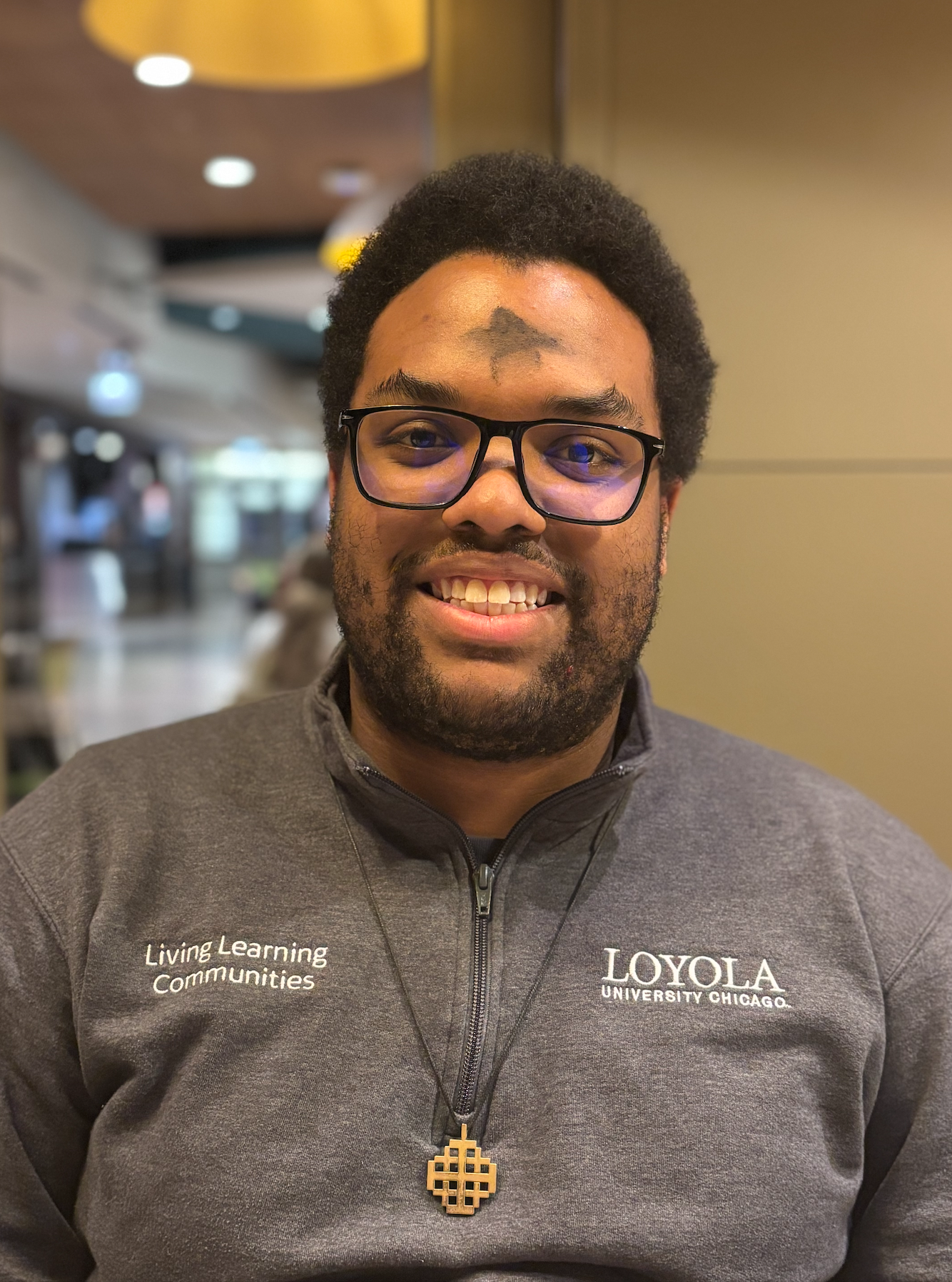
Oronde Manson
My research examines the relationship between Aristotle's conception of eudaimonia (human flourishing) and the Christian understanding of happiness as developed by St. Augustine and St. Thomas Aquinas. Aristotle argues that the highest human good is achieved through a life of virtue and rational contemplation. Augustine and Aquinas, while deeply influenced by Aristotle, contend that human flourishing ultimately finds its fulfillment not in reason alone but in union with God. Through a close reading of works including Nicomachean Ethics, Confessions, City of God, and selections from Aquinas's Summa Theologiae, this project explores how Christian thinkers adopted, transformed, and completed Aristotle's ethical framework. Rather than rejecting classical philosophy, Augustine and Aquinas argue that divine grace perfects human nature and directs it toward its ultimate end. By investigating this dialogue between classical philosophy and Christian theology, my research seeks to better understand the Catholic intellectual tradition's account of virtue, happiness, and the purpose of human life, while highlighting the enduring relevance of these ideas to contemporary philosophical discussions.

Munya Noman
In “Confessions,” Augustine of Hippo repeatedly distinguishes between fleeting human joys and the “true joy” found in the love of God. Human attachment, because it is unstable and vulnerable to loss, appears incapable of sustaining happiness without sorrow, while divine love promises permanence, rest, and freedom from grief. Through his theory of ordo amoris, Augustine is often read as calling for detachment from the human in order to reach the eternal. Yet this paper argues that Augustine’s own narrative complicates, and ultimately destabilizes, that framework. Through a close reading of Augustine’s mourning for his unnamed friend in Book IV, this paper contends that he inadvertently reveals a form of joy rooted precisely in fragility, vulnerability, and relational dependence. Rather than presenting grief merely as evidence of misordered love, Augustine’s language of mutuality and shared identity suggests that human love is not simply a failed substitute for divine joy, but a necessary site through which joy becomes intelligible at all. Methodologically, this project combines close textual analysis with affective and narrative theology, reading Augustine’s grief not as a deviation from his thought but as theologically significant. In dialogue with contemporary essayist Zadie Smith’s understanding of joy as constituted through pain, fracture, hope, terror, and happiness, I argue that Augustine unintentionally gestures toward a conception of joy inseparable from mortality and loss. His intense mourning exposes a tension between his theological claims and his lived experience: attachment forms the self even through suffering. By reading Augustine against himself, this paper reframes joy not as a purely eternal state achieved through detachment from the human, but as an affective experience forged within human connection. Augustine’s paradox ultimately reveals that joy is not diminished by impermanence; rather, its value emerges precisely from the conditions of mortality, grief, and vulnerability that he seeks to transcend.

Allison Rugg
My research will focus on the groundbreaking contributions of Dr. Magda Arnold within the fields of psychology, neuroscience, and philosophy in the mid 19th century. Arnold established the reappraisal theory of emotion which regards subjective, emotional experience as a vitally important aspect in understanding the whole human person. Arnold’s theory positions emotions as not simply biological or instinctive, but as emanated from individual choice or agency, evaluation of a situation, and most importantly, individual experiences. I will aim at more thoroughly clarifying, contextualizing, and amplifying Arnold’s work as well as explore the ways in which this work was significantly influenced by her Catholic heritage and spirituality. I will do this by reviewing and analyzing relevant literature as well as visiting Loyola’s archives and discussing my research with experts and collaborators. Furthermore, my research will investigate whether Arnold’s appraisal theory of emotion has been mistakenly credited to Dr. Richard Lazarus, whom the field of psychology frequently acknowledges as the theory’s founder. There are several reasons why this could have happened: namely, Arnold’s identity as an immigrant woman and anti-Catholic bias that permeated mid-century American culture. If my research and analysis support a history of false attribution, I intend to restore Arnold as the “Mother of Appraisal Theory of Emotion” and illustrate how the practice of mis-citation—including omission of citation—causes much harm to the advancement of scientific inquiry.
Past Undergraduate Research Fellows
Matthew Battaglia (2025-2026)
Advisor: Paddy Gilger, S.J.
Abraham Fielder (2025-2026)
Advisor: Naomi Fisher
Charles Chengary (2024-2025)
Advisor: Derrick Witherington
Grant DeRaedt (2024-2025)
Advisor: Matthew Dunch, S.J.
Mark Gomez (2023-2024)
Advisor: Paddy Gilger, S.J.
Matthew McKenna (2023-2024)
Advisor: Jeffrey Fisher
Grace Shallal (2023-2024)
Advisor: Paula Tallman
Sarah LaVanway (2020-2021)
Majors: Theology, Global and International Studies
Minor: Catholic Studies
Frances Rafferty (2020-2021)
Major: Environmental Policy
Minor: Catholic Studies
Joseph I. De Larauze (2018-2019)
Majors: Economics, English
Minors: Business Administration, Catholic Studies
Sarah Miklius (2018-2019)
Major: International Studies
Minors: Catholic Studies, Peace Studies
Sylvester Francis Alonz (2017-2018)
Majors: Religious Studies
Minor: Catholic Studies
Jenna Meyers (2017-2018)
Major: Economics
Minors: Business Administration, Catholic Studies, Theatre
Jay Egan (2016-2017)
Majors: Philosophy
Minor: Catholic Studies
Michael Malucha (2016-2017)
Major: Philosophy
Minors: Catholic Studies
Gustav Roman (2015-2016)
Major: English
Minors: Catholic Studies, History, Theology
Katie Dubielak (2015-2016)
Major: Social Work
Minor: Catholic Studies
Zac Davis (2014-2015)
Majors: Philosophy, Theology
Minor: Catholic Studies
Caley Terry (2014-2015)
Majors: English, Theology
Minor: Catholic Studies
Evan Thompson (2014-2015)
Major: History
Minor: Catholic Studies
Sarah Balas (2013-2014)
Major: English
Minor: Catholic Studies
Steven Patzke (2013-2014)
Majors: Theology, Philosophy
Minors: Catholic Studies, Pastoral Leadership
Mario L. Cuttone (2012-2013)
Majors: Accounting and Sport Management
Minor: Catholic Studies
Martha Ligas (2012-2013)
Majors: Psychology and Sociology
Minor: Catholic Studies
Gerard James Luisi II (2012-2013)
Majors: Philosophy and Political Science
Minor: Catholic Studies
Zachary Hugo (2011-2012)
Majors: Philosophy, Theology
Minor: Catholic Studies
Courtney Clark (2011-2012)
Majors: Religious Studies, Global and International Studies
Minors: French, Catholic Studies
Past Hank Center Undergraduate Research Assistants
2018-2019: Joseph De Laurauze and Emily Kate Marticello
2017-2018: Amy Christenson & Sarah O'Hanian
2016-2017: Angelo Jesus Canta & Gustav Roman
2015-2016: Ron Amiscaray, Gustav Roman, & Guy Valponi
2014-2015: Angelo Jesus Canta & Zac Davis
2013-2014: Paul Jentz, Samantha Ropski, & Alicen Schade
2011-2012: Lucia Wiley-Kellerman
2010-2011: Nuria Martinez
2009-2010: Daniel Wood