
Digital Policy Observatory
Critical Approaches to AI Policy: Recap of the 2026 Digital Politics Summer School
Cherry Cheuk, Kwan Chiu | August 15, 2026
The intersection of artificial intelligence and public policy is moving faster than ever. However, much of the mainstream debate around AI regulation remains focused on technocratic fixes, corporate compliance, and western-centric models. In June 2026, the Digital Politics Summer School, co-organised by the Center for Digital Ethics and Policy (CDEP) at Loyola University Chicago and the Digital Society Research Group (DISC) at Manchester Metropolitan University, convened to disrupt this narrative. Bringing together a global cohort of academics, civil society advocates, and the first-ever cohort of Critical AI Policy Virtual Fellows, the four-day event challenged participants to critique existing AI frameworks through the lenses of power, justice, and human dignity. Here is what went down at the 2026 school, capturing the vibrant energy and critical takeaways from a week of radical reimagining.

Who gets to build the AI-powered classroom? Greece’s AI education experiment and the New Cold War
Dr Aristea Fotopoulou | July 11, 2026
When Greece announced it would deploy ChatGPT Edu across selected secondary schools in October 2025, the news generated limited traction in a national media landscape, which is alarmingly dominated by political/economic scandals and femicides. The Memorandum of Understanding, signed at the Hellenic Expo in Thessaloniki in September 2025, positions Greece among the first countries worldwide to pilot large-scale use of OpenAI’s technology in public education (Estonia was one of the first countries to form a partnership with OpenAI). The Onassis Foundation, the country’s most prestigious philanthropic institution, was chosen to lead implementation in its selective public schools (‘πρότυπα’). The framing is optimistic: personalised learning, AI-ready graduates, and a nation preparing its youth for a transformed labour market.
Meta’s Shifting Response to AI‑Generated Misinformation
Lucie Čejková | June 28, 2026
This guest blog was written by Lucie Čejková, a CDEP/DISC Virtual Visiting Fellow and a junior researcher at the Faculty of Social Studies at Masaryk University. Her post examines how Meta approaches the governance of generative AI–driven misinformation, drawing on a recent case of AI-fabricated health disinformation circulating on Facebook in Czechia. By close reading of the platform’s Community Standards and their evolution over time, she highlights a broader shift from content removal to labeling and user-side responsibility. The blog concludes with reflections on the implications of this approach for platform accountability and outlines key considerations for policymakers.
CDEP/DISC AI Literacies Lab @ Manchester Festival of Libraries
June 12, 2026
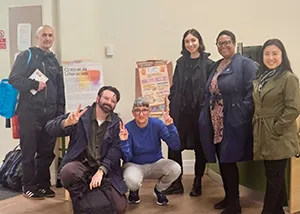
Last night we took our AI Literacies Lab out into the community as part of Manchester City of Literature Festival of Libraries! We were hosted by Chorlton Library, where we held an exhibition of our AI Literacies artworks created by Sonaksha. Thank you to everyone who came to the exhibition and discussion, it was great to speak to local communities about our ongoing Critical AI Literacies work and share the resources we have made with the help of AHEAD – Arts and Humanities Engagement and Dialogue.

Sustainable AI and the Imperative of Global Distributive Justice
Inês Neves | June 11, 2026
This guest blog was authored by CDEP/DISC Virtual Visiting Fellow Inês Neves, PhD in Law and Invited Assistant Professor at the Faculty of Law of the University of Porto, Portugal. In this post, Inês explores the role of Law in addressing the unequal distribution of the environmental and social impacts associated with AI infrastructures and value chains. Drawing on principles of sustainable development and global distributive justice, she examines the potential of extraterritorial regulatory approaches and a model of shared responsibility among States, companies, international organisations, and civil society to advance more sustainable and equitable AI governance.

The Enclosure of the Mind
Scott Timcke | June 5, 2026
This guest blog was authored by a CDEP/DISC Virtual Visiting Fellow Scott Timcke.

AI in UK Public Services: Beyond Administrative Efficiency
Camille Chichet | May 29, 2026
This guest blog was authored by a CDEP/DISC Virtual Visiting Fellow Camille Chichet, a public policy professional with experience of working within the legislative and executive branches of the French government. Her blog examines how AI in UK public administration is reshaping what the state notices, prioritises, and governs—and why transparency alone is not enough.

Do generative AI chatbots keep us safe from conspiracy theories?
Kate FitzGerald | May 29, 2026
This guest blog was authored by a CDEP/DISC Virtual Visiting Fellow Kate FitzGerald, a PhD Researcher at the Digital Media Research Centre in the Queensland University of Technology. In this post, Kate shares insights on her recent work considering how generative AI chatbots respond to conspiratorial prompts. She focuses on the role of low- and high-resource languages in implementing safety guardrails, and offers suggestion for policy approaches and regulation with regards to misinformation and conspiratorial thinking.
Welcoming the First Cohort of DISC/CDEP Virtual Fellows
April 13, 2026
This week, we are delighted to welcome our first cohort of Virtual Fellows in Critical AI Policy, hosted jointly by DISC and CDEP (Centre for Digital Ethics and Policy). Our Fellows come from many countries across Africa, Asia, Europe and North and South America, and bring with them a range of topics and critical perspectives, such as political economy of AI; environmental sustainability; misinformation and harms; legal and environmental aspects of AI policy; and decolonial/Indigenous, feminist and queer approach to AI. For the next four months, the Fellow will pursue their own research and work in groups to create targeted, cutting-edge policy interventions, culminating in a joint Policy Report and presentations at our 2026 Online Summer School.
Read More