
Story - Parkinson - Research for good
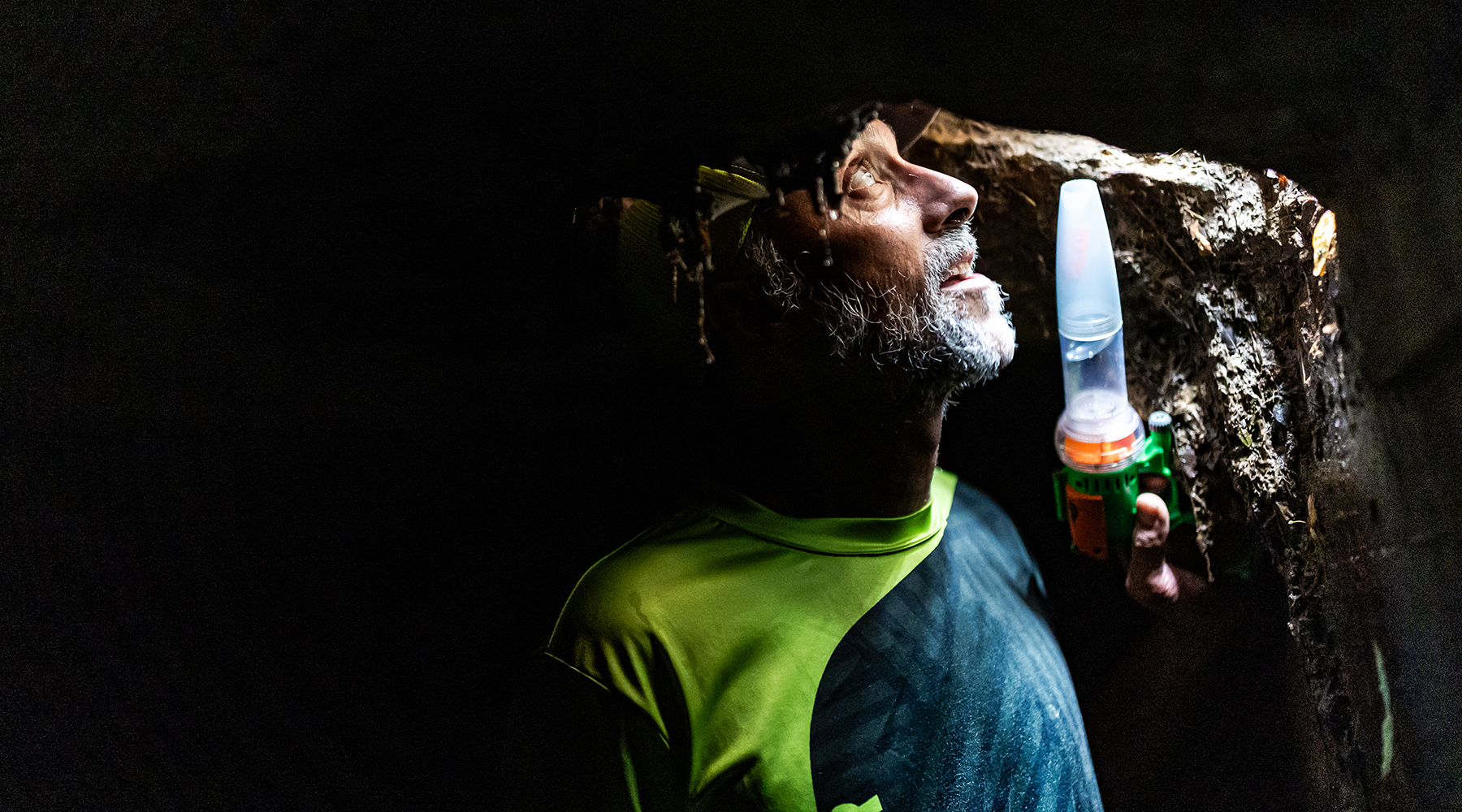
Justin Harbison, professor for the Parkinson School of Health Sciences and Public Health, explores a sewer drain in Des Plaines, where he studies mosquito populations and groundwater management.
Loyola researcher investigates West Nile virus from the sewers
Professor works with local governments to reduce mosquito population
To limit the transmission of West Nile virus, Associate Professor Justin Harbison is working with mosquito abatement districts in suburban Cook County to treat standing water with larvicide.
On a quiet street in Des Plaines, Illinois, Justin Harbison lowered a long rod attached to a cup into an open catch basin. When he pulled it out, the water-filled cup was teeming with swimming mosquito larvae but contained only a few floating pupae—a good sign. Harbison, known as the “Sewer Monster” for his work on mosquito control, has no fear of murky environs if that’s what it takes to protect Chicagoans. “I’m not sure when I got that title,” he says. “I think it was the result of working with younger-minded students with a talent for creative names.”

Loyola University Chicago
The pursuit of purpose
Loyola University Chicago has yielded research that not only informs, but has real impact.
Read more about Loyola's social impact
School of Law
Weekend warriors
Since 2016, Loyola’s School of Law has offered a flexible path to a law degree for career changers that prepares alums to lead with purpose.
Read more about Weekend JD
Stritch School of Medicine
Care in the curriculum
At Loyola’s Stritch School of Medicine, shadowing hospital chaplains is a required part of the curriculum for first-year medical students.
Read more about spiritual careHarbison is an associate professor in the Parkinson School of Health Sciences and Public Health at Loyola University Chicago. He works with four mosquito abatement districts in the Cook County suburbs to reduce the spread of mosquito-borne diseases by treating the standing water inside stormwater catch basins with larvicide.
It’s wet, nasty work, but halting the lifecycle of disease-carrying mosquitoes early is the best way to prevent disease spread, and the catch basins act as petri dishes for mosquito breeding. “If the mosquitoes get out there and are biting already, it’s a different scale of problem,” says Harbison. “We want to get them before that.”
In Chicago and other U.S. cities, Culex pipiens, or northern house mosquitoes, which can carry West Nile virus, like to lay their eggs in the sludgy runoff that collects in the sewer inlets. “West Nile virus is really our big thing,” Harbison says. “Overwhelmingly, the most common source of the West Nile-carrying mosquitoes is right here in these catch basins.”
The changing climate appears to be increasing the risk of West Nile transmission in Upper Midwest cities like Chicago. “It’s kind of counterintuitive,” Harbison says. “With drought, we tend to expect West Nile virus to be worse. And one of the reasons we think this is, is because catch basins play a bigger role. If it’s rainy, you’ve got the Forest Preserves of Cook County and all the standing water out there. But when it’s dry, pretty much the only standing water habitat that we can find is in these basins.””
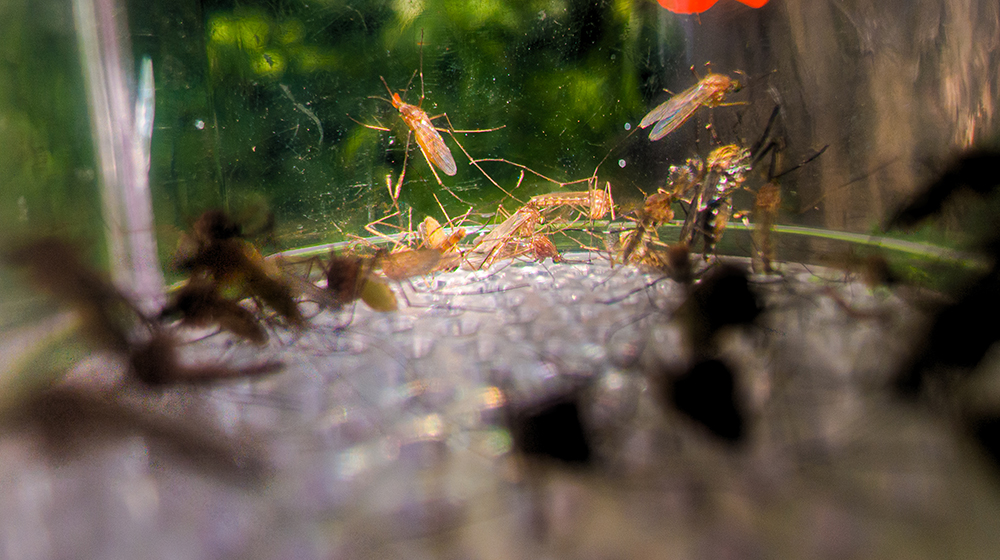
Mosquitoes in a glass tank.
“Every year, mosquitoes kill more people than people kill people, and the best way to combat that is through investment in public health.” Associate Professor Justin Harbison
West Nile virus, which hit the United States in 1999, is now prevalent across the continental United States. Through mid-September 2026, the Illinois Department of Public Health has identified 24 human cases of West Nile virus, with three fatalities. The virus has been found in 55 counties statewide this year. Currently there are no vaccines or treatments for the disease, according to the national Centers for Disease Control and Prevention. “There’s a clear trend associated with the longer mosquito seasons, which means longer time for potential disease risk,” Harbison says. “We also have new tools and better public education, and I would say we’re seeing decreases of West Nile in our area due to the work of our abatement districts.”
As temperatures rise, Harbison worries about the threat of other species of mosquitoes making their way north. Eastern equine encephalitis, a mosquito-born disease with a 30% fatality rate, is now present in 20 states. Dengue fever, which is carried by the Asian tiger mosquito, has shown up in the southern and southwestern U.S., according to the CDC. “If they are established here, that would be a problem,” he says. “Chicago is a big metropolitan area, and in addition we’ve got people coming and going all over the globe.”
“Every year, mosquitoes kill more people than people kill people, and the best way to combat that is through investment in public health,” says Harbison. “I write scientific articles like a normal academic, but with these public health collaborations we can react and see outcomes in real time. That’s exciting for me.”