
Exploring AI’s promise and equitable care
By Daniel P. Smith
November 13, 2026
Like many, Tom Lawry recognizes the potential of artificial intelligence (AI) to transform health care. After all, AI sparks compelling opportunities in areas like advanced diagnostics, drug discovery, precision medicine, and enhanced clinical operations.
But according to Lawry, an internationally recognized leader in AI and health care innovation, the contemporary challenge isn’t unlocking that promise. Rather, it’s making sure AI’s benefits reach everyone to create a more responsive, just, and impactful system.
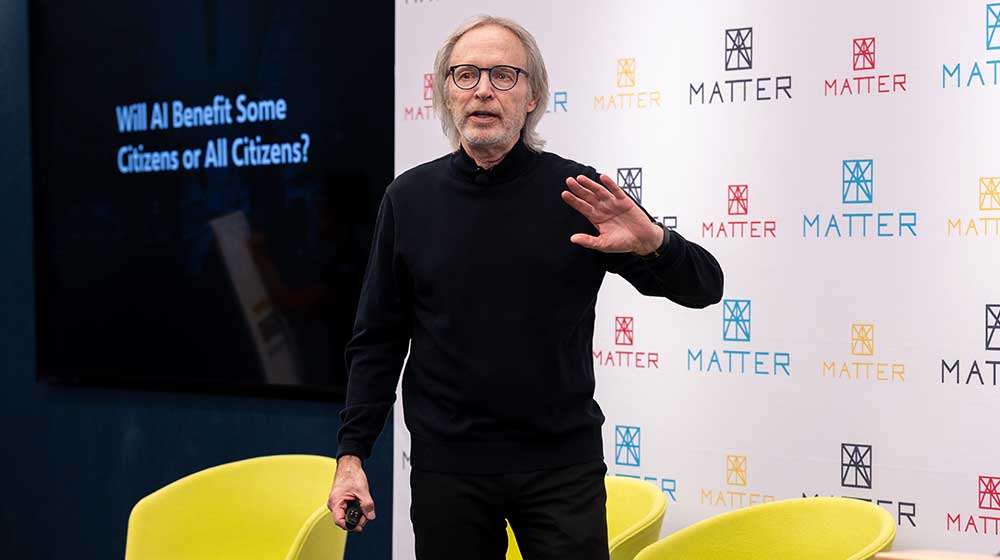
“We have tremendous opportunity to say, ‘How do we start raising the bar in health care?’” Lawry said during his keynote presentation at the sixth annual Loyola Chicago Health Equity Quest hosted by Loyola’s Parkinson School of Health Sciences and Public Health in collaboration with MATTER, a Chicago-based global health care accelerator.
The November 4 event explored AI’s role in advancing health equity. Titled AI for Health Equity by Design, the Health Equity Quest featured a three-hour morning workshop exploring practical AI use cases as well as Lawry’s keynote and an expert panel discussing how AI-driven solutions could be inclusive, community-informed, and built for meaningful impact.
At a time when many institutions are running away from health equity conversations, Parkinson School interim dean Jenny O’Rourke was proud to see Loyola embrace the topic—action fueled by the university’s Jesuit values and a belief health care remains a fundamental human right.
“The Health Equity Quest supported dialogue around health equity and application with AI use, with the goal to strengthen and evaluate what we’re doing in the health care arena,” O’Rourke said.
Opportunity, Empowerment, and Equity
Lawry’s inspired keynote highlighted the day-long event held at MATTER’s Merchandise Mart headquarters. As one example of AI’s potential in the health care arena, Lawry noted Singapore’s efforts to curb fast-rising rates of diabetes. With about half of the nation’s population projected to be fully diabetic by 2050, health care leaders responded by creating a national framework to combat the chronic disease. The effort included providing 100,000 citizens an AI-powered wearable translating personal health data into prescribed “nudges,” such as increasing one’s daily step count. Early data suggests the tech-fueled intervention is slowing the progression of pre-diabetic to full diabetic cases in Singapore, thereby saving lives and reducing health care expenditures.
“We know AI works,” said Lawry, the best-selling author of Hacking Healthcare: How AI and the Intelligent Health Revolution Will Reboot an Ailing System. “We’ve got multiple use cases from around the world and it’s now a matter of how we start applying things like that here.”
Lawry urged the Health Equity Quest attendees, both those physically at the event and those tuning in virtually, to note the moment – and seize it.
“AI gives us a once-in-a-century transformation opportunity,” he said.
While acknowledging risks, Lawry nevertheless called it easier to mitigate bias in an algorithm than human beings, and he championed AI as a powerful tool to address health disparities and propel human lives. “AI is not about technology. It’s about empowerment,” he said. “It’s about empowering clinicians to be better at the things they care about. It's about empowering those consumers who wish to and choose to take some better control of their health going forward.”
Following Lawry’s 20-minute keynote, MATTER CEO Steven Collens moderated a panel featuring Dr. Jennifer Miles-Thomas, vice chair of integration and innovation at Northwestern Medicine, Merage Ghane from the Coalition for Health AI, and Francisco Iacobelli, an associate professor in the Department of Health Informatics and Data Science at the Parkinson School. The quartet discussed current AI use cases in the health care world, its notable opportunities, and promoting responsible and equitable implementation.
“My hope is that the patient has the power for their health care, not the provider,” Iacobelli said of AI’s transformational promise.
Unlocking Possibilities
The 2026 edition of the Health Equity Quest kicked off with a morning workshop designed to help participants build foundational knowledge of AI and its potential applications in the health care arena. Through interactive exercises, guided discussion, and hands-on work, participants discovered how AI could provide a deeper understanding of community needs, strengthen outreach and engagement, support data-informed decision-making, and lead to solutions serving vulnerable populations.
Sara Shapiro Jiménez, the general manager of the Medical Organization for Latino Advancement, a nonprofit dedicated to advancing Latino health and supporting the professional development and leadership of health care professionals, called the morning workshop an eye-opening experience underscoring the “extraordinary potential of AI.” While Jiménez was already using AI to support various administrative tasks, the workshop underscored AI’s potential to help in other realms, such as customer relationship management.
“I’d been defining the boundaries of what I could accomplish based on my own technical limitations rather than exploring what might be possible with AI,” Jiménez said, adding that she left the morning workshop humbled by how much she had to learn, yet empowered by what she might accomplish. “The workshop didn't just teach me new ways to use AI. It fundamentally expanded my understanding of what’s possible.”
For Samantha Mallahan, a second-year medical student at Loyola Stritch School of Medicine, the morning workshop provided access to diverse professional perspectives alongside a richer appreciation for AI’s possibilities and, even more, the importance of responsibly implementing the technology.
“Equity has to be built in from the start, with community voices helping shape and lead its implementation,” Mallahan said after attending the Health Equity Quest. “AI is, at the end of the day, just a super powerful tool. What really matters is who’s behind it and who it’s built for.”
An Ever-Evolving Event
Spearheaded by the Parkinson School’s Center for Health Innovation and Entrepreneurship (CHIE), Loyola launched the Health Equity Quest in 2021 to spur innovation and solutions at the intersection of health equity and complex health problems.
On the heels of the COVID-19 pandemic, the inaugural Health Equity Quest examined health equity and emerging infectious diseases. In subsequent years, and guided by a new partnership with MATTER, the Health Equity Quest tackled other pressing topics, such as climate change, sustainable health care delivery, and mental health for early career professionals. CHIE and MATTER also experimented with various formats at the annual event, from workshops and panel discussions to traditional keynotes and pitch competitions.
In preparing the 2026 program, CHIE surveyed 1,500 prior event attendees to discover their interests. Respondents favored a hands-on workshop and summit revolving around AI issues in health equity.
“People want to know how AI can result in a more human level of care, and that’s why the enthusiasm in the room at the Health Equity Quest was so high,” CHIE founding director Michael Bloom said, adding that student CHIE Innovation Fellows hosted virtual watch parties at both the university’s Lake Shore Campus and its Health Sciences Campus in Maywood. “The question on so many minds isn’t just what AI can do, but how it can further health equity.”
Collens, the MATTER CEO, said the Health Equity Quest combined Loyola’s deep expertise in health equity and strong community connections with his organization’s commitment to turning ideas into practical solutions. In doing so, it highlighted how cross-sector collaboration can help ensure emerging technologies serve the communities that need them most.
“The Health Equity Quest is a great example of what happens when we bring those perspectives together—challenging assumptions, learning from one another, and identifying opportunities to make a meaningful difference,” Collens said.