
Engaging small business ecosystems
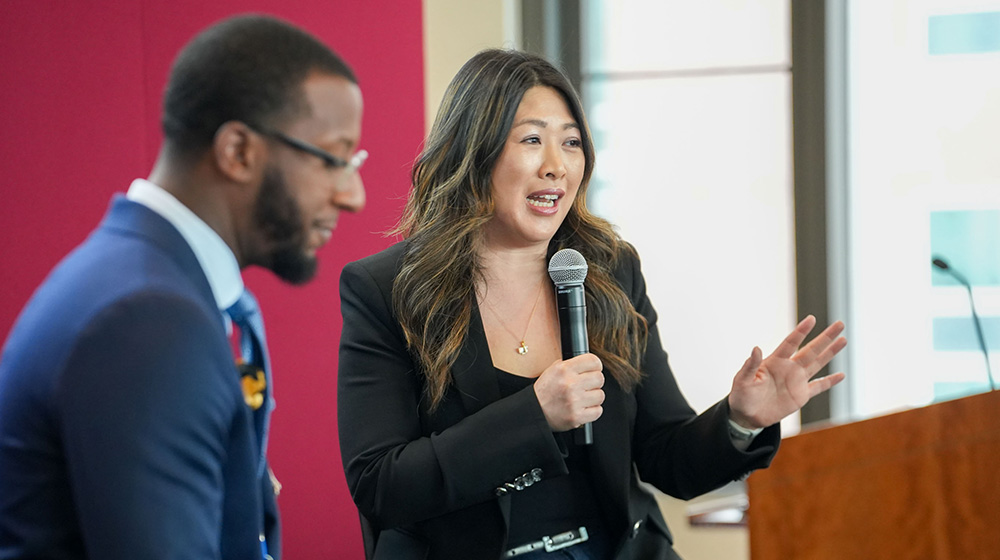
Sugar Bliss CEO Teressa Ging (right) shared at the Capacity Building for Capacity Builders conference how she utilized the small-business ecosystem to help her business survive and thrive. Jonathan McGee (MBA ’22) moderated the conversation.
Business supporting organizations (BSOs), capital providers, and academics gathered at the Quinlan School of Business in May for in the third annual Capacity Building for Capacity Builders conference. Together, business leaders reflected upon what has worked to strengthen the small business ecosystem in Chicago, what challenges they continue to face, and what practices show promise for the future.
“Everyone in the room today is a difference maker and has the potential to make an even greater impact over the next year,” said Michael Behnam, dean of the Quinlan School of Business, in his opening remarks. “We are honored to join with you in helping ensure equal access to services for all Chicago businesses.”
Capacity Building for Capacity Builders is one of the key activities of the Quinlan School of Business’s Social Impact Initiative, which is supported by a $625,000 grant from the U.S. Small Business Administration.
Key takeaways
Several common themes and resources emerged over the course of the day. Below are some of the key takeaways.
1. Building relationships to access capital
The day started with a chat between Sugar Bliss founder and CEO Teresa Ging and Jonathan McGee (MBA ’22), an economic development expert and Baumhart Scholars MBA graduate. The conversation set an inspirational tone for the day as Ging recalled leaving a stable job in finance to pursue a career in baking in 2007.
After opening a small retail space in the loop, Ging’s Sugar Bliss products are being sold and distributed throughout Chicago, including major grocers Mariano’s and Jewel Osco. According to Ging, her success would not have been possible without the support of BSOs and access to capital, including a $200,000 startup loan.
“You should always be working with multiple banks,” Ging said. “I have relationships with banks throughout Chicago. You need to start making those relationships and it’s important to start them early.”
She also implored BSOs to continue helping small businesses access capital, as well helping with branding, trademarking, and strategies for navigating the first three years, which is when most small businesses fail.
2. Addressing data overload
A key focus of the conference was enabling BSOs to uncover common pain points and share strategies to address them. The issue of data overload rose to the top during conference sessions—both the drain of entering data into a multitude of databases and receiving overwhelming amounts of data that is hard to decipher.
“Eighty percent of your time is being spent entering data into databases,” said Sheree Moratto, sustainability director for the Rogers Park Business Alliance.
According to attendees, when BSOs and their clients receive data, they do not have the support to understand it or package it into useable bites. Additionally, they receive overlapping data, leading to feeling overwhelmed and that they are working in the business not on the business.
In efforts to combat this, the Women’s Business Development Council (WBDC) is creating surveys with other Together, they hope to identify resource overlaps, oversights, and make each other more efficient. Attendees echoed the need for continued alignment so everybody can focus on servicing clients, not sifting through spreadsheets.
3. Identifying resources
Throughout the day, resources were identified and shared for attendees to use when they returned to their work. They include:
- Cook County Small Business Source: providing one-on-one business advising and access to capital to support small businesses.
- Next Street: Identifying and attacking systemic barriers preventing small businesses from growing and providing access to experts, networks and capital.
- WBDC Workshops: The WBDC is hosting workshops and events throughout the summer to strengthen the skills, knowledge, and networks of BSOs.
- EDLI: The Entrepreneurship Development and Leadership Institute is an online community the aims to foster connections among Black, Latino, and Women entrepreneurs, and provide them with the necessary resources to support their growth.