
Research Spotlight
Congratulations to Jacob Cunningham on receiving a competitive American Heart Association Predoctoral Fellowship for his research, Neprilysin-Mediated Phospholamban Cleavage in Heart Failure.
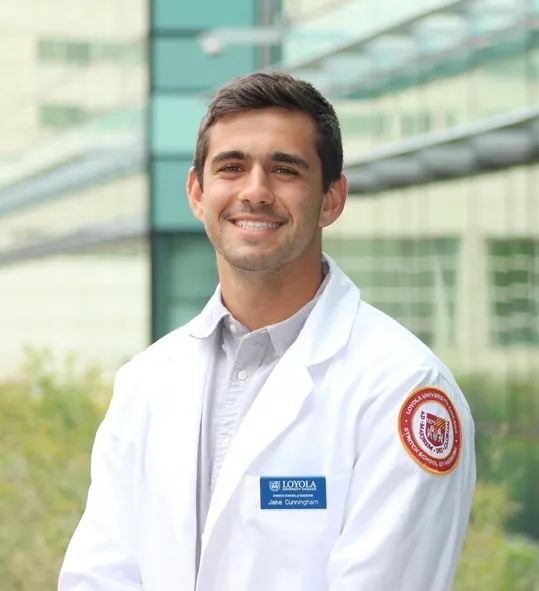
Jacob Cunningham, G3
Track: Cell and Molecular Physiology
Mentor: Seth Robia, PhD Undergraduate: University of California-Berkeley Interests: Cardiovascular Disease, Biophysics
“What I’ve found most meaningful about the MD/PhD program is the chance to move between the clinic and the lab, using patient-centered questions to shape the science and scientific discovery to imagine better care. The program has given me the mentorship, flexibility, and community to grow as both a physician and a scientist.” Jacob Cunningham
Jake Cunningham is an MD/PhD student at Loyola University Chicago whose work focuses on cardiac calcium handling, molecular mechanisms of heart failure, and the development of spectroscopy-based tools for biomedical research and diagnostics.
Jake grew up in San Diego, where much of his early life was shaped by the outdoors. Surfing, mountain biking, hiking, and spending time outside gave him an early appreciation for curiosity, observation, and adventure. His interest in medicine became more personal during his senior year of high school, when his mother underwent open-heart surgery. That experience introduced him to the impact and precision of medicine, but his path toward becoming a physician-scientist developed gradually through research, mentorship, and clinical exposure.
As an undergraduate at UC Berkeley, Jake became increasingly interested in the molecular mechanisms that underlie heart disease. A formative experience came during a summer at UC San Diego in the lab of Dr. Paul Insel, where he studied GPCR signaling in heart failure and aging. That work helped him see how molecular pathways can shape complex disease processes and introduced him to the excitement of asking mechanistic questions with clinical relevance. Jake then began gaining clinical experience through ophthalmology at UCSF and Berkeley. Working with physicians including Dr. Creig Hoyt and Dr. Maanasa Indaram, he saw how thoughtful clinical care requires patience, curiosity, and humility. Later, through clinical research with Dr. Harb, he began to connect what he was seeing in patients with the types of questions that could be pursued in the lab.
At Loyola, Jake joined the laboratory of Dr. Seth Robia, where he has been able to grow as a scientist while learning new approaches in spectroscopy, biophysics, and cardiac physiology. His research focuses on calcium handling in heart failure, particularly the regulation of SERCA, a calcium pump essential for cardiac contraction and relaxation. Much of his work has centered on how small regulatory proteins, including phospholamban, alter SERCA function and contribute to cardiac physiology and disease. More recently, Jake has investigated a potential new role for neprilysin in heart failure. Neprilysin is best known as a therapeutic target in heart failure treatment, but Jake’s work explores whether it may also directly regulate calcium handling by cleaving phospholamban. This project reflects one of the main themes of his training: connecting molecular mechanisms to clinically meaningful questions.
Jake credits the Robia Lab, his mentor Dr. Seth Robia and the Loyola research community with helping him become a more rigorous and independent scientist. Entering a lab rooted in spectroscopy and biophysics pushed him outside his comfort zone, but also taught him how to think more quantitatively, troubleshoot complex experiments, and follow unexpected results. The environment has encouraged both creativity and discipline, giving him space to test ideas while learning how to build stronger scientific arguments. During his time at Loyola, Jake has received an American Heart Association fellowship and NIH F30 grant contributed to a provisional patent related to a novel spectroscopy-based diagnostic.
His broader goal is to build a career as a physician-scientist focused on mechanisms that may eventually improve how disease is diagnosed, understood, and treated.
For Jake, the most meaningful part of the MD/PhD path has been learning how to connect clinical problems with the molecular mechanisms that drive them. His training at Loyola has strengthened his ability to ask questions that begin with patients, move through the lab, and ultimately aim to improve how disease is understood and treated.