
Ignatian Pedagogy
Ignatian Pedagogy is a nearly 500-year old framework based on the Spiritual Exercises of St. Ignatius, Loyola's Chicago's namesake and founder of the Society of Jesus, or the Jesuits. Ignatian Pedagogy seeks to educate the whole person - mind, body, and spirit - by intentionally cultivating five aspects of learning: context, experience, reflection, action, and evaluation.
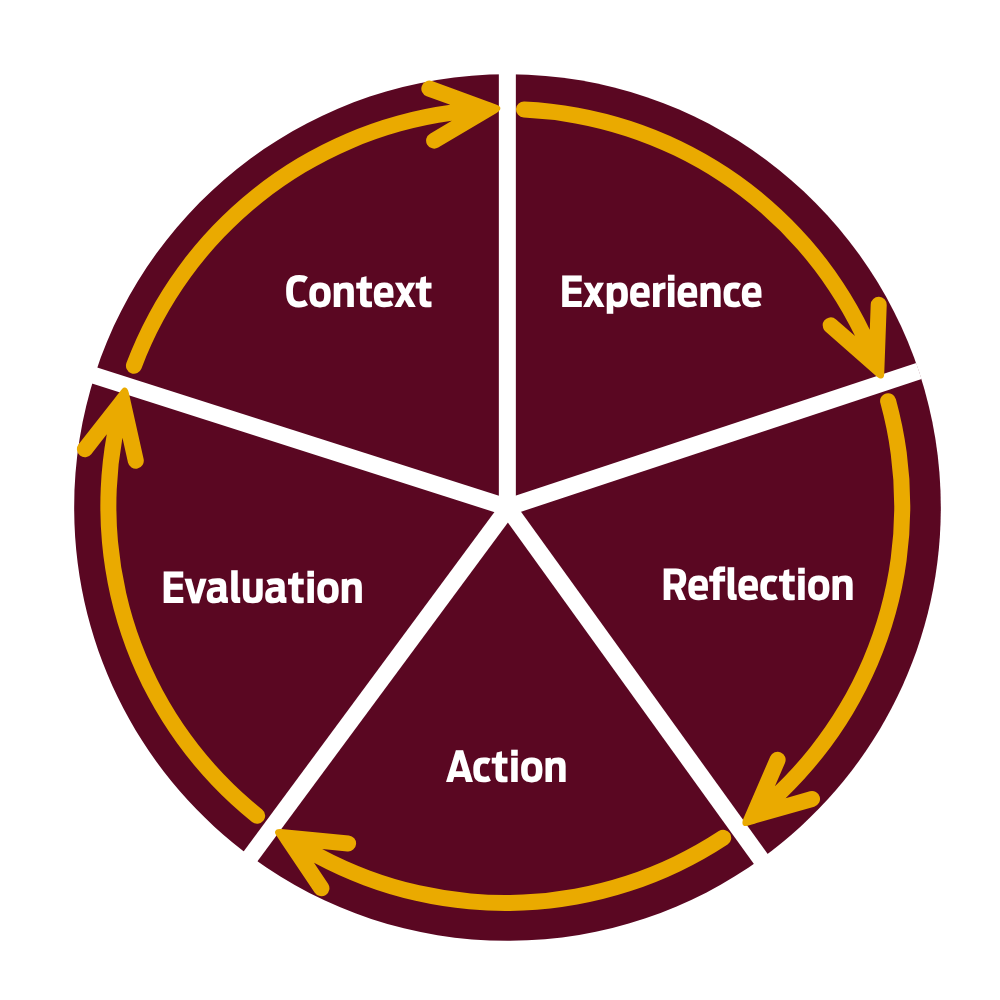
The five elements of the Ignatian Pedagogy Paradigm are meant to interact with one another and we are asked to cycle through the process multiple times. In short, IPP is iterative.
Context is starting point of the framework. For education to be impactful, we must understand the world in which students live - the time and space they occupy as well as the socio-geo-political happenings of our day. Being able to relate to students is key to understanding and accompanying them in their education and allows the instructor to relate the material of their course to what students already know and experience. Context is constantly evolving and therefore must be under on-going consideration.
The lived experience of each individual in the learning space must be invited and embraced in a Jesuit education. We acknowledge that each person’s background and learning thus far in their lives has direct implications for their learning going forward. In addition, educators are called to provide impactful experiences for their students, where they can engage their minds, hearts, senses, and imagination. Inviting everyone’s distinct experience enriches the learning process for the whole group.
Reflection lies at the center of the Ignatian pedagogical process. Inspired by St. Ignatius's Examen, we are asked to regularly pause to check in with ourselves. With consistent, intentional and often guided opportunities for reflection on - and discernment of - our relationships, experiences, and context, we can deepen our learning and discover ever more occasions to lead truly extraordinary lives.
Action points to the expectation that we are to prepare our students – and ourselves – to find ways to utilize what we learn to inform meaningful actions by applying our education to our communities and society. Action also refers to the transformation that will occur within each educator and student. In both ways, we are always striving to impact each person's development and growth in the direction of the greater good.
Evaluation is a continual practice to pay attention to and critique the impact of our experiences and actions. The Ignatian tradition invites us to ask "who am I becoming?" as we move through educational experiences. This allows us to lean in the direction of continual progress toward actualized excellence or magis.
At first, these distinct elements can follow the cyclical process as displayed above. As we deepen our engagement with Ignatian Pedagogy, we will find that the heart of the process lies in the interaction of the five elements. We can find ourselves taking action based on what we have learned while evaluating the effect of our experience and action on ourselves and those around us.
Ignatian Pedagogy Resources
The following resources can help gain a better understanding of what Ignatian Pedagogy is and how to implement it in the classroom.
The Ignatian Pedagogical Paradigm
This video from AJCU member Saint Louis University introduces the essential elements of the IPP framework.
Ignatian Pedagogy: A Practical Approach
The foundational document about Ignatian Pedagogy from the Society of Jesus
Precis of Ignatian Pedagogy: A Practical Approach
A brief summary of "Ignatian Pedagogy: A Practical Approach" by Sharon J. Korth
Transformative Education in the Jesuit Tradition
Background reading on how Jesuit Education at Loyola seeks to transform students