
A scholar for others
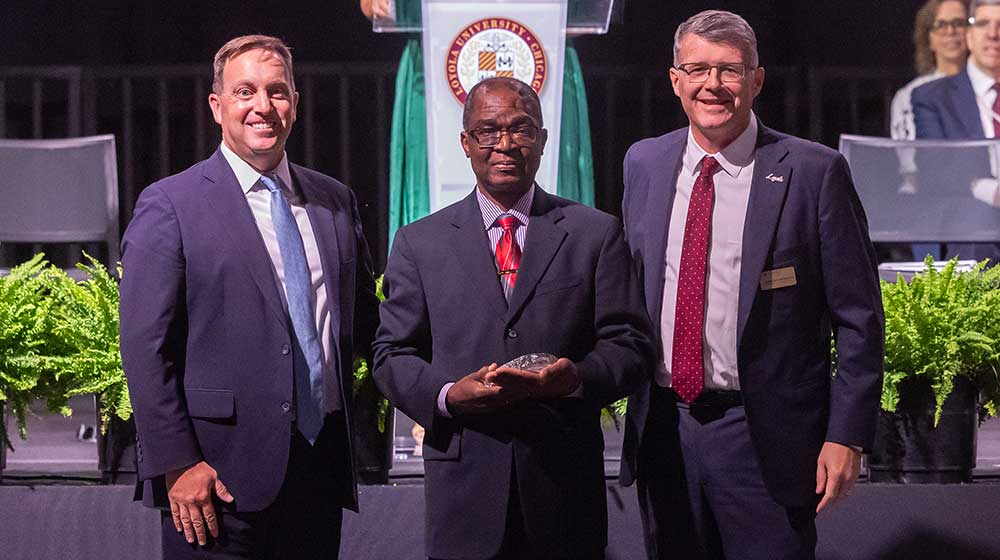
Professor Bamidele Tayo (center) accepts the Pedro Arrupe, S.J., Faculty Award for Diversity Leadership from President Mark C. Reed (left) and Provost Doug Woods (right).
By Daniel P. Smith
October 16, 2026
Throughout his 20-year career at Loyola University Chicago, Professor Bamidele Tayo has devoted himself fully to the Jesuits’ social justice mission.
Tayo has tackled health disparities as a global health researcher, helped expand research capacity in Africa, and lived as a “person for others” through service, teaching, mentoring, and innovative research designed to mitigate inequities.
And his spirited work has not gone unnoticed.
Loyola recently named Tayo, professor of public health sciences at the Parkinson School of Health Sciences and Public Health, the 2026 recipient of its Pedro Arrupe, S.J., Faculty Award for Diversity Leadership. The annual honor recognizes a Loyola faculty member who demonstrates the ideals of diversity, equity, and inclusion through teaching, research, and service. Loyola leadership honored Tayo at its University Convocation on August 21, an annual event reaffirming the university’s academic mission and celebrating its ongoing dedication to the values of Jesuit education.
“The Arrupe award is an affirmation I’m doing the right things on behalf of Loyola University Chicago and its mission,” Tayo says. “It’s proof I’m leveraging the lively environment and rich support Loyola provides to positively influence the lives of others and be an instrument for the greater good.”
Research to drive equity
Tayo joined the Department of Public Health Sciences in 2006 as a postdoctoral research associate, pulled to the University by the late Professor Emeritus Richard Cooper and Associate Dean Amy Luke—both of whom would become influential mentors for Tayo.
A genetic epidemiologist and statistical geneticist, Tayo has spent much of his career investigating the genetic underpinnings of diseases disproportionately impacting the lives of Black populations around the globe, including hypertension, chronic kidney disease, and sickle cell disease.
“My motivation is to increase the representation of underrepresented populations, especially African ancestry, in genomic research and thereby position them for associated benefits,” says Tayo, himself a native of Nigeria.
In one groundbreaking effort, Tayo and his team provided vital evidence now transforming care of sickle cell disease in Africa. Though U.S-based clinicians successfully used Hydroxyurea, a U.S. Food and Drug Administration-approved therapeutic, to treat sickle cell disease and increase patient lifespans, clinicians in Africa rarely prescribed the medicine over concerns about its side effects. After conducting a clinical study in Nigeria, however, Tayo’s team published detailed reports demonstrating the efficacy of fixed low-dose Hydroxyurea to manage sickle cell disease.
“Our research provided the evidence for physicians, patients, and caregivers that the medicine was beneficial and useful, which is trickling down to affect individuals at the population level and positioning them to enjoy longer lives,” Tayo says.
Supporting scientists of color
In addition to conducting innovative genetic epidemiology research, Tayo has co-led the training of more than 150 junior research scientists throughout Nigeria and Ghana over the past 15 years alongside colleagues from Loyola, New York University, and other institutions as part of a National Institutes of Health-funded training grant. The novel program has helped junior scientists in Africa rapidly sharpen their skills in population health sciences research, thereby facilitating discovery, stimulating improved health outcomes, and expanding research capacity across the continent.
“Many of those we have trained over the years are now the leaders training others,” Tayo says. “It’s empowering work because we know it’s extending knowledge and battling health inequities.”
At Loyola, meanwhile, Tayo has been an ardent champion for mentorship and representation at both Parkinson and the Stritch School of Medicine. He has supported multiple students, particularly those of color, pursuing research projects centered on genetic epidemiology or global health topics. He has also been a member of Parkinson’s Rank and Tenure Committee since its 2019 inception, a role in which he has actively worked to ensure faculty of color receive the best guidance in their applications for promotion and tenure.
Tayo credits his own mentors—Cooper and Luke—for inspiring his career arc, including his steadfast devotion to work addressing inequities, increasing access, impacting lives, and putting Ignatian ideals into practice.
“I learned early in my career from Drs. Cooper and Luke that giving back to the communities where we do research in ways that promote social justice is ideal and I do not shy away from that work,” Tayo says.