
The Agent Trap
The Agent Trap
What Your AI Dashboard Won't Show You
By Dr. Sanjay Basu, Vice President, Gen AI and GPU Cloud Engineering, Oracle Cloud Infrastructure
Most enterprises in 2026 believe they have an AI strategy. What they actually have is a vendor relationship and a slide deck.
That sounds harsh. But I have spent the last several years at the intersection of Gen AI deployment and GPU cloud infrastructure, and I keep watching the same movie. A company announces an agentic AI initiative. A team deploys something resembling an agent in a sandbox. Executives tour the demo. The initiative gets a budget line. And then, quietly, nothing ships to production.
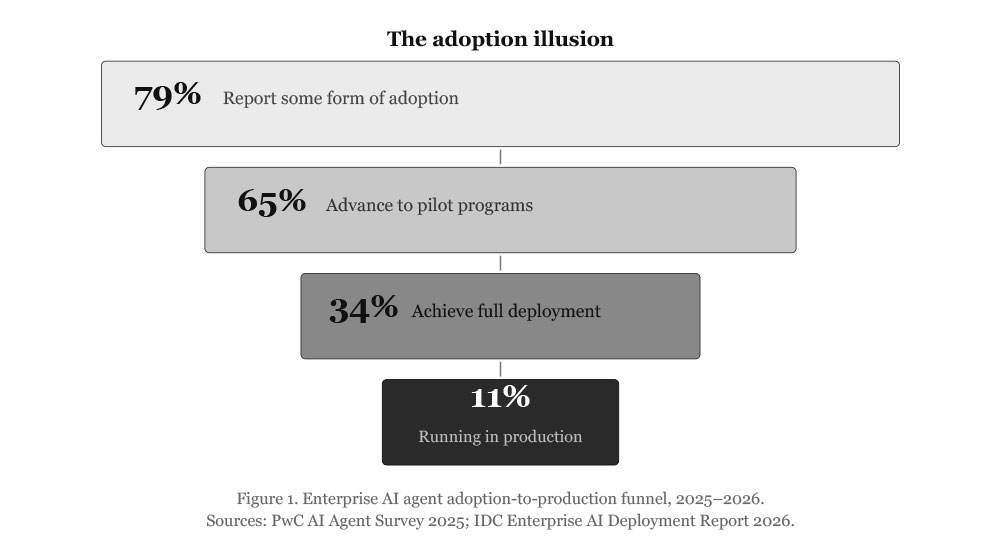
The numbers back this up. While 79 percent of organizations now report some form of AI agent adoption, only 11 percent actually run them in production.1 That is not a technology gap. That is a governance gap wearing a technology costume.
Gartner put it plainly in mid-2025: over 40 percent of agentic AI projects are expected to be canceled or fail to reach production by 2027.2 The root causes are escalating inference costs, lack of standardized protocols, and what many practitioners now call innovation theater. That is the art of building impressive prototypes that cannot survive contact with a real enterprise environment.
I want to say something that may be uncomfortable for some readers. The failure rate is not a technology problem. It is a leadership problem dressed up as one.
When MIT researchers studied enterprise AI deployments in 2025, they found 95 percent failed to deliver measurable P&L impact.3 That statistic did not emerge because the models were wrong. It emerged because organizations allocated more than half of their generative AI budgets to sales and marketing tools, while the biggest demonstrable ROI sat in back-office automation. Resources chased visibility, not value. That is a management decision.
There is a concept I have been thinking about, which I term as the Definition Trap. Ask ten executives what an AI agent is, and you will get ten different answers. Some think it is an enhanced chatbot. Some think it is an automated workflow. A few have the right instinct, but even they struggle to translate that instinct into a deployment specification. An agent, properly understood, is a system that perceives its environment, reasons through a goal, selects and executes tools, and adapts based on feedback, without requiring a human to issue instructions at each step. That capability demands infrastructure that most enterprises simply have not built.
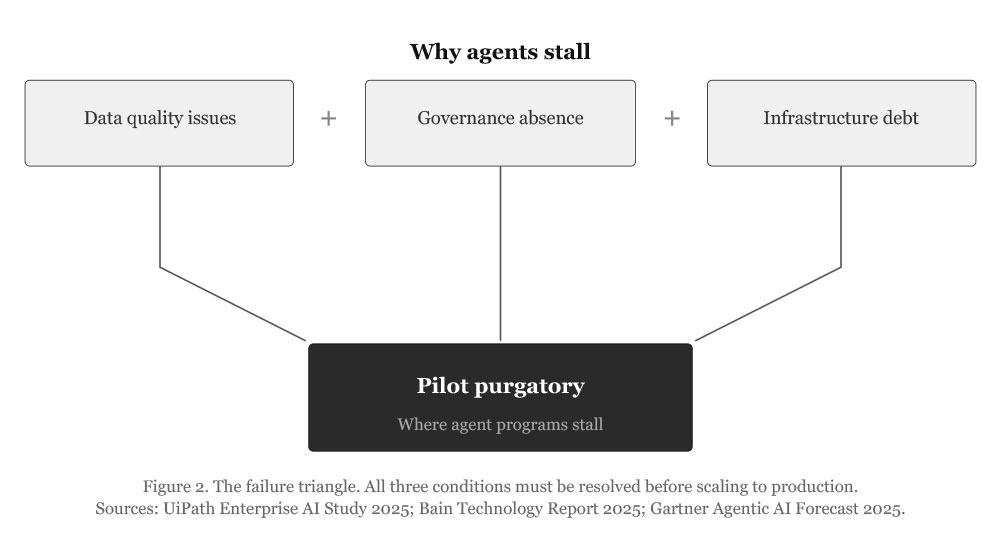
Data quality is the unsexy culprit nobody wants to address. A UiPath study found data quality issues as the primary reason for pilot failures, with lack of interoperability a close second.4 Sixty-three percent of executives cited platform sprawl as a growing concern. These are not AI problems. They are data architecture problems that predate the current AI wave by a decade or more. An agent is only as good as the context it can access. Feed it fragmented, stale, or poorly structured data, and you have not built an intelligent agent. You have built an expensive, autonomous way to get the wrong answer faster.
The organizations that break out of this pattern share a telling attribute. They build infrastructure before they build agents. They define what success looks like before they run a pilot. McKinsey's research shows that only 6 percent of organizations qualify as AI high performers, capturing meaningful EBIT impact from their investments.5 What separates that 6 percent is not access to better models. It is organizational discipline.
This matters because the competitive implications are real and compounding. The window to establish agentic AI as a genuine operational capability is not infinite. Enterprises that close the gap between pilot and production will build structural advantages that latecomers will find difficult to close.
So, what should a business leader actually do?
Start with one workflow. Not the most visible workflow and not the most impressive demo. The right workflow is the one where you can measure before and after, where the data is already clean enough to use, and where failure is recoverable. Prove the economics in that narrow lane first. Then scale the architecture, not just the agent count.
Invest in observability. An agent you cannot monitor in production is a liability. You need to know what it is doing, why it is doing it, and when it is wrong. Governance that exists only in a policy document and not in your architecture will not survive a production incident.
And most importantly, stop measuring adoption. Start measuring production outcomes. The number of agents deployed is irrelevant. The number delivering verified business value is the only statistic that matters.
We are at a genuine inflection point. The capability is real. The infrastructure is maturing. The path to production value exists. But the enterprises that will capture it are the ones willing to treat AI agents as accountable production systems, not as experiments in perpetuity.
The question worth asking in your next strategy meeting is not what your agents can do. The question is what you can prove they did.

Author
Dr. Sanjay Basu leads the Generative AI Engineering and GPU Infrastructure teams at Oracle Cloud. With over 30 years in technology, Sanjay holds advanced degrees in management and computer engineering, and is pursuing a second Ph.D. in AI. He's a member of ACM, AAAI, IEEE, and a Fellow of the IETE. Sanjay has authored numerous technical books, science fiction anthologies, and holds six U.S. patents.
Article References
- PwC AI Agent Survey, 2025. Reported in Digital Applied, "Agentic AI Statistics 2026: Definitive Collection," 2026.
- Gartner, "Gartner Predicts Over 40% of Agentic AI Projects Will Be Canceled by End of 2027," Press Release, June 2025.
- MIT Enterprise Generative AI Deployment Study, as reported in Fortune, August 2025.
- UiPath, Enterprise AI Agent Interoperability and Data Quality Study, 2025. Reported in Multimodal.dev, "10 AI Agent Statistics for 2026," December 2025.
- McKinsey Global AI Survey, 2025. Only 6% of surveyed organizations reported 5%+ EBIT impact attributable to AI, qualifying as high performers.
Most enterprises in 2026 believe they have an AI strategy. What they actually have is a vendor relationship and a slide deck.
That sounds harsh. But I have spent the last several years at the intersection of Gen AI deployment and GPU cloud infrastructure, and I keep watching the same movie. A company announces an agentic AI initiative. A team deploys something resembling an agent in a sandbox. Executives tour the demo. The initiative gets a budget line. And then, quietly, nothing ships to production.
The numbers back this up. While 79 percent of organizations now report some form of AI agent adoption, only 11 percent actually run them in production.1 That is not a technology gap. That is a governance gap wearing a technology costume.
Gartner put it plainly in mid-2025: over 40 percent of agentic AI projects are expected to be canceled or fail to reach production by 2027.2 The root causes are escalating inference costs, lack of standardized protocols, and what many practitioners now call innovation theater. That is the art of building impressive prototypes that cannot survive contact with a real enterprise environment.
I want to say something that may be uncomfortable for some readers. The failure rate is not a technology problem. It is a leadership problem dressed up as one.
When MIT researchers studied enterprise AI deployments in 2025, they found 95 percent failed to deliver measurable P&L impact.3 That statistic did not emerge because the models were wrong. It emerged because organizations allocated more than half of their generative AI budgets to sales and marketing tools, while the biggest demonstrable ROI sat in back-office automation. Resources chased visibility, not value. That is a management decision.
There is a concept I have been thinking about, which I term as the Definition Trap. Ask ten executives what an AI agent is, and you will get ten different answers. Some think it is an enhanced chatbot. Some think it is an automated workflow. A few have the right instinct, but even they struggle to translate that instinct into a deployment specification. An agent, properly understood, is a system that perceives its environment, reasons through a goal, selects and executes tools, and adapts based on feedback, without requiring a human to issue instructions at each step. That capability demands infrastructure that most enterprises simply have not built.
Data quality is the unsexy culprit nobody wants to address. A UiPath study found data quality issues as the primary reason for pilot failures, with lack of interoperability a close second.4 Sixty-three percent of executives cited platform sprawl as a growing concern. These are not AI problems. They are data architecture problems that predate the current AI wave by a decade or more. An agent is only as good as the context it can access. Feed it fragmented, stale, or poorly structured data, and you have not built an intelligent agent. You have built an expensive, autonomous way to get the wrong answer faster.
The organizations that break out of this pattern share a telling attribute. They build infrastructure before they build agents. They define what success looks like before they run a pilot. McKinsey's research shows that only 6 percent of organizations qualify as AI high performers, capturing meaningful EBIT impact from their investments.5 What separates that 6 percent is not access to better models. It is organizational discipline.
This matters because the competitive implications are real and compounding. The window to establish agentic AI as a genuine operational capability is not infinite. Enterprises that close the gap between pilot and production will build structural advantages that latecomers will find difficult to close.
So, what should a business leader actually do?
Start with one workflow. Not the most visible workflow and not the most impressive demo. The right workflow is the one where you can measure before and after, where the data is already clean enough to use, and where failure is recoverable. Prove the economics in that narrow lane first. Then scale the architecture, not just the agent count.
Invest in observability. An agent you cannot monitor in production is a liability. You need to know what it is doing, why it is doing it, and when it is wrong. Governance that exists only in a policy document and not in your architecture will not survive a production incident.
And most importantly, stop measuring adoption. Start measuring production outcomes. The number of agents deployed is irrelevant. The number delivering verified business value is the only statistic that matters.
We are at a genuine inflection point. The capability is real. The infrastructure is maturing. The path to production value exists. But the enterprises that will capture it are the ones willing to treat AI agents as accountable production systems, not as experiments in perpetuity.
The question worth asking in your next strategy meeting is not what your agents can do. The question is what you can prove they did.