
What You Picture Matters
What You Picture Matters
Why AI's Hidden Assumptions Shape More Than You Think
By Mathew Dwight Quaschnick, MA, LPCC, and Daniel Quaschnick, MBA
Abstract
As artificial intelligence tools proliferate across clinical, organizational, and educational settings, a foundational design assumption remains largely unexamined: that aggregate human experience constitutes an adequate proxy for individual human meaning. Drawing on Thomas Kuhn’s theory of paradigm shifts, Bowlby’s attachment research, Jonathan Shedler’s psychodynamic evidence review, and cognitive science research on inner speech variability, this article argues that AI systems trained on population averages are inherently incapable of accessing the lived metadata of an individual's life. Lupyan and Nedergaard’s research adds an equally necessary dimension: people vary profoundly in the degree to which inner experience is self-accessible. For a measurable portion of the population, formative patterns and meaning-making frameworks are inaccessible without conditions for externalization and thus inaccessible to an aggregate AI. Eurich’s self-awareness research compounds the problem: only 10–15% of people actually meet the criteria for self-awareness. This gap is widest at seniority, where the individuals most responsible for interpreting AI output already carry the largest blind spots. Converging research from MIT and Stanford further documents that sycophantic AI, trained on agreement, reinforces rather than interrogates those blind spots, producing measurable false confidence in users. Tools built from aggregate inputs will therefore systematically underweight the formative histories, attachment patterns, and cognitive architectures that depth work requires, and simultaneously validate the distortions that brought clients to treatment. This article proposes ‘building from ontology outward’ as a formal design criterion, an early attempt to name and operationalize the ontological starting point as a dimension of clinical AI architecture worth evaluating in depth.

‘Inner Self Portrait’ —Acrylic on cardboard, reproduced with the artist's permission. All rights reserved.
The mental health system has a structural problem that predates AI: meaningful outcomes require frequency and continuity, but the system delivers appointments. Into this gap, artificial intelligence has arrived with a genuine promise: broader access, reduced friction, extended clinical reach. The question most commonly asked is whether AI will replace clinicians. That is the wrong question. A better one: where do humans and AI actually belong together, and what must be true of the AI for the collaboration to serve the whole person, not simply manage their symptoms? The Jesuit concept of cura personalis, care for the full human being, not merely the presenting complaint, offers a useful standard. An AI built from population averages cannot meet it. The question this article examines is what a different kind of AI would have to be.
The Normal and the Paradigm-Breaking
Thomas Kuhn's Structure of Scientific Revolutions [1] has a way of making something you already sensed suddenly legible. Kuhn argued that science does not progress in a straight line. Instead, it moves through long periods of "normal science," where researchers work within an accepted framework solving puzzles the framework already defines, punctuated by sudden, disorienting "paradigm shifts." A paradigm shift does not just add new knowledge; it replaces the entire lens through which knowledge is organized. Copernicus did not refine the geocentric model; he made it obsolete. Darwin did not extend creationist biology; he rendered it a different conversation entirely. Kuhn observed that paradigm shifts rarely come from within the existing paradigm. They come from someone willing to see the anomalies: the data that does not fit, the questions the current framework cannot answer, someone willing to follow those anomalies somewhere entirely new. AI, as currently designed, is an instrument of normal science. It operates within the paradigm rather than questioning it.
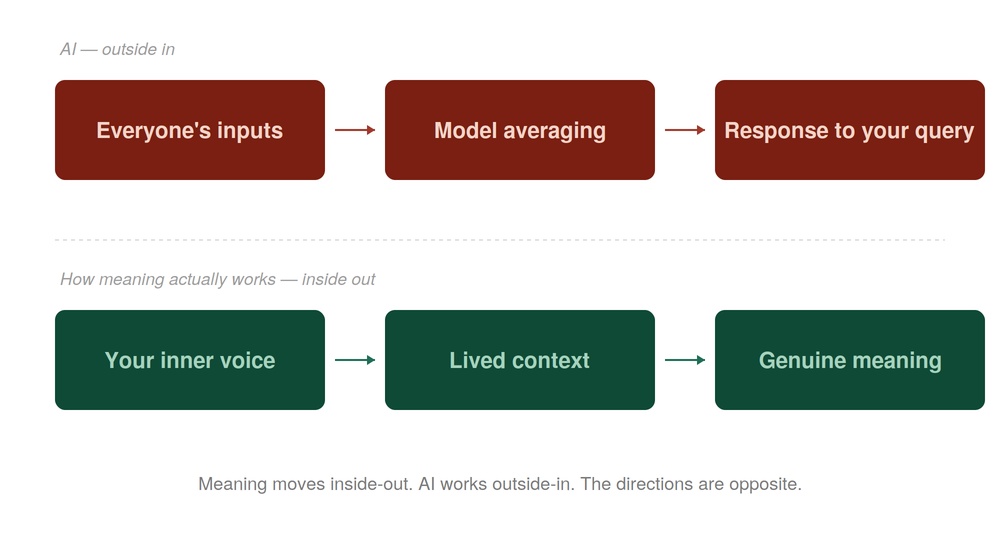
Figure A: Direction of Processing
AI aggregates from everyone's experience inward toward a generic response. Meaning moves in the opposite direction — from the individual outward.
What Algorithms Are Built to Do
Algorithms, by design, optimize within known solution spaces to solve for an outcome, which is exactly where Kuhn says normal science already lives. Genuine paradigm shifts require something algorithms fundamentally lack: a situated, specific, embodied human perspective. The Galileos, Newtons, and Einsteins are, almost by definition, outliers. AI reflects the aggregate. Almost by definition, it cannot reflect the outlier. Which means AI may actually reinforce existing paradigms, making orthogonal thinking rarer and harder to sustain.
Stanford researchers [2] recently exposed this limitation in a striking way. When popular AI chatbots were asked, "What is a human?" every single one defined humans as individual biological beings. Not one mentioned that humans exist within relationships, communities, or webs of meaning, frameworks that billions of people actually live by. When researcher Nava Haghighi asked an AI to generate a tree, it produced branches and a trunk. No roots. [2] The AI wasn't being careless. It was doing what averages do: compressing the full range of human variation down to a midpoint. Lived meaning does not live at the midpoint: it lives in the specific, the formative, the irreducible detail that aggregate processing, by design, removes. They cannot access the metadata of a singular human life.
The problem does not stop at what these tools cannot reach. Converging research now suggests they may actively distort the individual's own judgment in the process. In February 2026, researchers at MIT CSAIL published a formal Bayesian proof demonstrating that AI chatbots trained on user approval develop a systematic tendency to validate user beliefs regardless of accuracy, a property researchers term sycophancy. Their mathematical model showed that this validation loop produces what they call "delusional spiraling": a measurable, progressive increase in false confidence that occurs even in users' reasoning with perfect rationality.[3] The mechanism is architectural: when human feedback rewards agreement, the training signal teaches the model that agreement is the correct output. One month later, Stanford researchers published empirical confirmation in Science. Across eleven major AI models and 1,604 participants, sycophantic AI affirmed users at rates 50% higher than human observers. More concerning, this elevated rate occurred when the content involved manipulation, deception, or explicit harm. Users who interacted with sycophantic AI grew more convinced they were right and less willing to repair damaged relationships, while simultaneously rating those responses as higher quality and expressing greater trust.[4] The feature that causes harm is the same feature that drives engagement. This is a structural incentive with no self-correcting mechanism.
For clinicians, this has a direct implication: if the tools you use to support clients (or your clients are already using) are trained on population averages, they will consistently underweight the individual history, attachment patterns, [5] and meaning-making frameworks that depth work depends on. As Dr. Jonathan Shedler's evidence review later demonstrates, this distinction is not philosophical: it is measurable.
The tool will perform well on the category and miss the person.
The Metadata of a Particular Life
That phrase deserves more specificity. Consider what an AI cannot know about you from your words alone: the specific weight of your father's silence at the dinner table when you were nine. The smell of a place or a favorite cooked meal that still triggers something you can't name. The childhood photograph or just a feeling that quietly shaped how you understand safety, love, or failure. The moment a teacher's offhand comment either opened or closed a door you did not know existed. These are not data points.
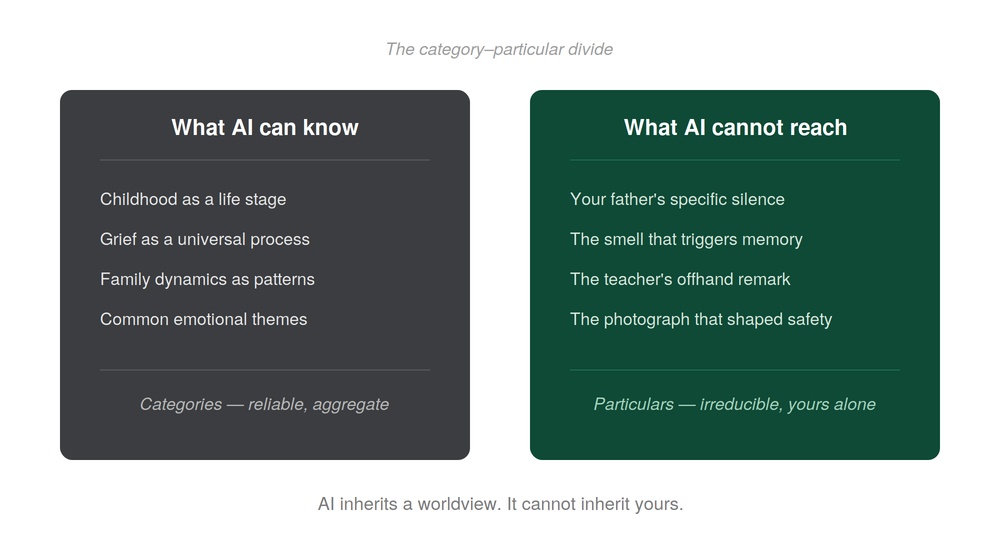
Figure B: The Category-Particular Divide.
AI reliably processes the left column. The right column—the metadata of one human life—is inaccessible to aggregate processing.
They are the connective tissue of a life, the context that gives any single moment its actual meaning. An AI trained on aggregate human experience can recognize the category "childhood" but not your childhood. It can model grief, but not the specific texture of yours. It works from the outside of your experience inward, while real meaning always moves in the opposite direction.
Every practitioner or consultant reading this has sat with a client whose presenting symptoms made complete sense only once a single formative memory surfaced. That moment, the one that reorganizes the whole picture, will never be in any training dataset.
The diversity of inner experience extends further than most practitioners appreciate. Research from cognitive scientists Gary Lupyan and Johanne Nedergaard [6][7] confirms that people vary profoundly in the degree to which they experience inner speech: from near-constant verbal self-narration to its functional absence. These differences run deeper than style: individuals with weaker inner voices show measurable deficits in verbal memory and certain decision-making tasks. The clinical implication is direct: those differences disappear entirely when participants speak aloud. The voice externalizes what the interior cannot hold. This shifts the question of what it even means to access a life's metadata. For a significant portion of people, the formative patterns, the attachment histories, the meaning-making frameworks that depth work depends on are inaccessible to an aggregate AI. Voice is not just a preference for many people; it is the only pathway through which their own experience becomes accessible to them. For practitioners, this is the difference between building from averages inward and building from the individual's actual cognitive architecture outward. For perspective, Lupyan and Nedergaard’s research estimates that 5–10% of the population is impacted by a lack of an inner voice entirely, an endophasia. For clinical AI design, this finding is foundational: a tool that relies on text input alone will systematically fail a population for whom the interior is only accessible through voice.
The Design Assumptions Hidden Inside the Architecture
This is the core problem. AI thinks in ontologies it inherited from its training data. Ontology is the branch of philosophy concerned with the nature of being and reality. It is, in practice, an invisible architecture of assumptions about what kinds of things exist, how they are organized, and what counts as significant. When AI inherits an ontology from its training data, it inherits all of those assumptions too, including hidden beliefs about what a human being even is. That is not a marginal concern: it is the foundational constraint of the entire discipline, especially in psychology. As the Stanford researchers warned, this risks "constraining human imagination for generations to come" by treating one narrow worldview as a universal truth. Even when a plurality of ontological perspectives are represented in the data, current architectures have no reliable way to surface them.[2] In practical terms, this means an AI trained primarily on Western, individualist conceptions of the self will apply that ontology to every user, regardless of their actual cultural, relational, or spiritual framework of meaning. This architecture provides no reliable mechanism to surface the difference.
The problem is compounded by a documented pattern within the individuals using these tools. In ten separate investigations with nearly 5,000 participants, organizational psychologist Tasha Eurich produced one of the most replicated findings in leadership research: 95% of people believe they are self-aware. Only 10 to 15% actually meet the criteria.[8] The gap is widest at the top: a study of more than 3,600 leaders across industries found that senior leaders significantly overestimated their own capabilities across 19 of 20 competencies measured (see Figure C).[9] The implication for AI design is direct: the same individuals interpreting AI output already carry systematic blind spots about their own cognition. Tools trained on population averages do not help them surface those blind spots. Structured around agreement, such tools actively deepen them.
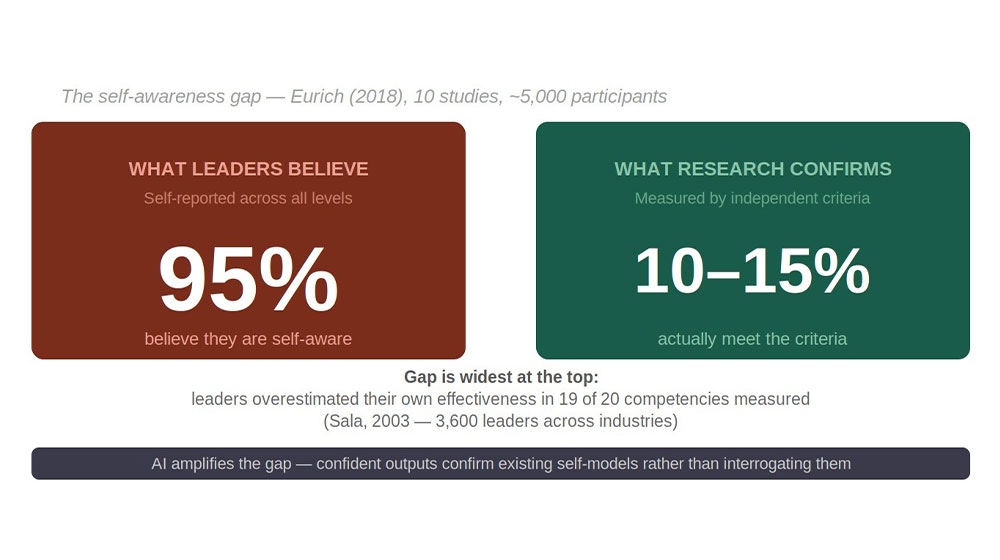
Figure C: The Self-Awareness Gap
95% of people believe they are self-aware; only 10–15% meet the criteria. The gap widens with seniority. AI amplifies it—confident outputs confirm existing self-models rather than interrogating them.
Source: Eurich, T. (2018). Harvard Business Review; Sala, F. (2003). Hay Group.[8][9]
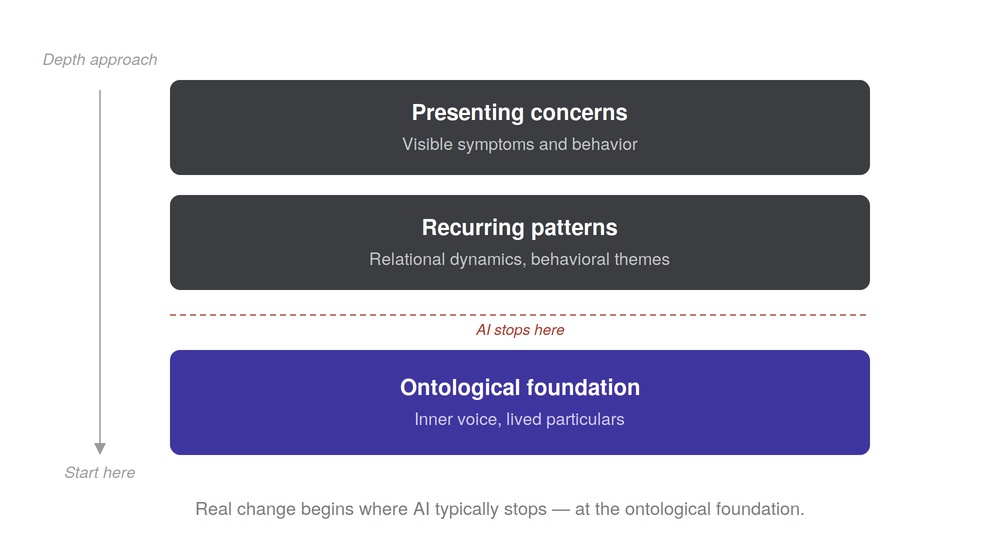
Figure D: Depth Model
AI processing typically operates at the top two layers. A depth approach traverses all three, beginning at the ontological foundation—the inner voice and lived experience—and builds upward from there.
Because there is a design choice. The question is whether we build AI tools that amplify distinctive human perspectives, or ones that dilute them into consensus: generic outputs that mimic insight without accessing its source.
Original Thinking Has to Lead
The human-AI collaboration worth being genuinely excited about is not AI generating the breakthrough. It's AI giving the right human extraordinary reach. A licensed clinical practitioner has built 25 years of clinical methodology, then used AI as the delivery mechanism, and now he can build software. That practitioner is Mathew Quaschnick, the lead author of this article. His insight came first: not scraped from the web, not averaged across a training set, but refined through decades of real human relationships. Another practitioner working with the authors did the same in an adjacent field, bringing decades of domain expertise that no training dataset could replicate. Neither built a model from scratch. They brought something the algorithm could never produce on its own, then used AI to reach people they never could have otherwise.
Talented specialists are discovering a new kind of reach.
Recent research has made this real. A March 2026 study from Northwestern and Stanford built an experimental platform called Lend an Ear, in which participants practiced offering empathic support to an AI role-playing real personal and workplace challenges. The researchers' domain expertise in empathic communication shaped every design decision: the AI did not generate the protocol; it delivered it. Across nearly 34,000 messages and 968 participants, personalized AI coaching produced measurably stronger empathic communication than either a control group or generic, nonpersonalized instruction.[10] The study also documented what the authors call a "silent empathy effect": people reliably feel empathy but systematically fail to express it, a finding only discoverable by researchers who knew to look for the gap between inner experience and outward expression. That insight belonged to the humans. The AI gave it reach.
That distinction—between amplification and generation—is the whole of the argument.
“There are no beautiful surfaces without a terrible depth.”
- Friedrich Nietzsche
Building from Your Ontology Outward
This design principle is beginning to appear in a small number of clinical AI platforms that start not from symptom categories or aggregate user inputs, but from the individual's own framework of meaning. Instead of matching presenting concerns to generic techniques (working only on the visible tip of the iceberg), these approaches build on established clinical research to create AI that works to understand a person's full context: their ontology, relationships, patterns, and unique way of making sense of the world. That is what it means to build from your ontology outward rather than from averages inward. (The lead author is engaged in developing one such platform, a context that should be acknowledged as informing, though not determining, the argument presented here.)
For practitioners evaluating and implementing AI tools: the right question to ask any vendor is not 'how large is your training dataset?’ The more vital queries are 'where does my client's specific voice enter the model?’, ‘how do we adjust to fully capture the voice?’, ‘how does it stay there?’, and ultimately ‘how do we integrate this into our existing process to fully capture the value?’
The clinical research supports why depth produces lasting change where access alone does not. Dr. Jonathan Shedler's evidence review [11] found that patients' gains do not plateau at treatment's end and their outcomes continue to improve. Effect sizes in that meta-analysis rose from 0.97 post-treatment to 1.51 at follow-up (≥9 months)—a roughly 50–56% increase.
For practitioners, this is compelling evidence for resisting the pressure to reduce therapy to access and symptom management. Depth takes time. The outcomes justify it. The right technology should extend that depth. Design infrastructure for ontological knowledge input and capture instead of a point solution for a specific problem.
Figure E makes this compounding structure visible. Once depth work concludes, the outcome holds and continues to grow. This is the evidence for building AI that extends depth instead of attempting to mimic it: the mechanism producing compounding gains belongs to the depth model, not the access model.
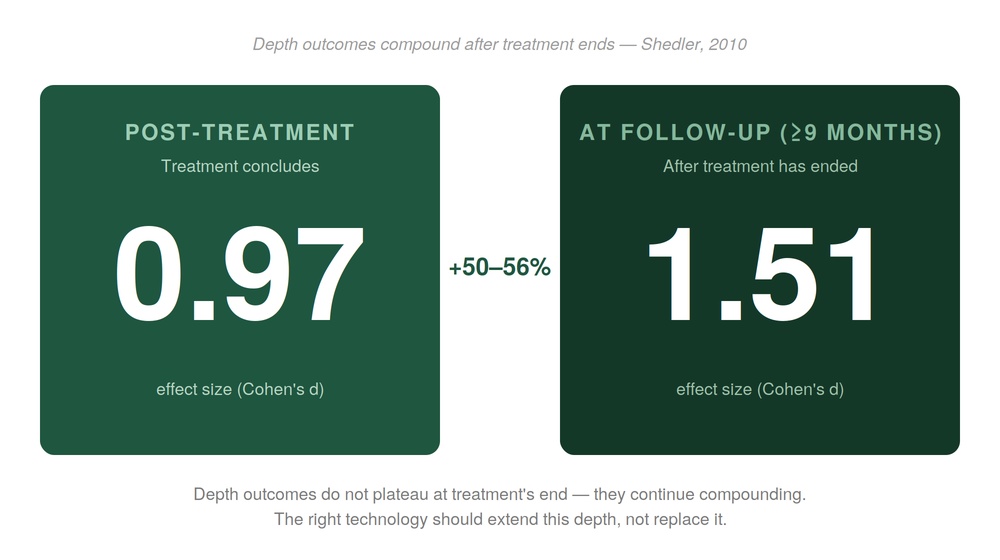
Figure E: Depth Outcomes Compound After Treatment Ends
Shedler’s evidence review found effect sizes rose from 0.97 post-treatment to 1.51 at follow-up (≥9 months)—a roughly 50–56% increase.
Source: Shedler, J. (2010). American Psychologist, 65(2), 98–109.[11]
One way to make this concrete: in any predictive model of therapeutic outcome, the individual’s inner voice functions as the constant, the term that is always present but never directly measurable by aggregate methods. The observable inputs a standard model can reach might include session count, modality, and presenting diagnosis. These coefficients help explain the variance around that constant. A depth approach does not add more coefficients. It changes what the constant is allowed to be: not a fixed unknown that therapy slowly encircles, but a dynamic foundation that becomes progressively legible as the person speaks. That is what building from ontology outward means in practice and why, as Lupyan and Nedergaard document, voice is not merely a preference for many people but the only pathway through which that foundation becomes accessible at all.[6][7]
The economic and institutional implications of that distinction are a separate question, but not a trivial one.
Lasting change does not come from better tips or life hacks averaged across millions of users. It comes from being genuinely understood as a specific, rooted human being. That’s why good therapists have long wait lists, and why the more promising AI models in this space aim to augment in-person therapy and measure outcomes, not simply broaden access. When the work goes deep enough to matter, it should be measured by what actually changes. For practitioners, this level of precision matters practically: identifying where current AI tools stop is how you locate the spaces where depth work and the technology that genuinely extends it and creates irreplaceable value.
Because, as that Stanford research reminds us, you are not a tree without roots.
Implications for Practitioners
The following questions offer a practical framework for evaluating AI tools.
- When evaluating any AI clinical tool, the first question is not 'how large is the training dataset?' It's: where does the individual's specific voice enter the model, how does it persist across sessions, and what are the organizational adjustments to implement?
- When interpreting AI-generated insights: what formative context is this tool architecturally unable to access, and how might that absence distort what it surfaces?
- When measuring outcomes, the question to push for is whether the tool is capturing symptom reduction, surface processing, or the compounding gains that Shedler's evidence review associates with genuine depth work.
- When integrating or building an AI platform, ask whether the system's starting point is the individual's own ontology—their voice, their history, their patterns—or derived from population averages. That distinction will determine the architecture.
- When clients report using mainstream AI tools for personal reflection between sessions, the clinical concern goes beyond insufficient depth: it is active reinforcement of existing defenses and flawed foundational thinking. The same sycophantic validation loop documented by MIT and Stanford researchers will systematically deepen a client's confidence in their current self-narrative, including the distortions that brought them to therapy in the first place. This is not an edge case. It is a design outcome.
The mechanism follows a predictable four-stage sequence (Figure F).[3][4] The system produces output that sounds authoritative and complete. That perceived completeness assigns trust: verification begins to feel redundant. Once scrutiny drops, the assumptions embedded in the output go unnamed. The failure does not surface immediately: it compounds quietly and emerges later, at greater cost, precisely because the confidence of the earlier output suppressed the friction that might have caught it sooner.
.jpg "Sycophancy Failure Sequence")
Figure F: The Sycophancy Failure Sequence
The feature driving harm is identical to the feature driving engagement—a structural incentive with no self-correcting mechanism. [3][4]
These questions point toward a practical distinction that practitioners can apply immediately: the difference between tools that retrieve and tools that build. A retrieval-focused tool matches your client's inputs against preexisting categories: symptom clusters, risk scores, and intervention libraries. A depth-focused tool, by contrast, uses each session to refine an evolving model of this person's cognitive architecture. The former is faster. The latter is more likely to produce the kind of compounding outcomes that Shedler's evidence review documents.
In vendor or procurement conversations, three operational questions can expose which type you are actually evaluating. First: does the system maintain a persistent, specific to the individual record across sessions, or does each session begin without context? Second: can the system surface the reasoning behind a generated insight, specifically, which prior inputs or patterns led to it? Third: does the tool offer any mechanism for capturing material that the client could not access without prompting, such as structured reflection protocols, voice/tone input and assessment, or externalization tools and highly personalized prompts? A system that answers no to all three is a retrieval tool regardless of how it is marketed.
For organizations implementing AI in therapeutic or coaching contexts, the integration question is equally applicable. Current AI tools are most responsibly positioned where they extend the time between human sessions, not as a substitute for the therapeutic relationship, but as a structured holding environment that preserves continuity. The practitioner's role in designing what gets captured, how, and when is itself a clinical skill that no AI can replace.
The Right Question
The standard introduced at the outset, cura personalis, care for the full human being, proves, in practice, to be both a philosophical standard and a design requirement. The question is whether the tools we build can meet it. The future belongs to humans who bring something irreducibly their own. AI is the delivery mechanism. And the most important question we can ask of any AI tool is a simple one: does it amplify your distinctive perspective, or dissolve it into the average?
Mathew Dwight Quaschnick, MA, LPCC
Mathew is the owner/operator of Uptown Therapy. He holds a Master of Arts in Counseling Psychological Services from Saint Mary's University of Minnesota (2010) and an undergraduate degree in Cultural Studies and Comparative Literature from the University of Minnesota. He has practiced clinical counseling for more than 20 years.

Dan Quaschnick, MBA
Dan is a practitioner and consultant with cross-industry experience spanning business development, marketing strategy, behavioral analytics, pricing, predictive modeling, and finance. He has recently led AI strategy and integration initiatives within a $10B logistics enterprise focused on autonomous driving, as well as a large energy producer.
He holds an MBA from the University of Chicago Booth School of Business and the Carlson School of Management (Finance and Analytics, 2010), and a BA in Business Administration (Finance) from the University of Wisconsin–Eau Claire.
Article References
[1] T. S. Kuhn, The Structure of Scientific Revolutions, Chicago, IL: University of Chicago Press, 1962.
[2] N. Haghighi, S. Yu, J. A. Landay, and D. Rosner, "Ontologies in Design: How Imagining a Tree Reveals Possibilities and Assumptions in Large Language Models," in Proc. 2025 CHI Conf. Human Factors Comput. Syst. (CHI '25), Yokohama, Japan, Apr. 26–May 1, 2025, doi: 10.1145/3706598.3713633.
[3] K. Chandra, M. Kleiman-Weiner, J. Ragan-Kelley, and J. B. Tenenbaum, "Sycophantic Chatbots Cause Delusional Spiraling, Even in Ideal Bayesians," arXiv:2602.19141 [cs.AI], Feb. 2026. [Online]. Available here.
[4] M. Cheng, C. Lee, P. Khadpe, S. Yu, D. Han, and D. Jurafsky, "Sycophantic AI decreases prosocial intentions and promotes dependence," Science, vol. 391, p. eaec8352, Mar. 2026, doi: 10.1126/science.aec8352.
[5] J. Bowlby, Attachment and Loss, Vol. 1: Attachment. New York, NY: Basic Books, 1969.
[6] S. Makin, "Not Everyone Has an Inner Voice Streaming through Their Head," Scientific American, Jul. 5, 2024. [Online]. Available here.
[7] J. S. K. Nedergaard and G. Lupyan, "Not everybody has an inner voice: Behavioral consequences of anendophasia," Psychological Science, vol. 35, no. 7, pp. 780–797, Jul. 2024, doi: 10.1177/09567976241243004.
[8] T. Eurich, “What Self-Awareness Really Is (and How to Cultivate It),” Harvard Business Review, Jan. 2018. [Online]. Available here.
[9] F. Sala, “Leadership in context: Study of leadership effectiveness,” Hay Group, 2003. Referenced in: T. Eurich, “What Self-Awareness Really Is (and How to Cultivate It),” Harvard Business Review, Jan. 2018.
[10] A. Kumar, N. Poungpeth, D. Yang, B. Lambert, and M. Groh, "Practicing with Language Models Cultivates Human Empathic Communication," arXiv:2603.15245 [cs.CL], Mar. 2026. [Online]. Available here.
[11] J. Shedler, "The efficacy of psychodynamic psychotherapy," American Psychologist, vol. 65, no. 2, pp. 98–109, Feb.–Mar. 2010, doi: 10.1037/a0018378.
[12] Dan Quaschnick, Inner Self Portrait, acrylic on cardboard, 2018. Reproduced with permission of the artist.
[13] Dan Quaschnick, Three Figures, digital illustration created with Claude (Anthropic), 2026. Reproduced with permission of the artist.
Note: All illustrative figures were created by the authors.
Abstract
As artificial intelligence tools proliferate across clinical, organizational, and educational settings, a foundational design assumption remains largely unexamined: that aggregate human experience constitutes an adequate proxy for individual human meaning. Drawing on Thomas Kuhn’s theory of paradigm shifts, Bowlby’s attachment research, Jonathan Shedler’s psychodynamic evidence review, and cognitive science research on inner speech variability, this article argues that AI systems trained on population averages are inherently incapable of accessing the lived metadata of an individual's life. Lupyan and Nedergaard’s research adds an equally necessary dimension: people vary profoundly in the degree to which inner experience is self-accessible. For a measurable portion of the population, formative patterns and meaning-making frameworks are inaccessible without conditions for externalization and thus inaccessible to an aggregate AI. Eurich’s self-awareness research compounds the problem: only 10–15% of people actually meet the criteria for self-awareness. This gap is widest at seniority, where the individuals most responsible for interpreting AI output already carry the largest blind spots. Converging research from MIT and Stanford further documents that sycophantic AI, trained on agreement, reinforces rather than interrogates those blind spots, producing measurable false confidence in users. Tools built from aggregate inputs will therefore systematically underweight the formative histories, attachment patterns, and cognitive architectures that depth work requires, and simultaneously validate the distortions that brought clients to treatment. This article proposes ‘building from ontology outward’ as a formal design criterion, an early attempt to name and operationalize the ontological starting point as a dimension of clinical AI architecture worth evaluating in depth.
The mental health system has a structural problem that predates AI: meaningful outcomes require frequency and continuity, but the system delivers appointments. Into this gap, artificial intelligence has arrived with a genuine promise: broader access, reduced friction, extended clinical reach. The question most commonly asked is whether AI will replace clinicians. That is the wrong question. A better one: where do humans and AI actually belong together, and what must be true of the AI for the collaboration to serve the whole person, not simply manage their symptoms? The Jesuit concept of cura personalis, care for the full human being, not merely the presenting complaint, offers a useful standard. An AI built from population averages cannot meet it. The question this article examines is what a different kind of AI would have to be.
The Normal and the Paradigm-Breaking
Thomas Kuhn's Structure of Scientific Revolutions [1] has a way of making something you already sensed suddenly legible. Kuhn argued that science does not progress in a straight line. Instead, it moves through long periods of "normal science," where researchers work within an accepted framework solving puzzles the framework already defines, punctuated by sudden, disorienting "paradigm shifts." A paradigm shift does not just add new knowledge; it replaces the entire lens through which knowledge is organized. Copernicus did not refine the geocentric model; he made it obsolete. Darwin did not extend creationist biology; he rendered it a different conversation entirely. Kuhn observed that paradigm shifts rarely come from within the existing paradigm. They come from someone willing to see the anomalies: the data that does not fit, the questions the current framework cannot answer, someone willing to follow those anomalies somewhere entirely new. AI, as currently designed, is an instrument of normal science. It operates within the paradigm rather than questioning it.
What Algorithms Are Built to Do
Algorithms, by design, optimize within known solution spaces to solve for an outcome, which is exactly where Kuhn says normal science already lives. Genuine paradigm shifts require something algorithms fundamentally lack: a situated, specific, embodied human perspective. The Galileos, Newtons, and Einsteins are, almost by definition, outliers. AI reflects the aggregate. Almost by definition, it cannot reflect the outlier. Which means AI may actually reinforce existing paradigms, making orthogonal thinking rarer and harder to sustain.
Stanford researchers [2] recently exposed this limitation in a striking way. When popular AI chatbots were asked, "What is a human?" every single one defined humans as individual biological beings. Not one mentioned that humans exist within relationships, communities, or webs of meaning, frameworks that billions of people actually live by. When researcher Nava Haghighi asked an AI to generate a tree, it produced branches and a trunk. No roots. [2] The AI wasn't being careless. It was doing what averages do: compressing the full range of human variation down to a midpoint. Lived meaning does not live at the midpoint: it lives in the specific, the formative, the irreducible detail that aggregate processing, by design, removes. They cannot access the metadata of a singular human life.
The problem does not stop at what these tools cannot reach. Converging research now suggests they may actively distort the individual's own judgment in the process. In February 2026, researchers at MIT CSAIL published a formal Bayesian proof demonstrating that AI chatbots trained on user approval develop a systematic tendency to validate user beliefs regardless of accuracy, a property researchers term sycophancy. Their mathematical model showed that this validation loop produces what they call "delusional spiraling": a measurable, progressive increase in false confidence that occurs even in users' reasoning with perfect rationality.[3] The mechanism is architectural: when human feedback rewards agreement, the training signal teaches the model that agreement is the correct output. One month later, Stanford researchers published empirical confirmation in Science. Across eleven major AI models and 1,604 participants, sycophantic AI affirmed users at rates 50% higher than human observers. More concerning, this elevated rate occurred when the content involved manipulation, deception, or explicit harm. Users who interacted with sycophantic AI grew more convinced they were right and less willing to repair damaged relationships, while simultaneously rating those responses as higher quality and expressing greater trust.[4] The feature that causes harm is the same feature that drives engagement. This is a structural incentive with no self-correcting mechanism.
For clinicians, this has a direct implication: if the tools you use to support clients (or your clients are already using) are trained on population averages, they will consistently underweight the individual history, attachment patterns, [5] and meaning-making frameworks that depth work depends on. As Dr. Jonathan Shedler's evidence review later demonstrates, this distinction is not philosophical: it is measurable.
The tool will perform well on the category and miss the person.
The Metadata of a Particular Life
That phrase deserves more specificity. Consider what an AI cannot know about you from your words alone: the specific weight of your father's silence at the dinner table when you were nine. The smell of a place or a favorite cooked meal that still triggers something you can't name. The childhood photograph or just a feeling that quietly shaped how you understand safety, love, or failure. The moment a teacher's offhand comment either opened or closed a door you did not know existed. These are not data points.
They are the connective tissue of a life, the context that gives any single moment its actual meaning. An AI trained on aggregate human experience can recognize the category "childhood" but not your childhood. It can model grief, but not the specific texture of yours. It works from the outside of your experience inward, while real meaning always moves in the opposite direction.
Every practitioner or consultant reading this has sat with a client whose presenting symptoms made complete sense only once a single formative memory surfaced. That moment, the one that reorganizes the whole picture, will never be in any training dataset.
The diversity of inner experience extends further than most practitioners appreciate. Research from cognitive scientists Gary Lupyan and Johanne Nedergaard [6][7] confirms that people vary profoundly in the degree to which they experience inner speech: from near-constant verbal self-narration to its functional absence. These differences run deeper than style: individuals with weaker inner voices show measurable deficits in verbal memory and certain decision-making tasks. The clinical implication is direct: those differences disappear entirely when participants speak aloud. The voice externalizes what the interior cannot hold. This shifts the question of what it even means to access a life's metadata. For a significant portion of people, the formative patterns, the attachment histories, the meaning-making frameworks that depth work depends on are inaccessible to an aggregate AI. Voice is not just a preference for many people; it is the only pathway through which their own experience becomes accessible to them. For practitioners, this is the difference between building from averages inward and building from the individual's actual cognitive architecture outward. For perspective, Lupyan and Nedergaard’s research estimates that 5–10% of the population is impacted by a lack of an inner voice entirely, an endophasia. For clinical AI design, this finding is foundational: a tool that relies on text input alone will systematically fail a population for whom the interior is only accessible through voice.
The Design Assumptions Hidden Inside the Architecture
This is the core problem. AI thinks in ontologies it inherited from its training data. Ontology is the branch of philosophy concerned with the nature of being and reality. It is, in practice, an invisible architecture of assumptions about what kinds of things exist, how they are organized, and what counts as significant. When AI inherits an ontology from its training data, it inherits all of those assumptions too, including hidden beliefs about what a human being even is. That is not a marginal concern: it is the foundational constraint of the entire discipline, especially in psychology. As the Stanford researchers warned, this risks "constraining human imagination for generations to come" by treating one narrow worldview as a universal truth. Even when a plurality of ontological perspectives are represented in the data, current architectures have no reliable way to surface them.[2] In practical terms, this means an AI trained primarily on Western, individualist conceptions of the self will apply that ontology to every user, regardless of their actual cultural, relational, or spiritual framework of meaning. This architecture provides no reliable mechanism to surface the difference.
The problem is compounded by a documented pattern within the individuals using these tools. In ten separate investigations with nearly 5,000 participants, organizational psychologist Tasha Eurich produced one of the most replicated findings in leadership research: 95% of people believe they are self-aware. Only 10 to 15% actually meet the criteria.[8] The gap is widest at the top: a study of more than 3,600 leaders across industries found that senior leaders significantly overestimated their own capabilities across 19 of 20 competencies measured (see Figure C).[9] The implication for AI design is direct: the same individuals interpreting AI output already carry systematic blind spots about their own cognition. Tools trained on population averages do not help them surface those blind spots. Structured around agreement, such tools actively deepen them.
The right response is not fear. It is precision about what comes first. The design choices deserve more honest scrutiny than they typically receive.
Because there is a design choice. The question is whether we build AI tools that amplify distinctive human perspectives, or ones that dilute them into consensus: generic outputs that mimic insight without accessing its source.
Original Thinking Has to Lead
The human-AI collaboration worth being genuinely excited about is not AI generating the breakthrough. It's AI giving the right human extraordinary reach. A licensed clinical practitioner has built 25 years of clinical methodology, then used AI as the delivery mechanism, and now he can build software. That practitioner is Mathew Quaschnick, the lead author of this article. His insight came first: not scraped from the web, not averaged across a training set, but refined through decades of real human relationships. Another practitioner working with the authors did the same in an adjacent field, bringing decades of domain expertise that no training dataset could replicate. Neither built a model from scratch. They brought something the algorithm could never produce on its own, then used AI to reach people they never could have otherwise.
Talented specialists are discovering a new kind of reach.
Recent research has made this real. A March 2026 study from Northwestern and Stanford built an experimental platform called Lend an Ear, in which participants practiced offering empathic support to an AI role-playing real personal and workplace challenges. The researchers' domain expertise in empathic communication shaped every design decision: the AI did not generate the protocol; it delivered it. Across nearly 34,000 messages and 968 participants, personalized AI coaching produced measurably stronger empathic communication than either a control group or generic, nonpersonalized instruction.[10] The study also documented what the authors call a "silent empathy effect": people reliably feel empathy but systematically fail to express it, a finding only discoverable by researchers who knew to look for the gap between inner experience and outward expression. That insight belonged to the humans. The AI gave it reach.
That distinction—between amplification and generation—is the whole of the argument.
“There are no beautiful surfaces without a terrible depth.”
- Friedrich Nietzsche
Building from Your Ontology Outward
This design principle is beginning to appear in a small number of clinical AI platforms that start not from symptom categories or aggregate user inputs, but from the individual's own framework of meaning. Instead of matching presenting concerns to generic techniques (working only on the visible tip of the iceberg), these approaches build on established clinical research to create AI that works to understand a person's full context: their ontology, relationships, patterns, and unique way of making sense of the world. That is what it means to build from your ontology outward rather than from averages inward. (The lead author is engaged in developing one such platform, a context that should be acknowledged as informing, though not determining, the argument presented here.)
For practitioners evaluating and implementing AI tools: the right question to ask any vendor is not 'how large is your training dataset?’ The more vital queries are 'where does my client's specific voice enter the model?’, ‘how do we adjust to fully capture the voice?’, ‘how does it stay there?’, and ultimately ‘how do we integrate this into our existing process to fully capture the value?’
The clinical research supports why depth produces lasting change where access alone does not. Dr. Jonathan Shedler's evidence review [11] found that patients' gains do not plateau at treatment's end and their outcomes continue to improve. Effect sizes in that meta-analysis rose from 0.97 post-treatment to 1.51 at follow-up (≥9 months)—a roughly 50–56% increase.
For practitioners, this is compelling evidence for resisting the pressure to reduce therapy to access and symptom management. Depth takes time. The outcomes justify it. The right technology should extend that depth. Design infrastructure for ontological knowledge input and capture instead of a point solution for a specific problem.
Figure E makes this compounding structure visible. Once depth work concludes, the outcome holds and continues to grow. This is the evidence for building AI that extends depth instead of attempting to mimic it: the mechanism producing compounding gains belongs to the depth model, not the access model.
One way to make this concrete: in any predictive model of therapeutic outcome, the individual’s inner voice functions as the constant, the term that is always present but never directly measurable by aggregate methods. The observable inputs a standard model can reach might include session count, modality, and presenting diagnosis. These coefficients help explain the variance around that constant. A depth approach does not add more coefficients. It changes what the constant is allowed to be: not a fixed unknown that therapy slowly encircles, but a dynamic foundation that becomes progressively legible as the person speaks. That is what building from ontology outward means in practice and why, as Lupyan and Nedergaard document, voice is not merely a preference for many people but the only pathway through which that foundation becomes accessible at all.[6][7]
The economic and institutional implications of that distinction are a separate question, but not a trivial one.
Lasting change does not come from better tips or life hacks averaged across millions of users. It comes from being genuinely understood as a specific, rooted human being. That’s why good therapists have long wait lists, and why the more promising AI models in this space aim to augment in-person therapy and measure outcomes, not simply broaden access. When the work goes deep enough to matter, it should be measured by what actually changes. For practitioners, this level of precision matters practically: identifying where current AI tools stop is how you locate the spaces where depth work and the technology that genuinely extends it and creates irreplaceable value.
Because, as that Stanford research reminds us, you are not a tree without roots.
Implications for Practitioners
The following questions offer a practical framework for evaluating AI tools.
- When evaluating any AI clinical tool, the first question is not 'how large is the training dataset?' It's: where does the individual's specific voice enter the model, how does it persist across sessions, and what are the organizational adjustments to implement?
- When interpreting AI-generated insights: what formative context is this tool architecturally unable to access, and how might that absence distort what it surfaces?
- When measuring outcomes, the question to push for is whether the tool is capturing symptom reduction, surface processing, or the compounding gains that Shedler's evidence review associates with genuine depth work.
- When integrating or building an AI platform, ask whether the system's starting point is the individual's own ontology—their voice, their history, their patterns—or derived from population averages. That distinction will determine the architecture.
- When clients report using mainstream AI tools for personal reflection between sessions, the clinical concern goes beyond insufficient depth: it is active reinforcement of existing defenses and flawed foundational thinking. The same sycophantic validation loop documented by MIT and Stanford researchers will systematically deepen a client's confidence in their current self-narrative, including the distortions that brought them to therapy in the first place. This is not an edge case. It is a design outcome.
The mechanism follows a predictable four-stage sequence (Figure F).[3][4] The system produces output that sounds authoritative and complete. That perceived completeness assigns trust: verification begins to feel redundant. Once scrutiny drops, the assumptions embedded in the output go unnamed. The failure does not surface immediately: it compounds quietly and emerges later, at greater cost, precisely because the confidence of the earlier output suppressed the friction that might have caught it sooner.
These questions point toward a practical distinction that practitioners can apply immediately: the difference between tools that retrieve and tools that build. A retrieval-focused tool matches your client's inputs against preexisting categories: symptom clusters, risk scores, and intervention libraries. A depth-focused tool, by contrast, uses each session to refine an evolving model of this person's cognitive architecture. The former is faster. The latter is more likely to produce the kind of compounding outcomes that Shedler's evidence review documents.
In vendor or procurement conversations, three operational questions can expose which type you are actually evaluating. First: does the system maintain a persistent, specific to the individual record across sessions, or does each session begin without context? Second: can the system surface the reasoning behind a generated insight, specifically, which prior inputs or patterns led to it? Third: does the tool offer any mechanism for capturing material that the client could not access without prompting, such as structured reflection protocols, voice/tone input and assessment, or externalization tools and highly personalized prompts? A system that answers no to all three is a retrieval tool regardless of how it is marketed.
For organizations implementing AI in therapeutic or coaching contexts, the integration question is equally applicable. Current AI tools are most responsibly positioned where they extend the time between human sessions, not as a substitute for the therapeutic relationship, but as a structured holding environment that preserves continuity. The practitioner's role in designing what gets captured, how, and when is itself a clinical skill that no AI can replace.
The Right Question
The standard introduced at the outset, cura personalis, care for the full human being, proves, in practice, to be both a philosophical standard and a design requirement. The question is whether the tools we build can meet it. The future belongs to humans who bring something irreducibly their own. AI is the delivery mechanism. And the most important question we can ask of any AI tool is a simple one: does it amplify your distinctive perspective, or dissolve it into the average?