
Building a better sports prediction market
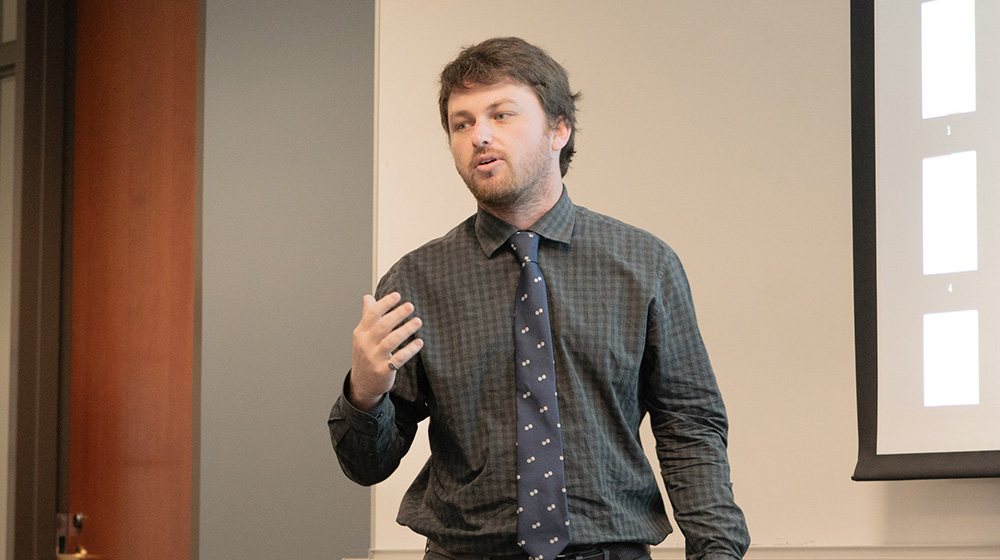
Noah Henderson teaching a sport management course. He is a recognized expert and analyst in prediction markets, as well as name, image and likeness in college athletics.
Sports betting is ballooning across sports industries, evolving into betting and prediction markets through companies such as Polymarket Kalshi.
At the Quinlan School of Business, Noah Henderson, clinical assistant professor and director of Sport Management, is teaching one of the nation’s first courses on the risks and ethical responsibilities of the sports gambling industry. Below, he outlines how gambling became part of the sports experience and how Quinlan is equipping students with the tools to build a better and more ethical version of the industry.
Reflection by Noah Henderson, J.D.
Clinical Assistant Professor and Director of Sport Management
Sports gambling is hard to avoid. Our students who commute to class at the Water Tower Campus on the Red Line pass through a wall of DraftKings advertisements at the Addison stop adjacent to Wrigley Field. Later that night, when their friends get together to watch a game, the pregame show, and often the in-game broadcast itself, remind them of the featured parlay or live gambling odds. When they scroll through their social media feeds before bed, many will see their favorite influencers promoting sports betting or online casino content.
Our students, and our community, shouldn't have to navigate this landscape blind. As sports betting and prediction markets become an unavoidable part of the culture our students live in, Quinlan’s sport management program is working to help students understand the forces driving them, not just as consumers but as the future professionals, regulators, and executives who will shape how the industry evolves.
Setting the frame
Why did our sporting culture change virtually overnight from treating sports gambling as taboo and often antithetical to the purity of sport to embracing it as part of the sports experience? The short answer is money. DraftKings, FanDuel, BetMGM, and many others pour enormous sponsorship dollars into leagues, teams, and media companies while offering another way to keep fans engaged. This is nothing new, sports leagues and franchises have always been hungry to commercialize their properties to the maximum extent. So, the longer story concerns the sudden dismantling of the federal barriers to legalized sports gambling.
In 2018, the Supreme Court’s decision in Murphy v. NCAA struck down the federal law that had prohibited states without a history of legalized sports wagering from authorizing sports betting. Since that decision, 39 states and the District of Columbia have legalized sports betting within their borders. Illinois is one of those states.
The tradeoff is clear: economic benefits through job creation, tax revenue, and a reduced reliance on black-market sports gambling services, weighed against increased risks of problem gambling and gambling disorder and, in some communities, competitive threats to tribal gaming economies or a broader moral and cultural resistance to gambling altogether.
Gambling on anything
Our seniors have experienced the phenomenon of sports gambling throughout their time in college. Our freshmen now enter school having to navigate an even more expansive gambling product, Commodity Futures Trading Commission-regulated prediction markets, or, as many students know them, Polymarket and Kalshi.
Rising to prominence in late 2024, these companies offer users the ability to buy event contracts, products that contain virtually identical financial exposure to wagering on sporting contests through traditional sportsbooks. These platforms allow users to wager on a myriad of events, such as elections, monthly rainfall, and even whether Jesus will return this year. For their sports offerings, these platforms operate outside the traditional state-by-state sports-gambling framework, relying instead on federal regulation.
Why does that matter? Consider two concrete examples. Illinois restricts sports gambling to people 21 or older, in part to protect younger and often more impulsive consumers. Illinois also prohibits wagering on Illinois collegiate teams, reflecting concerns about athlete harassment, corruption, and gambling on college campuses. Federally regulated prediction markets are not bound by those same state restrictions and platforms such as Kalshi and Polymarket permit users beginning at age 18 and can offer contracts on Illinois collegiate teams.
The ability of Kalshi, Polymarket, and other prediction-market services to preempt state regulation in this manner is being litigated across the country. Regardless of how those disputes are resolved, the reality for our students and their communities is that gambling products are becoming more accessible, more sophisticated, and more deeply embedded in the sports experience.
Understanding the industry
In Spring 2025, Loyola’s Sport Management Program launched one of the first undergraduate courses in the country devoted specifically to sports gambling. The course examines the industry’s business and regulatory structure, while challenging students to grapple with questions about addiction, consumer protection, and the ethical consequences of aggressively marketing gambling products, particularly to younger consumers and historically underserved communities.
Those questions are especially relevant in Loyola’s own backyard. Gambling-related harms can fall disproportionately on communities already facing economic and social vulnerability. Loyola’s School of Social Work, Cicero Family Services, and the Illinois Department of Human Services, host the annual Latine Problem Gambling Conference, bringing together researchers, public officials, practitioners, and community leaders to confront those issues directly. Loyola faculty, student athletes, and athletics leaders have delivered featured presentations at the conference, and our Sport Management students have had the opportunity to attend and hear firsthand from Illinois lawmakers and other stakeholders about the policies being considered to protect the communities they serve.
The wall of gambling advertisements our students pass on their way to class is unlikely to disappear. If anything, the products behind those advertisements will continue to evolve faster than the laws designed to regulate them. Universities cannot control that environment, but they can prepare students to navigate it.
At Loyola, that means treating sports gambling as more than a new source of revenue. Our responsibility is to equip students with the tools to understand those competing forces and, ultimately, to become the people capable of building a better version of the industry they inherit.