

Story - Arilova Randrianasolo
Decoding cultural intelligence
A Quinlan professor is helping businesses build bridges across borders and cultures.
“I had connections to these different worlds. How and why do I navigate them in different ways?” asks Arilova Randrianasolo, associate professor of marketing at Loyola University Chicago’s Quinlan School of Business.
His inquiry stems from his childhood, when he crossed cultures frequently. Randrianasolo was born in Madagascar, moved to the U.S. at seven years old, and traveled often to Europe and Madagascar to visit family. This led to his developing an acute perception for differences across cultures—and to the inspiration for his career as a researcher.
Today, he studies the complexities at the intersection of business and cultures, with the goal of creating a theoretical foundation that will help businesses and organizations work across borders more easily. To achieve that, Randrianasolo researches cultural intelligence, organizational and consumer legitimacy, and base of the pyramid marketing.
Where brilliance meets purpose
Accounting
From balance sheets to C-Suites
Kevin Lee, senior lecturer of accounting and business law, brings broad business knowledge and his years of industry experience into his classrooms.
Read how accounting translates to business leadership
Info Systems and Cybersecurity
Investigating home cybersecurity
Assistant Professor Ning Yang studies cybersecurity within families—and guides her students to think critically about tech.
Read how AI is not always the best choice
Social Impact MBA
Accelerating social impact in Chicago
Led by Karen Weigert, the Baumhart Center will soon fund mission-driven startups and a distinctive experience for Baumhart Scholars MBA students.
Read about the new social impact fundDeveloping cultural intelligence in business
While studying for his doctoral degree, Randrianasolo became fascinated with the concept of cultural intelligence, which is defined as the ability of an individual to function in intercultural settings. As he explains, cultural intelligence is typically viewed as having four distinct characteristics—cognitive (informational), behavioral (the how-to), motivational (the level of ambition), and metacognitive (understanding of your own mental schemas). In his own research, Randrianasolo focuses on the last as the most critical.
“Metacognitive cultural intelligence has to precede the other facets of cultural intelligence,” he says. He also focuses on metacognition as it is the most efficient way to develop cultural intelligence.
"If you develop metacognition, that cultural awareness, it’s not that you don’t need any specific training to operate in a new culture. You’re simply able to pick up on things better and more quickly."
“Our research shows that of the four facets of cultural intelligence, only the metacognitive aspect is transferable from culture to culture.” Arilova Randrianasolo, Associate Professor of Marketing
Leaning into metacognition
The implications for businesses are noteworthy, says Randrianasolo.
“As businesspeople, we know we need to adapt to cultures and social norms, in everything from marketing to how we lead teams to body language,” he says. “The metacognition is kind of the superpower for developing the specific cognitive components of that.”
Pragmatically, one of Randrianasolo’s goals is to provide the knowledge base that will allow businesses to streamline training regimens when entering or working in a new or different culture. He and his co-author are now creating a model on how to develop metacognition for managers specifically.
“If a business wants to send their products into China, they need to sharpen their cognitive understanding of Chinese culture, but what if they want to expand to Argentina? They need more training. If you develop the metacognitive cultural capacity of people, everything moves faster.” Arilova Randrianasolo, Associate Professor of Marketing
Modeling how to enter new markets
Beyond metacognition, Randrianasolo’s research also focuses on base of the pyramid marketing, which targets low-income consumers.
“It’s comprised of the world’s least developed markets but is also collectively the largest market globally,” he says. At the base of the pyramid, companies need to sell large quantities of goods with thin profit margins.
This ties to another of Randrianasolo’s research interests: organizational legitimacy, or how businesses can establish themselves in a way to flourish within a culture.
“I ask students all the time, ‘How do you define marketing?,’ and I get a lot of different answers,” he says. “I define it in four words: creating and appropriating value. And what is culture? Culture tells you what’s valuable.”
To create value and succeed, businesses entering new cultures need to gain acceptance.
“To do that, I use the ACL model of Authenticity, Credibility, and Legitimacy,” says Randrianasolo. “Authenticity means we are perceived in the culture for being who we say we are. Credibility means competence. We know what we’re doing. And legitimacy means we are part of and good for the community. My motto is, don’t tear your ACL.”
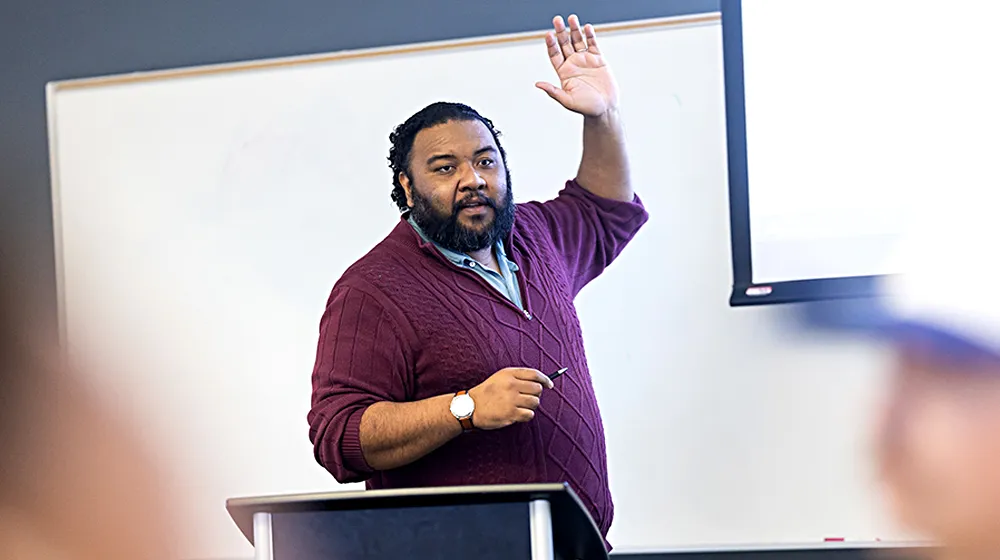
Arilova Randrianasolo, associate professor of marketing, helps Quinlan School of Business students develop deeper cultural understanding and apply it to business.
Supporting students
When he is not researching, Randrianasolo teaches international business and marketing to Quinlan graduate students, including an innovative Research, Insights & Storytelling course that leans into the resources of the Quinlan Behavioral Lab.
Quinlan EMBA student Sydney Bunting was inspired by a marketing class she took with Randrianasolo and by his supportive approach to teaching. She is currently managing her own startup, Formål, which is focused on innovative Pilates and studio equipment.
“Lova’s genuine curiosity and encouragement made me believe in what I was building.” Sydney Bunting, Quinlan EMBA student
"As someone who has never felt very confident in the things I do, those simple conversations and words of encouragement made me realize that I really can do this and helped open my mind to where I could take the company," Bunting adds. "I walked away far more confident in speaking my mind."
According to Randrianasolo, the support that Bunting felt is not accidental.
“In the classroom, I am creating an environment loosely based on the same tenets that underpin legitimacy,” he says. “We become a supportive community of learners, working together to explore the power of cultural understanding and how to put that concept into practice in very effective ways. Cultural intelligence is a real superpower for Quinlan students as they continue in their careers.”