

Story - Ning Yang
Investigating home cybersecurity
A Quinlan professor is a leader in cybersecurity research and helping students understand the subtleties of technological tools.
Cybersecurity is squarely in the headlines these days, with frequent stories about rogue AI agents and international hackers stealing information.
The news articles are a reminder, if one was needed, that cybersecurity is a current and increasingly pressing issue for business. Ning Yang, assistant professor of information systems at Loyola University Chicago’s Quinlan School of Business, argues that it is also a pressing issue for families.
“You might buy a smart toy for your child, and the next thing you know, the toy is sending information about your house to a company.” Ning Yang, Assistant Professor of Information Systems
"A lot of people look at how organizations and big companies deal with cybersecurity and compliance behaviors. But technology is everywhere, in every household, and in every aspect of our lives, so it’s also important to study how cybersecurity plays out there," says Yang.
Cybersecurity within families
Yang studies cybersecurity and online safety from an information systems perspective, with particular attention to how people and families adapt their behaviors as technologies evolve. Through her work, she is helping the business community and families understand present and emerging cybersecurity risks.
At the center of Yang’s research is technology adaptation—how technology is used and how that can change over time and in different circumstances.
Where brilliance meets purpose
Accounting
From balance sheets to C-Suites
Kevin Lee, senior lecturer of accounting and business law, brings broad business knowledge and his years of industry experience into his classrooms.
Read how accounting translates to business leadership
Marketing and Global Business
Decoding cultural intelligence
Through his research, Associate Professor Arilova Randrianasolo is helping businesses work across borders more easily.
Read about the ACL model for entering new markets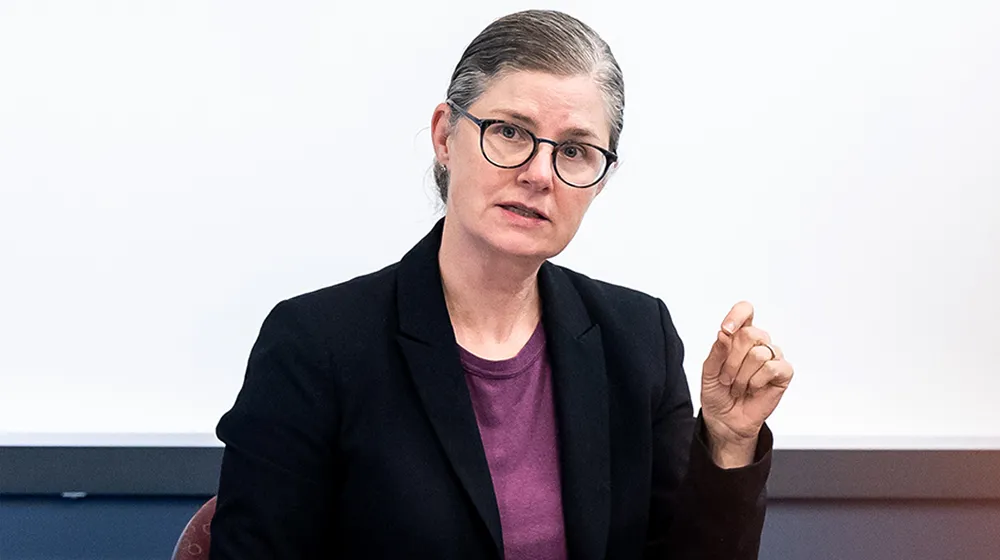
Social Impact MBA
Accelerating social impact in Chicago
Led by Karen Weigert, the Baumhart Center will soon fund mission-driven startups and a distinctive experience for Baumhart Scholars MBA students.
Read about the new social impact fundIn a recent paper, “Rethinking Cybersecurity Behavior Beyond Compliance: Evidence from Distributed Governance in Household,” published in the International Journal of Information Management, Yang and her colleagues looked at how the dynamic between parents and children affects cybersecurity and cyberhygiene in the home. The paper also argued that households provide an empirical context to examine distributed cybersecurity responsibility.
Yang looked at the behavior of families with children in two separate age groups, ages 8 to 11 and ages 12 to 16. Parents were at first quite strict with the younger children, but parents often let the older children have a high level of freedom, believing the children were more tech savvy.
“This is like a distributed organization setting. The younger kids who are not knowledgeable are more like juniors or interns in the organization. As they grow older, they gain more experiences, they share more responsibility, and they become more autonomous. At that point, they’re actually changing the power distribution and dynamic of the household.” Ning Yang, Assistant Professor of Information Systems
This negotiated authority can then undermine sustained cybersecurity behaviors.
Another finding from the households was security fatigue, as parents often had many things going on in their lives and had trouble keeping up with cybersecurity.
“For instance, parents may set up their children’s Chromebook and internet settings in the beginning, but they don’t follow up later and keep the settings up to date,” Yang says. “The business implications are that employers can likewise get cybersecurity fatigue and let their guard down.”

Assistant Professor Ning Yang challenges her information systems students to think critically about data and technology.
Evaluating data and AI
As a teacher, Yang brings the latest information systems research and findings into the classroom, helping students understand the subtleties of the technological tools they will work with as executives. In her applied data mining and artificial intelligence course, which is required in the MS in Business Analytics, Yang probes the value and provenance of data, and the utility of AI in different applications.
“Some people are inclined to just accept data, but they have to understand what the data actually capture. If you measure customer satisfaction on a 1-to-5 scale, do you really know what the customer thinks? That doesn’t give you a big picture.” Ning Yang, Assistant Professor of Information Systems
Badamtsetseg Dash-Ulzii (MSF ’26), an entrepreneur, found that Yang’s course challenged her presumptions.
“One of the most important things I learned is that data mining is both technical and interpretive,” she says. “The class taught me how to build models, but also how to question what a model might be missing and whether its results make sense in the real world.”
In the class, Yang also challenges her students to think critically about AI tools. She created a model where students pitted their own analytical skills using off-the-shelf software against AI.
Dash-Ulzii created a final project examining heart disease.
"I was surprised that the simpler logistic regression model performed slightly better than the AI neural network—a reminder that a more complex model is not automatically the better choice," she said.
“That experience helped me see AI not as something that simply gives an answer, but as a tool that requires careful evaluation and human judgment.” Badamtsetseg Dash-Ulzii (MSF ’26)
For Yang, this kind of lightbulb moment is exactly the outcome she wants.
“These are graduate students, and I don’t want to force my ideas on them,” she says. “I give them challenging problems, and they analyze and think through them on their own.”