
Partnering in Panama
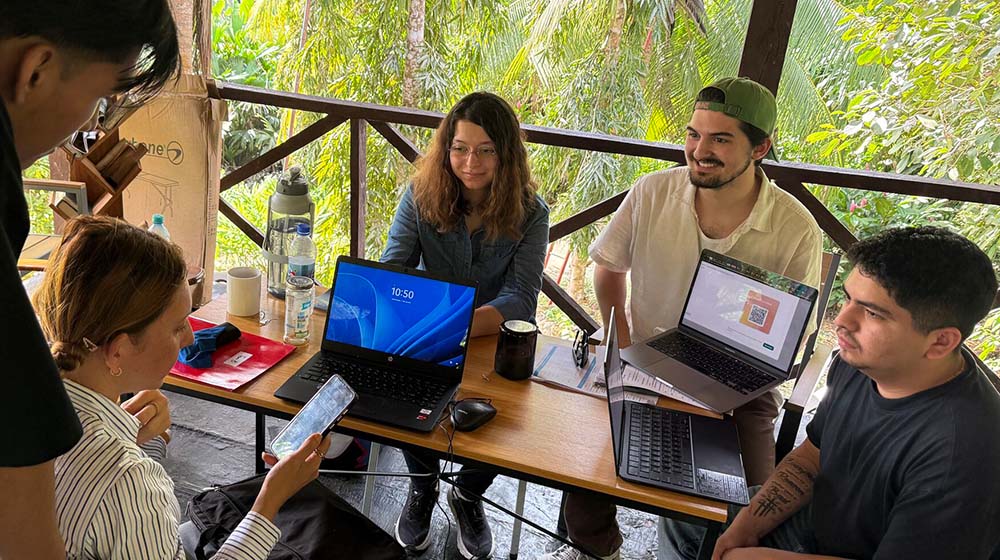
Quinlan students studied on location with business owner Keyda Morales to create marketing strategies for her handmade products.
In January 2026, Quinlan School of Business students in MGMT 335: Micro-Enterprise Consulting for Impact traveled to a resource-limited community in Panama to work with a local business owner, visit iconic sites, and interact with indigenous communities.
While there, students developed a deep understanding of adapting business practices to differing socio-economic conditions while also making a lasting impact for their client.
Sharpening strategies
Through her microenterprise, Essence and Ranch, Keyda Morales makes sustainable, handmade soaps and shampoos from her home. Eager to make her business more efficient, she partnered with Quinlan students in Associate Professor Shabnam Azimi's and Executive Lecturer of Management and Baumhart Center Director Karen Weigert's study abroad course.
“I saw an opportunity to bridge the gap between classroom theory and real-world impact,” said Azimi.
Over the course of 10 days, students worked hand in hand with Morales’ out-of-home business.
“We got to see the most professional thing you could imagine,” said Weigert. “Our students created strategies, design tactics, actually created some deliverables that she’ll be able to use.”
Students studied Morales’ operations and applied skills in marketing, management, finance, and accounting to sharpen her business strategies while remaining focused on sustainability. They helped revise online order forms on Instagram and WhatsApp, designed labels, considered how to reduce packaging, and created a one-year plan with her business capabilities in mind.
Students even helped Morales experiment with her shampoo.
“She was growing local plants that she was then using,” said Azimi. “The students actually helped her do a sample set of shampoos, all the while there’s literally a monkey in a tree above us watching.”
To ensure that Morales could use the marketing plan long after they left, the students presented their final recommendations to her and left a PowerPoint, all in Spanish.
“Towards the end, she was in tears and she said, ‘This is super helpful,’” said Azimi. “Everything that she wanted, they delivered.”
Challenging expectations
During the study abroad course, students immersed themselves in the community. In the town of Tortí, students experienced a small agricultural economy where residents use their limited cash on immediate needs and expenses. This immersion helped students create context-aware strategies to move Morales’ business forward.
“Students had enough time to be able to engage with people and grasp their culture, their pace of life, and how this is so different from the United States,” said Azimi.
Student Aurora Clifford (BBA ‘28) was humbled by the financial situation of the locals.
“Working all day for five dollars to spend on food, then working the next day to have money for tomorrow’s food… it showed us how saving money wasn’t really an option for them,” she said.
The student also saw how many of the conveniences of American life could not be applied to Panama.
“I found myself reversing a lot of assumptions on things I take for granted,” said student Tyler Trudeau (BBA ‘26). “Things like transportation and delivery are so built into my environment; I found myself working backwards when I realized they didn’t have consistent accesses to that.”
Engaged in the community
In addition to understanding the economic constraints in Panama, students gained an appreciation for local culture.
Students stayed at El Hotel y Restaurante Avicar, a humble eco-lodge. As they explored the different facets of rural culture in Panama, the hotel served as a simple and grounding headquarters. Students would meet Morales too, on an lofted, open-air conference space overlooking the rainforest. The space allowed students to stay immersed in their environment while creating business plans for Morales.
In particular, a meeting with the indigenous Guna community at their reservation outside Tortí was deeply moving for students. Students observed the Guna people as they made traditional handmade crafts, were given temporary tattoos made from natural fruit extracts, and were invited to participate in traditional dances. Each of these is deeply rooted in Guna culture and history.
“To see the rural and indigenous communities really puts into perspective the economic divides that exist not only in Panama, but globally,” said Trudeau.
Through these experiences, Weigert believes students return to the United States with a deeper understanding of the different ways people live and thrive.
“When we think about the mission of this institution, we think about social change and building thriving communities in an inclusive economy on a healthy planet. We saw it all on this trip,” Weigert said.