
Standardized Participant Program
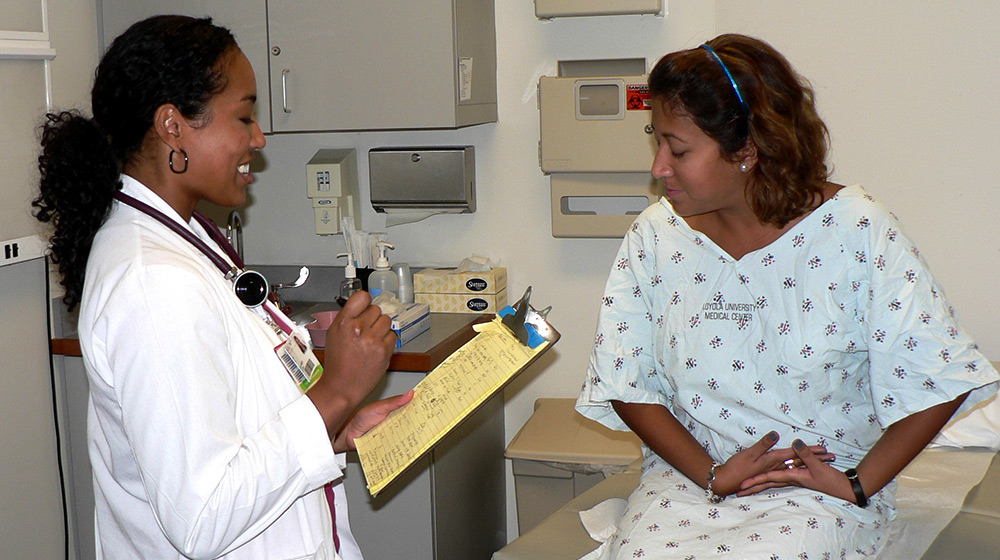
Loyola's Standardized Participant Program
Thousands of learners from many different disciplines have interacted with Loyola's Standardized Participants (SP) for learning or assessment since the inception of the SP program in 1997. Each SP is prepared to assume the personality, emotions and behaviors of the person they portray, to provide feedback to the learner both verbally and by completing various checklists, and to remotely observe other SP's encounters to provide data for continuous quality improvement of the program.
If you are interested in working as an SP for the CSE, please review the CSE Standardized Participant Handbook below and complete an application form.
LOYOLA UNIVERSITY CHICAGO
CENTER FOR SIMULATION EDUCATION
Standardized Participant Handbook
Mission Statement
The Center for Simulation Education provides innovative, simulation-based education and performance assessments across the continuum of education and skills development. It promotes patient safety and performance improvement with an emphasis on team-based patient care. Our work is grounded in the values of the Jesuit educational mission.
Clinical Skills Staff Welcome
Welcome and thank you for your interest in serving as a standardized participant (aka standardized patient or SP) here at the Selfridge Clinical Skills Center, a part of the Center for Simulation Education at Loyola University Chicago. You too are now part of a nationally recognized Jesuit Catholic institution with a rich tradition of excellence in higher education and healthcare. In your role as a SP, you will contribute to the education of future and current professionals in health care and other various fields. Please accept my personal best wishes for success.
Sincerely,
Donna Quinones, Senior Director, Center for Simulation Education
Phone: (464) 220-9165
Email: dquinones@luc.edu
Location and Office Hours
Selfridge Clinical Skills Center
Center for Simulation Education, Loyola University Chicago
2160 S. 1st Ave., Bldg. 120, Rooms 330 & 398
Maywood, IL 60153
Office hours are 8:00 a.m. to 5:00 p.m., Monday-Friday
Information and questions about SP work can be directed to the following staff:
Melissa Kempfer, SP Coordinator
Teams Phone: (464) 220-9166
Email: mkempfer@luc.edu
Abby Gilster, SP Educator
Teams Phone: (464) 220-9171
Email: agilster@luc.edu
Purpose of Handbook
This standardized participant (SP) handbook is designed to provide you with important information regarding policies and procedures, your wages, and your responsibilities as a SP here at the Selfridge Clinical Skills Center. Please read the contents of this handbook carefully as it addresses commonly asked questions regarding your work as a SP. Should you need further explanation, please contact Melissa Kempfer or Abby Gilster.
The contents of this handbook are presented for information purposes only and supersede all former SP information issued by the Selfridge Clinical Skills Center (SCSC). The SCSC reserves the right to change, suspend, or cancel, with or without notice, all or any part of the policies, procedures, wages, and responsibilities in this handbook. This handbook is applicable to all SPs at the SCSC. This handbook does not serve as a contract between the SP and SCSC. Employment as a SP at the SCSC is not guaranteed and may be ended by the SP or the SCSC at any time.
Equal Opportunity Employer
The SCSC as part of the Center for Simulation Education at Loyola University Chicago, an Equal Opportunity/Affirmative Action employer, abides by all applicable provisions of Federal, State and Local law. Loyola will not tolerate racial, sexual or any other form of harassment of any persons, including students, faculty, staff employees, or standardized participants and has established policies and procedures to promptly address any complaints.
Definition of a Standardized Participant (SP)
A Standardized Participant (aka SP aka Standardized Patient aka Standardized Client) is a person trained to portray a human in any simulation context in realistic and repeatable ways. This includes (but is not limited to) as a patient, client, family member, or healthcare provider. For example, SPs accurately and consistently portray the history, physical findings, personality, emotions and behavior of an actual patient at a particular point in the patient’s course of illness. In other experiences, a SP simply serves as a model for the examiner.
Parking
SPs may park in the Patient & visitor garage (Garage A) for any SCSC activities. SPs’ parking will be validated by SCSC staff. SPs also need to obey all parking restrictions posted. SPs choosing to park in restricted areas are solely responsible for any parking violations they may incur.
Work Hours
The work schedule for a SP often varies and is subject to the operational needs of the SCSC. The SCSC staff will provide you with an exact schedule prior to each experience you are scheduled to work. SCSC activities occur at various times of the day, including occasional evenings, and weekends. Prior to your hire as an SP for a case you will be made aware of the specific dates and times the SCSC would like you to serve as a SP.
Wages and Compensation
SPs are hired and compensation is determined based on specifically defined learner encounters. SPs are not considered employees of Loyola University Chicago. Compensation varies from case to case and is in part determined by the complexity of the SP role, the number of encounters a SP is expected to perform, if a physical exam is part of the role, the expected length of time that the SP will need to be present, and if remote recording by the SP will be needed. The flat rate being offered for each specific case will be stated in the case information provided to the SP prior to the SPs acceptance of the role.
SPs must submit an IRS form W-9 once every 2 years, and as necessary to update required information. SPs should expect to receive payment within thirty (30) days of the last day worked. Taxes will not be withheld and are the sole responsibility of the SP. Loyola University Chicago will issue a 1099 form at the end of the year when required in accordance with applicable IRS Code.
EXPECTATIONS
Being a SP
Prior to your actual hiring for a case, the SCSC staff will provide you with information about your SP role and about the dates and times for the training and actual encounters with learners. The SP must prepare to (a) take on the personality, emotions, and behaviors of the person they will be portraying, (b) provide feedback to the learner verbally and often by completing various checklists (e.g., the Patient Perception Scale, or a checklist of physical exam steps), and (c) occasionally observe, via video, live encounters, and rate student performance to provide reliability data (this would occur during work hours).
Here is a list of general expectations for being an SP. The SP…
- is punctual and reliable
- arrives prepared for role
- is accurate and consistent each time they present the case
- always stays in “role” during the encounter
- completes paperwork accurately
- provides feedback using the feedback principles learned in training
- respects the confidentially of all SCSC materials
- is open to continuous feedback regarding performance from SCSC staff
- engages in at least one SP/simulation related professional development activity per year
Training and Validation
Often, training (in person or on zoom) is required of SPs prior to actual work. The number of hours required for training varies, dependent on the difficulty of the material being learned. Competency in roles will be validated by the SCSC staff. Because of the confidential nature of case materials, SPs who work in the SCSC agree to not share any training or assessment materials with any other individual or institution. SPs are paid a flat fee of $25.00 for training which is added on to the predetermined rate when the SP works the session for which they were trained. On the day of events at SCSC before encounters begin, there will be a “tune up” for the SPs. The purpose of the tune up is reviewing the goals of the exercise, reviewing the materials, and answering any questions from SPs regarding the case. Additionally, there is a required annual feedback workshop to establish SP feedback foundations and methods once a year.
Program Assignment and SCSC Cancellation Policy
Work assignments are made by the SCSC Program Coordinators and SCSC Staff. The SCSC cannot guarantee a fixed minimum or maximum number of SCSC activities an individual may work. We reserve the right to cancel due to program changes. If the SCSC cancels more than 4 weeks ahead of the session, you will not receive payment. If the SCSC cancels between 2 and 4 weeks prior to the scheduled session you will be paid 50% of the payment. If the SCSC cancels 2 weeks or less prior to the scheduled session, you will be paid in full.
Standardized Participant Cancellation Policy
Our academic year runs from July 1 – June 30. You will be asked for your availability for our academic calendar in May or early June. You will be sent all dates for which you have been scheduled by the middle of June. We expect you to honor all commitments. A reminder email will be sent to you 7-10 days prior to each exercise for which you have been scheduled. SPs cancelling consecutive work assignments, arriving late, or not arriving at all, may no longer be contacted for future SP work.
*If you are ill the day of the exercise, please call Melissa at (464) 220-9166 and leave a message.
Educational Outgrowth
SPs must agree that the SCSC and its associated organizations and activities are authorized to take, obtain, and make use of media capture (including audio/video recording and photography) of any SP activities, without additional compensation. All recordings are the property of the SCSC. Media capture may be used for quality improvement, education, and/or marketing purposes and learners and SPs will not be identified beyond field of study. Media capture may be made available to publications, radio, television, and other media with SP permission. No media will be used for university marketing purposes unless all persons captured in the media, including SPs, sign the Loyola University Chicago Consent for Photo/Promotional release prior to the media being used.
Emergency Procedure
In the event of any medical emergency, assistance should be sought in the emergency department or 911 depending on the urgency of the problem.
Center for Simulation Education
The Center for Simulation Education has facilities in multiple buildings across campuses. Simulation experiences may be hosted at CSE facilities or may be supported by the CSE remotely (e.g., virtual or hybrid) . An overview of the areas that are part of our simulation center is provided below.
Facilities and Locations
Any references made to the CSE may include the following locations.
Health Sciences Campus
- Selfridge Clinical Skills Center: Rooms 330 and 398 (3rd floor in the Stritch School of Medicine) 14 patient rooms, a monitor room, and a clinical assessment room with computer stations. Primarily used for teaching and assessing healthcare-related clinical skills using standardized participants.
- Walgreen Family Virtual Hospital: (3rd floor in the Marcella Niehoff School of Nursing) Six high-fidelity simulation bays, each with associated control and debriefing rooms. Manikins available include six Laerdal SimMan 3Gs, one Laerdal SimBaby, one Laerdal SimJunior, and one Gaumard Noelle birthing mother with Baby Hal.
- Advanced Procedure Education Center: Room L70 (lower level in the Stritch School of Medicine) Virtual OR with METI HPS, wet/dry lab, anatomy lab, virtual reality trainers including Simbionix LAPMentor, Simbionix GI/BRONCHMentor, Mimic Robotic simulator.
- Stamm Procedural Training Room and Bedside Teaching Lab: Rooms L60E and L62 (lower level in the Stritch School of Medicine) Task training models, Harvey, EKG machines and a bedside teaching area are available.
Lake Shore Campus
- Room 306, 307, and 317 (3rd floor in the Mundelein Center) Four high-fidelity simulation bays and two multi-purpose spaces. Manikins available include three Laerdal SimMan 3Gs, one Laerdal SimMom, and one Laerdal SimJunior, one Gaumard Noelle.
Water Tower Campus
- Located on the 4th and 5th floors in the Maguire building. 12 interview rooms, one family room, two conference/debriefing rooms, with one control room and one shared classroom. Primarily used for teaching and assessing behavioral health-related skills with standardized participants.
Additional Resources for Standardized Participants