
Our Services
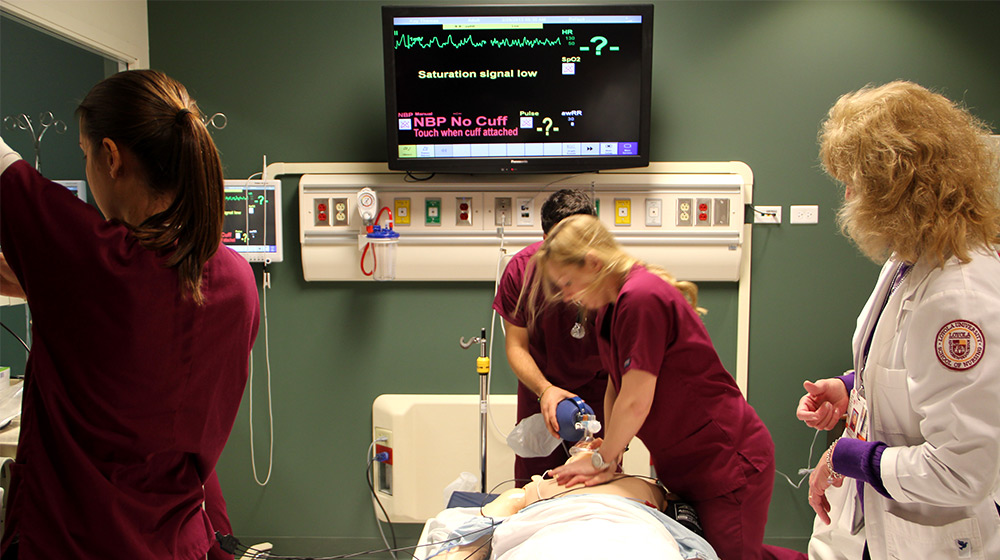
Supporting academic programs at Loyola’s three Chicago-area campuses
The CSE is a University-wide resource that currently serves several Loyola schools including Medicine, Nursing, Social Work, and Health Sciences and Public Health, as well as the Neiswanger Institute for Bioethics and the Institute for Transformative Interprofessional Education. The CSE is also a resource for a variety of training and continuing education programs within the Loyola University Health System. Beyond Loyola, the CSE offers tours to local high school students and special interest groups, and CSE facilities may be available to vendors and learner groups.
Our Services
Standardized Participants
Live actors, also known as SPs, SCs, Standardized Patients, and Standardized Clients
Interprofessional Education
Students from social work, nursing, and medicine work together to earn a Certificate of Advanced Brief Interventions for Substance Abuse among Minority Communities. Interprofessional teams interview a standardized participant via Zoom, using the SBIRT (Screening, Brief Intervention, and Referral to Treatment) approach, along with motivational interviewing techniques. The teams receive training and debriefing from an interprofessional team of faculty. C-FIRST: Loyola University Chicago (luc.edu)
Marcella Niehoff School of Nursing
Students in all of Loyola’s three Bachelor of Science in Nursing programs (4-year, Accelerated BSN, and Hybrid-Accelerated BSN) use simulation to enhance their learning throughout their curriculum. https://www.luc.edu/nursing/
Undergraduate students work with standardized participants to demonstrate leadership skills including delegation, prioritization, and good judgment when presented with ethical dilemmas. Standardized participants are also used in telehealth encounters with students.https://www.luc.edu/nursing/academics/degreeprograms/undergraduatedegrees/
The Doctor of Nursing Practice program incorporates simulation into its curriculum as a learning pedagogy as well. Standardized Participants provide students the opportunity to demonstrate history and physical exam skills along with clinical reasoning. The students receive immediate feedback from both the SP and the course director. Standardized participants are also integrated into final proficiency testing. https://www.luc.edu/nursing/academics/degreeprograms/graduatedegrees/
Stritch School of Medicine
Standardized participants are integrated into medical students’ four-year curriculum as both a teaching modality and to assess clinical skills. Patient Centered Medicine (PCM) courses use SPs in role-playing situations in small group settings, and while learning foundational physical exam skills and other important exams including breast and genitourinary exams. Students in PCM 1 and PCM 2, as well as all clinical clerkships (Internal Medicine, Family Medicine, Surgery, OB/GYN, Pediatrics, Psychiatry, Neurology, Emergency Medicine, Sub I Wards, and Sub I Units) have Objective Structured Clinical Exams (OSCEs) where students demonstrate clinical skills such as history-taking, physical exams, and clinical reasoning. SPs provide feedback from a patient perspective during these assessments. At the end of their M3 year, students participate in a Capstone Clinical Skills Experience where they see multiple SPs in a clinic setting and follow one of those patients to the virtual hospital to continue managing their care.
Parkinson School of Health Sciences and Public Health
Students in the Dietetics (MS) program and the Dietetic Internship course use standardized participants to demonstrate competence in completing a focused history and physical assessment.
School of Social Work
Standardized participants assume the role of the client for one-on-one telehealth encounters during students’ internship instruction and simulated experiences courses. Students receive feedback from both the standardized client and a clinical reviewer. Video recording of the encounter enhances the student’s ability to reflect on their own performance.
Neiswanger Institute for Bioethics
Students enrolled in the Clinical Ethics Consultation Training and Education program join standardized participants and faculty in two to four mock consults where they hone their ethics consulting skills. Students receive multiple layers of feedback from the SP, faculty and observers, as well as through reflecting on their own performance.
Pulmonary Fellows
Pulmonary Fellows from the Loyola University Health System participate in a communication exercise where they work with standardized participants in different scenarios that reflect common hospital interactions. These scenarios might include negotiating a plan of care with a surrogate, an interpersonal conflict with a team member, or leading a family meeting to understand the patient’s values, preferences, and spirituality so they are reflected in the medical plan of care. Faculty and peers can observe the encounters live (or later, via video) and provide feedback after each encounter.
Dental Medicine Residency
Dental residents work with standardized participants throughout their one-year, post-doctoral program. Communication exercises focus on multiple topics including single tooth infection, syncope, transplant, pre-radiation dental evaluations, and dento-alveolar trauma. Residents receive feedback from the program director, peers, and SPs after each encounter. Pre- and post-encounter activities further enhance their learning.
Spanish Bilingual Medical Student Certification
Medical students can earn the Spanish Bilingual Medical Student Certification by passing an Objective Structured Clinical Exam (OSCE) with an SP and passing two online phone exams (the Clinician Cultural and Linguistic Assessment (CCLA) and the Qualified Bilingual Staff Assessment). Earning this certification ensures that the student is culturally and linguistically competent to directly communicate with Spanish-speaking patients and can facilitate communication between the healthcare team and Spanish-speaking patients.
Manikins
Full body adult, child, or baby
Marcella Niehoff School of Nursing
Undergraduate students participate in a seven-hour simulation day using high-fidelity simulation during each of their clinical courses. Each simulation day consists of pre-briefing, participation in or observation of four simulation cases, debriefing after each simulation, and post-simulation activities. Student engagement during these hands-on simulation days allows for deep learning of essential nursing concepts.
Stritch School of Medicine
Second year medical students in their Pharmacology course have their first foray into high-fidelity simulation when manikins are brought to the lecture hall and students work in teams to diagnose and manage a sick patient. As they progress through medical school and have the knowledge and skills to better manage patients, they will have high-fidelity simulations in their Surgery, Emergency Medicine, and Sub I Units clerkships. They also will manage a patient in their Capstone Clinical Skills Experience that they had previously seen in the clinic setting. These experiences enhance both their confidence and competence when managing actual patients.
Interprofessional Education using TeamSTEPPS®
Senior-level nursing students, medical students in their Emergency Medicine clerkship, and Pharmacy students from Chicago State University and Roosevelt University join together each month for an interprofessional session where they apply the strategies and principles of TeamSTEPPS® (Team Strategies and Tools to Enhance Performance and Patient Safety) in the care and management of two simulated patients. Interprofessional teams of faculty from nursing, medicine, and pharmacy facilitate each team. Students have found these sessions to be very valuable. Typical learner comments include: “Efficient communication and understanding other’s roles. Huddles are great. I would like another one or two of these throughout the curriculum." The emphasis on communication and patient safety is critical as students transfer skills learned to their clinical practice.
Graduate Medical Education (GME)
Many Loyola University Health System (LUHS) resident and fellowship programs use the Walgreen Family Virtual Hospital for training. These residency programs include:
- Anesthesiology
- Dental Medicine
- Emergency Medicine
- General Surgery
- Internal Medicine
- Neonatal (fellowship)
- Neurology
- OB/GYN
- Pediatrics
LUHS Nursing Staff
Several departments train nursing staff using high-fidelity simulation, including Pediatrics, OB/GYN Perinatal, and Trauma. Department educators recognize the value of training in a safe environment and its impact on improving patient safety.
Skills and Task Training
Training/assessment/open lab, including using body PART models
Marcella Niehoff School of Nursing
Hands-on skills training begins in the Foundations of Nursing course and continues during just-in-time learning sessions for Medical/Surgical Nursing and Family Health Patterns. The Emergency and Acute Care Procedures for the NP course also teaches hands-on procedural skills in the CSE, and the Advanced Health Assessment Across the Life Span course teaches physical exam skills using the clinical skills center as a learning lab. https://catalog.luc.edu/undergraduate/nursing/
Stritch School of Medicine
Physicians-in-training have a hands-on ultrasound curriculum throughout their four years. In years one and two, the ultrasound curriculum corresponds to what is being taught in pre-clinical courses Structure of the Human Body, Mechanisms of Human Disease, and Function of the Human Body. Year three and four ultrasound curriculum is found in the Surgery, Emergency Medicine, and Sub I Units clerkships. https://www.luc.edu/stritch/regrec/
Harvey® - the Cardiopulmonary Patient Simulator is a low-fidelity manikin that helps students learn normal and abnormal heart and lung sounds, during PCM-2 and again in the Medicine clerkship. Several clerkships use just-in-time learning to teach skills on the first day of a rotation. Those clerkships include:
- OB/GYN: pelvic and breast exam, suture, labor and delivery, gowning and scrubbing
- Surgery: suturing, NG tube insertion, foley catheter insertion, laparoscopic skills
- Neurology: lumbar puncture
- Emergency Medicine: code leader training, defibrillator training, bag valve mask, compressions, ultrasound-guided peripheral IV, suture, airway management
- Sub I Units: ventilator
Stritch Student Interest Groups
Many Student Interest Groups (SIGs) use the CSE for extra skills enrichment. A faculty mentor facilitates these hands-on sessions to allow students to perform a task or learn new skills or procedures. SIGs doing task, skills, or procedure training currently include:
- Anesthesia Student Interest Group: airway management
- Orthopedic Student Interest Group: splinting and casting
- Ultrasound Student Interest Group: ultrasound skills
- Sports Medicine Student Interest Group: ultrasound skills
Graduate Medical Education (GME)
Many LUHS resident and fellowship programs use the CSE for skills enrichment and task and procedure training, including:
- Anesthesiology: airway management, ultrasound guidance, central line placement
- Dental Medicine: IV insertion, scrub skills
- Emergency Medicine: ultrasound training, wound care, vascular access, splinting, airway management, lumbar puncture, chest tube insertion, ophthalmology skills
- General Surgery: American College of Surgeons skills curriculum
- Internal Medicine: ultrasound training, central line placement, intraosseous (IO) vascular access
- Nephrology Fellowship: central line placement
- OB/GYN: laparoscopy skills, OASIS repair
- Ophthalmology: microscopic suturing, corneal treatment, glaucoma testing and treatment
- Orthopedics: suture, knot tying, arthroscopy, power tools, ultrasound guidance, injection and aspiration, casting reduction
- Pulmonary Fellowship: ultrasound guidance, central line placement
Extended Reality
Virtual, Augmented, or Mixed Reality
Marcella Niehoff School of Nursing
The school integrated virtual reality (VR) into their curriculum with CARE Pathway students https://www.luc.edu/nursing/about/inclusiveexcellence/carepathway/. Students work together, some using oculus headsets, to care for a virtual patient recognizing priority nursing interventions. The school intends to integrate VR into other classes.
Stritch School of Medicine
Students in their second year learn ophthalmology skills on virtual patients using oculus headsets, eye benches, and 3-D projection. Dr. Anuradha Khanna, Vice Chair of Education of the Department of Ophthalmology, developed the virtual reality (VR) software.
Graduate Medical Education (GME)
Residents in Ophthalmology, Emergency Medicine, and Internal Medicine learn more complex ophthalmology skills using VR software developed by Dr. Anuradha Khanna, Vice Chair of Education of the Department of Ophthalmology. https://www.loyolamedicine.org/gme/residencies/ophthalmology/virtual-reality-simulation-training
General Surgery and OB/GYN residents use virtual reality simulators such as the LAP Mentor, GI/BRONCH Mentor, and Mimic dV-Trainer. These simulators provide a curriculum for basic laparoscopic tasks and skills, training of gastrointestinal upper and lower endoscopic procedures, and basic robotic skills.
Cadaveric Education
including Tissue Specimens
Stritch School of Medicine
Students in the Structure of the Human Body course use both pro-section and dissection to learn the intricacies of the human body.
Graduate Medical Education (GME)
The Orthopedic Residency program, and Podiatry residents, use un-embalmed cadavers to learn and practice surgical skills, including novel techniques. Surgical equipment and supply vendors often contribute educational resources for these workshops, including equipment, supplies, and teaching support.
Group Tour with Hands-On Experience
Tours for high school students and other aspiring healthcare professionals typically include rotating through three separate stations to learn about core aspects of simulation education. These stations include: (1) a prosected cadaver, where organ systems are observed and discussed; (2) a display of various pathological specimens for a brief pathology overview, and of task training models actually used for skills development by nurses- and physicians-in-training; and, (3) a human patient simulator whose simulated health emergencies tour participants help to manage by performing CPR and diagnosing internal bleeding. To reserve a tour, please Email SimCenter@luc.edu .
Use of CSE Facilities
If you are interested in using Loyola's CSE facilities, please contact SimCenter@LUC.edu.