
Hope in Increments: The Elusive Promise of TIF in Chicago
Jamaal Tumaini, a 25-year-old African American physician from the Hope Hills neighborhood on the South Side of Chicago, has an impressive story. Despite being born to a single parent in the poverty-stricken Hope Hills community, a neighborhood once plagued by homelessness and a violent crime rate 700% higher than the national average, Tumaini’s home environment was relatively stable, enabling the curious young boy to excel against the odds. In 2024, the community-minded doctor returned to his Hope Hills neighborhood and opened a free health clinic to serve his local population.
Fortunately, as the promising young student progressed over the first two decades of the 20th century, his community did as well, particularly in the form of a timely Tax Increment Financing (TIF) investment by the city. For certain Chicago communities of color struggling with underinvestment, TIF has been the go-to investment tool for funding housing and development projects as future property tax revenues are leveraged to encourage new economic development and job creation within a designated district. Largely due to this investment, more housing, community programs, and job options were locally available for Tumaini during his adolescent years, and the committed physician now inspires others to follow his lead and give back to their beloved community.
Heartwarming, right? Don’t you just love local success stories where the city actually puts its money where its mouth is and gets it right?
Unfortunately, there are some major problems with this idyllic scenario. First, Jamaal Tumaini does not exist (“Tumaini” is a Swahili name meaning “hope”). Second, neither does the fictional Chicago Southside neighborhood of “Hope Hills.”
Finally, and most unfortunately, neither does equitable TIF funding for Chicago’s Southside communities.
“If you look at the tool on its own, you’re like, ‘Oh, well that makes sense, right?” offers Lauren Burdette, a Chicago-based consultant and the former Deputy Chief Equity Officer at the City of Chicago’s Office of Equity and Racial Justice. “You create this district and, as more investment comes in, property taxes will rise and then you’ll have money to reinvest in the community, and that’s great. But in reality, where does that investment actually come from?” poses Burdette, who first took on the issue eight years ago in protest of the $6 billion TIF-funded development of Lincoln Yards. “The government doesn’t have enough money on its own to do that investment” so you are “relying on private investors to actually come in and augment the government investment. And private investors, we know from many research studies, are much less likely to go into majority Black neighborhoods or even majority Hispanic ones unless they’re about to be gentrified. So the tool itself is really difficult to drive long term economic reform because of those inherent issues.”
“You create this district and, as more investment comes in, property taxes will rise and then you’ll have money to reinvest in the community, and that’s great. But in reality, where does that investment actually come from?” Lauren Burdette, IRJ Senior Advisor
Burdette recently contributed to a new report on TIFs issued by the Institute for Racial Justice at Loyola University Chicago in collaboration with Fifth Third Bank and Claretian Associates that further examines such issues. Rethinking Tax Increment Financing in Chicago: Findings from South Chicago and Implications for Equitable Development reveals numerous critical aspects regarding TIF funding including its misuse as the sole financial development tool for a municipality; its “diversion of rising property tax funds from other taxing bodies” that need it most; its lack of transparency regarding how funds are spent; and its perception as a “slush fund for wealthy developers.”
“Most other cities in America have capital plans,” acknowledges Burdette, noting “they have other financial tools available to them for housing, for commercial development, while Chicago, for 20-plus years, has only used TIF. It's significant that with Mayor Lightfoot's capital plan and Mayor Johnson's Housing and Economic Development Bond, Chicago is finally starting to use more tools," Burdette notes. "But the legacy of TIF as the city's primary instrument — and what that meant for neighborhoods like South Chicago — is still an important and unfinished story.”
Using South Chicago, a neighborhood in southeast Chicago with two TIFs as a case study to explore TIF’s structural limitations and their communal impact, the report details the tool’s limited financial impact in the area over the past two decades. It points to the persistent housing crisis as “more than 55% of South Chicago renters remain cost-burdened, and foreclosure rates during the 2008 crisis were nearly double the citywide average.” Further, in “South Chicago–where unemployment stands at 16.5% (twice the city average) and the population has declined 21% since 2000–property value growth is lower than many other areas of the city. This structural limitation undermines the tool’s potential to support the neighborhoods most in need of investment.”
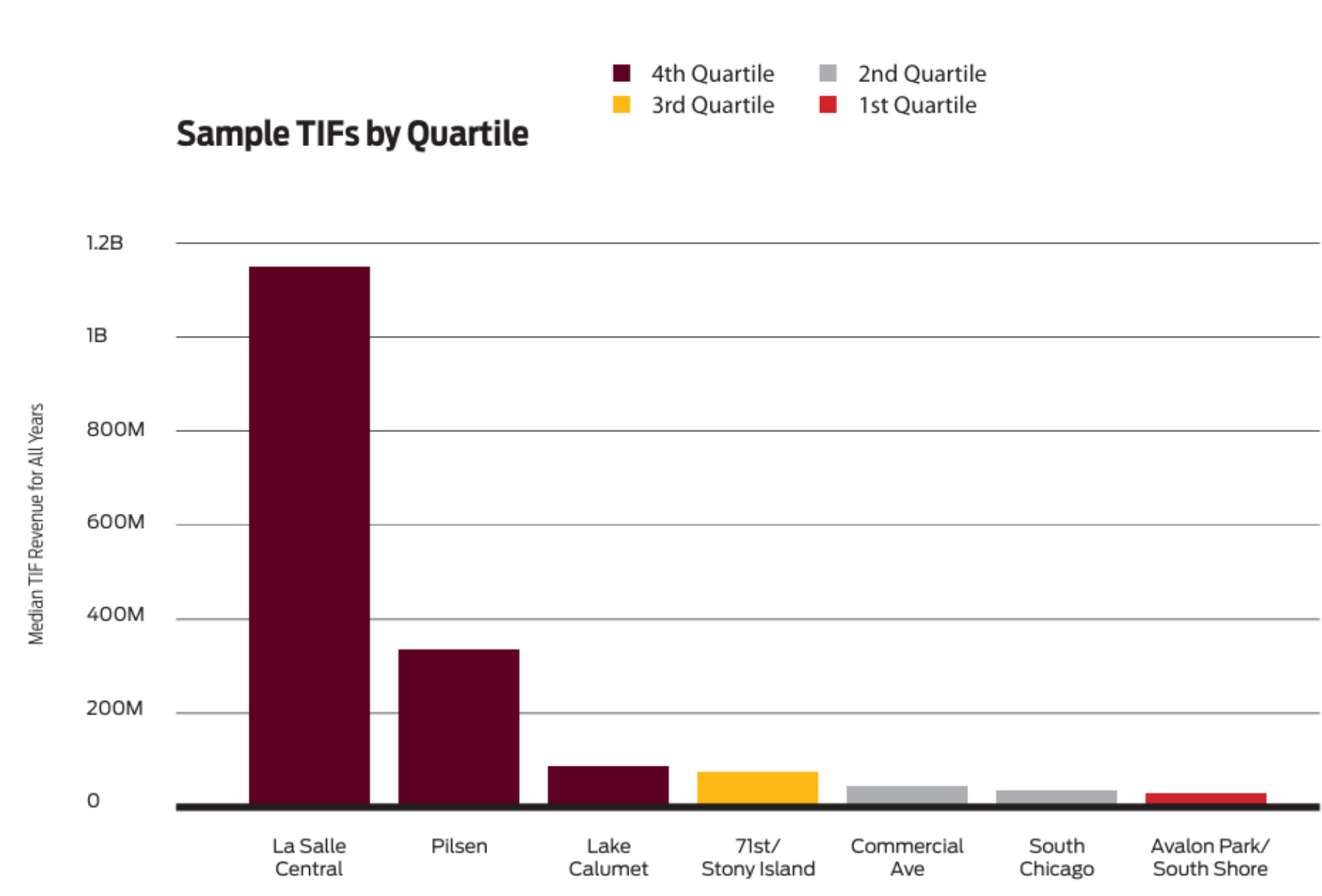
The South Chicago TIFs did fund meaningful projects, including the SACRED Apartments, an 81-unit affordable housing development with a ground floor grocery store, and Galleria 89, a 58-unit mixed-use complex on Commercial Avenue. The challenge is one of scale. Upon comparison, the South Chicago TIF raised a relatively paltry $26.5 million during its 20-plus year lifespan while downtown TIF La Salle Central, the youngest TIF, generated over $1.1 billion. Similarly, the report documents how Pilsen, a TIF in a now gentrifying area, generated $340 million while South Chicago’s second TIF, Commercial Ave, raised only $32.7 million during its lifespan.
The chart below shows how TIFs within the South Chicago community (South Chicago and Commercial Avenue) and adjacent to it (71st/Stony Island, Lake Calumet, Avalon Park/South Shore) compare to the La Salle Central and Pilsen TIFs:
Source: Rethinking TIF Districts: A Path to Racial Justice in Chicago
Part of this disparity is due to the flexible criteria by which municipalities can determine if a neighborhood is “blighted” or not. Such loose criteria by the state of Illinois enables far more affluent districts like LaSalle Central, a vital area of financial activity encompassing most of downtown Chicago, to get richer while other areas of the city in need or largely devoid of such pre-existing industry, get left behind. This structural inequity is further compounded by the aforementioned issue of how private investors are less likely to invest in communities of color.
According to Malik S. Henfield, full professor and founding dean, “IRJ was built to connect rigorous research to the rooms where decisions actually get made. What this report makes plain is that the communities most in need of investment have been structurally shortchanged by a tool that was never designed to carry the weight Chicago put on it. That is a policy design problem and until we name it as such, we will keep asking the wrong questions about why neighborhoods like South Chicago are not transforming.”
Consistently, the report clearly reveals how the original promise of TIF to serve those communities most in need remains as fictitious and unrealized as the brief two-paragraph lifespan of Jamaal Tumaini. The program is further hobbled by its status as a reimbursement-based program that caters to larger businesses with substantial cash flow, and its diversion of additional tax revenues from other taxing bodies.
That acknowledged, the newly released document does leave room for optimism as it outlines several key recommendations to steer the program back towards its initial intention. They include coupling it with alternate housing and economic development financing options reviewed by local community groups; ensuring the city makes financial tools more transparent and engages communities in TIF district redevelopment plan creation; reforming TIF’s status as a reimbursement-based program to make it more accessible to smaller developers; pushing the state of Illinois to allow more flexible uses while offering consistent economic development funding that promotes racial equity; and providing incentives for private sector and philanthropic funders to align their investments with community-driven plans and sustained partnerships in communities of color alongside committed universities and research and policy centers.
Ultimately, when it comes to the elusive promise of TIF in Chicago, it is a program only as effective as the will of those who control, lobby, and develop it. And though Burdette initially believed the program to be little more than a slush fund for elite developers, she has since come to believe the issue to be more complex.
“TIF was being used as kind of a substitute capital plan, so fixing up government buildings, fixing roads, fixing streetlights—things that actually are like core government functions—is not evil, right?” poses Burdette, noting “that’s not a bad investment. What is bad about it is that’s not the initial point of TIF. The idea of TIF is that it’s a tool to drive economic development in areas that need it most.” But if the “only thing you’re doing is those kind of infrastructure investments, and there’s no ‘let’s build up actual affordable housing or new commercial businesses and support some of the businesses in the area with new workforce strategies’ and things like that, then it’s not fulfilling the intent of what it was created to do.”
“TIF is a tool,” confirms Burdette, stressing that “tools can be used for good or neutral or evil.”
“And TIF has been used for all of those in Chicago.”
When community priorities come first, and public, private, and philanthropic partners align their resources accordingly, progress becomes more sustainable and equitable.
Rethinking Tax Increment Financing in Chicago, was produced by the Institute for Racial Justice at Loyola University Chicago as part of IRJ’s research-to-policy model, which translates rigorous analysis into public understanding and actionable insight. The work draws on the South Chicago Quality of Life Plan and was developed in partnership with Claretian Associates, with support from Fifth Third Bank.