
Why Chicago’s TIF System Isn’t Working for South Side Neighborhoods
Lauren Burdette spent years inside Chicago's city government watching a familiar pattern play out. A neighborhood with decades of disinvestment gets a Tax Increment Financing district. Plans are drawn up. Goals are set. And then the fundamental problem asserts itself: TIF captures revenue from rising property values, and in communities where property values stay low, there isn't much revenue to capture.
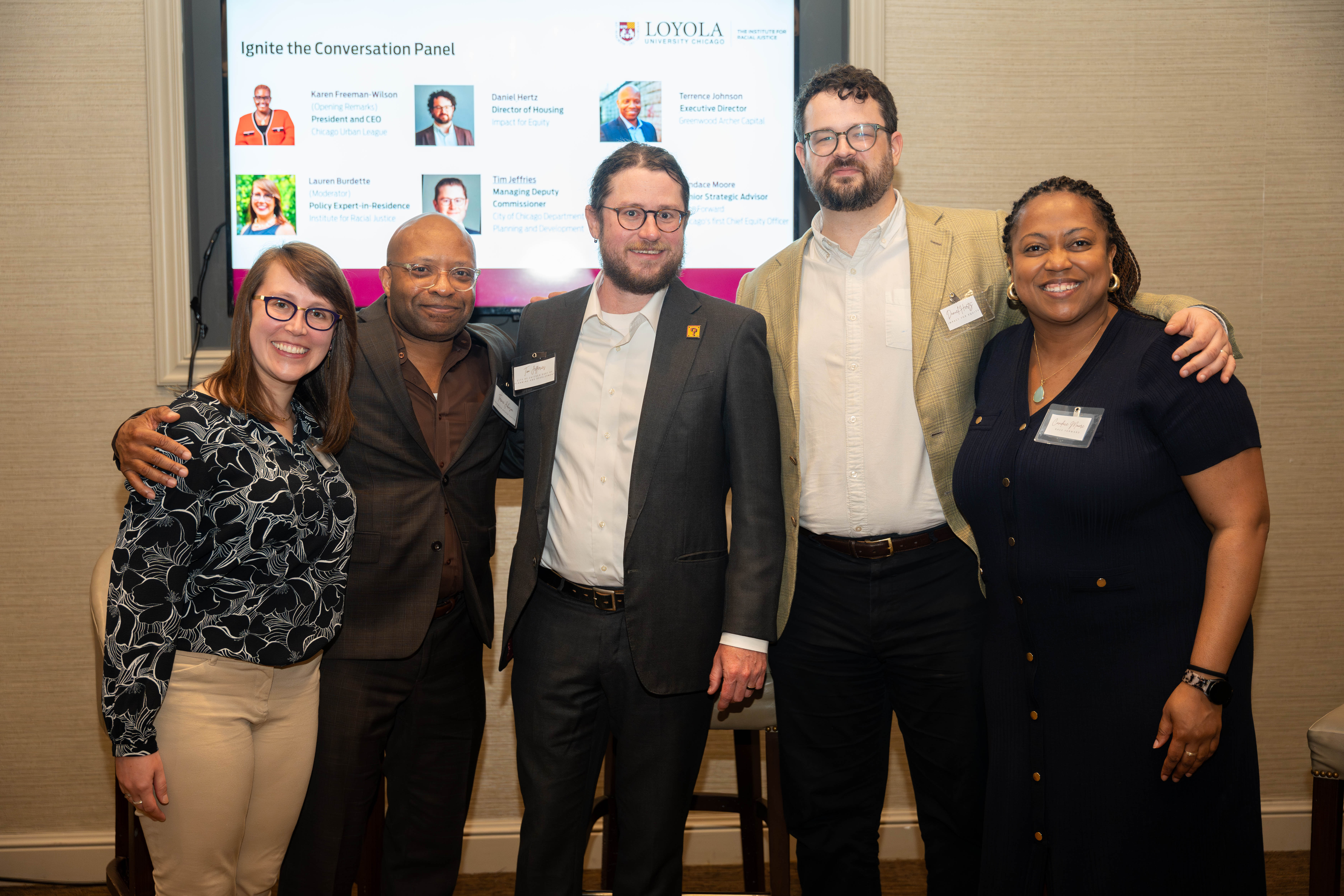
Lauren Burdette, Senior Advisor at the Institute for Racial Justice; Terrence Johnson, Executive Director at Greenwood Archer Capital; Tim Jeffries, Managing Deputy Commissioner at the City of Chicago Department of Planning and Development; Daniel Hertz, Director of Housing at Impact for Equity; and Candace Moore, Senior Strategic Advisor at Race Forward.
“Like many Chicagoans, before I joined the City, I was convinced the money was going toward predatory developers or was a slush fund for mayors. But over time, I saw it was more complex than that.” Lauren Burdette, Senior Advisor at the Institute for Racial Justice
A new report from the Institute for Racial Justice (IRJ) at Loyola University Chicago puts hard data behind that complexity. Rethinking Tax Increment Financing in Chicago: Findings from South Chicago and Implications for Equitable Development, produced in partnership with Claretian Associates and with financial support from Fifth Third Bank, documents how South Chicago’s two long-standing TIF districts generated just $26.5 million and $32.7 million respectively over their lifetimes. Together, that is about 5 percent of what LaSalle Central, a single downtown district created after both South Chicago TIFs, generated alone. In a neighborhood where unemployment stands at 16.5 percent, twice the city average, and more than 55 percent of renters remain cost-burdened, that disparity is built into the structure of TIF itself. The tool works largely as designed. The problem is that the design reproduces the inequalities it was meant to correct.
From Insight to Implementation: Lauren Burdette’s Path to Systems Change
Burdette, a Chicago-based consultant and former Deputy Chief Equity Officer in the city’s Office of Equity and Racial Justice, is one of the report’s lead authors and a Senior Advisor at IRJ. For the past two decades, she has devoted her career to the question of how government systems can be made to work for the people they have most consistently failed. As a leading equity official in the country’s third-largest city, she helped design Chicago’s first-ever budget equity process, supported racial equity action plans for over 30 departments, and led the citywide launch of Chicago Connected, a program that provided no-cost, high-speed internet to over 100,000 public school students and their families. She currently serves on the board of Helix Education and on the City of Chicago’s Equity Advisory Council.
“With Lauren, the first word that comes to mind is smart,” offers Candace Moore, Chicago’s first Chief Equity Officer and now a Vice President of Place, Policy, and Power at Race Forward, and one of the expert advisors whose insights shaped the TIF report. “That smartness comes from the fact that she is very curious, willing to learn, willing to listen, and really dedicated to figuring out how to solve problems for those she cares about.”
That orientation toward problem-solving has deep roots. Burdette holds a master’s in public policy from the University of Michigan’s Ford School and a bachelor’s in history and political science from the University of Pennsylvania. She first saw inequities clearly knocking on doors during a congressional campaign in the wake of 9/11. “You see realities that conflict with what you’ve been taught about America being fair for everyone,” she recalls. “It’s easy when you have privilege to perceive the world a certain way as you grow up, like there’s a giant cloak hiding reality. If you’re fortunate enough to be exposed to truth through experience, that cloak gets holes poked in it.” By the time she began teaching 7th graders on the southwest side of Chicago, her commitment to racial justice was cemented. “Like many white people, I went through a guilt phase after realizing the unfairness of privilege,” she admits. “Eventually, I had to say to myself, ‘Stop! That’s unproductive. What do you do about it?’” For her, that meant becoming “an authentic co-conspirator, a deep and consistent partner in the work of building a new world.”
It is a disposition that fits IRJ’s model precisely. Most policy research moves in one direction: from university to report to shelf. IRJ is built around a different premise: community knowledge, academic rigor, and the rooms where decisions actually get made have to be connected in both directions, and that requires people who have actually worked inside those rooms. Burdette is that kind of person.
"IRJ was designed from the beginning to connect scholarship to the rooms where decisions actually get made. That requires advisors who have genuinely worked inside those rooms. Lauren is exactly who you recruit when you're serious about that mission. Her leadership experience at the city level gives our research a layer of depth and accountability that's hard to replicate." Dr. Malik Henfield, Professor and founding dean of IRJ.
That understanding shapes the report’s findings in concrete ways. The analysis shows that much of what the South Chicago TIFs funded went toward basic infrastructure: roads, lighting, public works. “That’s not evil,” Burdette says. “But it’s not what TIF was created to do. And that matters, especially when you consider who’s actually benefiting from these decisions.” The report also documents a transparency problem: financial reporting requirements are complex, making it difficult to trace where funds went and what they produced.
Chicago’s reliance on TIF as its primary development tool across multiple mayoral administrations compounded these structural problems. The city has begun to reckon with this, pursuing a $1.25 billion housing and economic development bond in 2024 as a more flexible tool. Whether that shift is sufficient to address the scale of disinvestment in neighborhoods like South Chicago remains an open question, and the report is careful not to treat a change in financing instruments as a substitute for the deeper reforms it recommends.
Those recommendations reflect Burdette’s instinct to work within systems while pushing to change them. They call on community groups to develop quality of life plans that give investment something concrete to align with; on the city to reform TIF’s reimbursement structure so smaller and minority-owned businesses can actually access it; on the state to expand allowable uses of TIF funds beyond capital projects; and on universities and research institutions to build sustained community partnerships rather than extractive consulting relationships.
“One of the things we did in city government that was really helpful, and really relevant to IRJ and its vision, was build deep partnerships with the community. We had an advisory council, but we also had people outside of that who we talked to all the time. We were literally all at the table, problem-solving together.” Lauren Burdette, Senior Advisor at the Institute for Racial Justice
The political environment makes that work harder than it should be. “We are in a place right now where people are literally doing Control-F looking for the word ‘equity’ and cutting it,” Burdette says. “It’s not like there’s thoughtful analysis, just censorship. And there’s grief in that, in not being able to name the work for what it is. But the work to ensure that people get what they need continues, with or without a label.”
When community priorities come first, and public, private, and philanthropic partners align their resources accordingly, progress becomes more sustainable and equitable.
Rethinking Tax Increment Financing in Chicago, was produced by the Institute for Racial Justice at Loyola University Chicago as part of IRJ’s research-to-policy model, which translates rigorous analysis into public understanding and actionable insight. The work draws on the South Chicago Quality of Life Plan and was developed in partnership with Claretian Associates, with support from Fifth Third Bank.