

Story - Irem Sengul Orgut
Advancing food bank operations
A Quinlan professor's pioneering research—and new class—will help those in need.
Food insecurity in the United States is on the rise. Studies indicate that more than 10% of households in the U.S. were food insecure in 2019, and that figure almost tripled during COVID. Estimates also put food waste nationally at upwards of 30%.
Irem Sengul Orgut, an associate professor of supply chain management at Loyola University Chicago’s Quinlan School of Business, is helping get food to those in need by building analytical tools to connect food resources to those in need with greater efficiency.
Orgut specializes in optimization, a discipline that finds the best solution to complex problems given a set of variables. More specifically, she focuses on humanitarian supply chain operations, which are extremely challenging to model.
Her work on food bank operations is recognized as one of the pioneering works in a rapidly growing field.
The power of optimization
Optimization focuses on finding a way to do a task or developing a system for maximum efficiency. A classic optimization puzzle called the Traveling Salesman problem asks how to efficiently visit 10 different points on a map. That question sounds straightforward but turns out to be extremely difficult to solve. And it’s exactly the kind of problem at the heart of many supply chain challenges.
Food banks need to balance many factors and inputs—often with incomplete or unreliable data—to reach peak efficiency. The challenges include serving a broad geographic area, accepting large-scale donations from entities such as the federal government and charitable organizations, and coordinating with a variety of local agencies such as food pantries and soup kitchens to get the food to those who need it.
Improving the efficiency of these operations, even in incremental amounts, can greatly improve many human lives.
Where brilliance meets purpose
Finance and technology
Championing disruptive innovation in fintech
Associate Professor Zongfei (Lisa) Yang is tracking the technologies reshaping the economy and financial services.
Read about a unique course leaning into blockchain
Analytics and AI
At the intersection of AI and society
Assistant Professor Yuxiao (Rain) Luo is helping create guardrails for AI to benefit society through his research and courses.
Read about where data analytics meets ethics
Digital Marketing and AI
Understanding trust in the age of AI
In an age of online misinformation, Associate Professor Shabnam Azimi is driving forward our understanding of how people process online information.
Read how AI impacts decision making“Sometimes we say 1% is not that much and it won’t make a lot of difference, but if we can find a way to distribute just 1% more food from often large-scale food banks, that can translate to thousands of more meals for the people that need them.” Irem Sengul Orgut, Associate Professor
According to Orgut, food bank supply chains are particularly knotty: “In for-profit supply chains, data is typically well organized, and you have more control over collecting and cleaning the data. Charitable agencies are almost 100% volunteer-run, and data collection takes a lot of resources, which these organizations may not have. As a result, with humanitarian supply chains, the data is very fragmented and inconsistent.”
Solving problems through innovative modeling
To make the most of the imperfect data, Orgut builds models to predict and manage the supply chain, using techniques she covers in her Introduction to Supply Chain Management course, part of the BBA in Supply Chain Management at the Quinlan School of Business and a business core requirement.
“We look at seasonal patterns and take into account greater food donations toward the end of the month and during holiday seasons, for instance, then we work to find equitable distribution across the geographic area. We sometimes have to take into account very rural areas in some counties, as well as shelf life and other factors in the models to find the optimum distribution strategies for food banks.” Irem Sengul Orgut, Associate Professor
While the findings apply to food banks, the students are learning how to optimize supply chains for any business or organization that faces logistical challenges in bringing their wares to market.
To further expand Quinlan’s work at the intersection of business analytics and the humanitarian sector, Orgut is creating a new course, Analytics for Social Good. “The course will focus solely on the use of analytics to solve problems that humanitarian and nonprofit organizations face,” she said. “In that course, I'm also incorporating AI to teach students the fundamentals of coding and vibe coding so they will have a more grounded understanding of the tools and how to put them to work effectively in this dynamic field.”
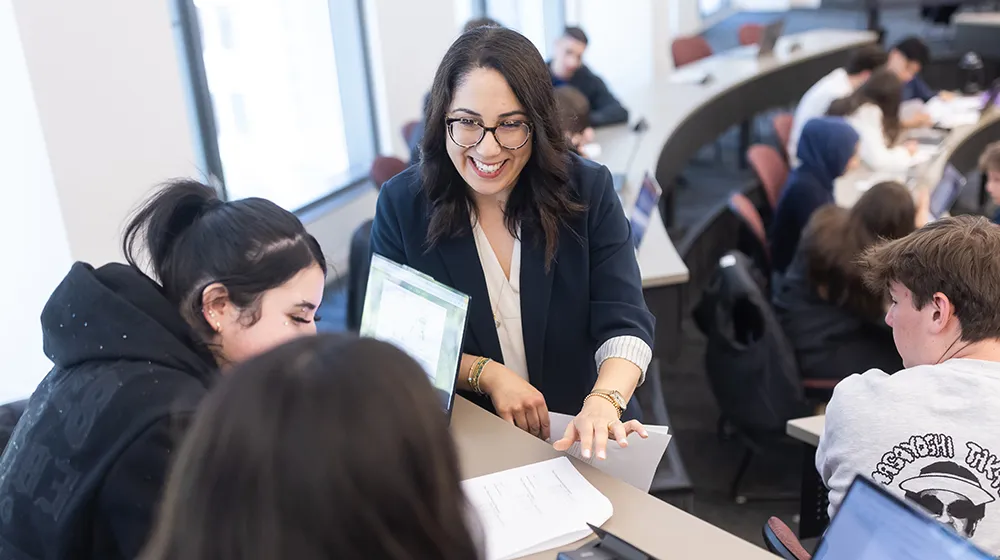


Students in Associate Professor Orgut's class build models to predict and manage supply chains in for-profit and nonprofit organizations.
Alleviating hunger and food waste
Orgut continues her groundbreaking research in humanitarian supply chain operations. She is a co-principal investigator on a project that received $2 million in multi-institutional grant funding from the National Science Foundation to develop an app to address hunger relief in the U.S. The app is called SHARING, which is short for Serving Households in Areas with food Insecurity with a Network for Good. It will help food banks more precisely serve food-insecure individuals and families and reduce waste by combining survey-based data on client preferences with real-world data from partner food assistance organizations.
“We get data, for example, on food preferences such as whether a particular family is vegan or whether they have a refrigerator. Older persons may not cook or have a working kitchen or be physically able to cook food.” Irem Sengul Orgut, Associate Professor
“In addition, students, who can also experience food insecurity, may have different needs if they are athletic and need a higher calorie intake. Some students may enjoy cooking every day and some may not cook at all. By gathering all this data, we can more efficiently and equitably serve food-insecure households.”