

Story - Yuxiao (Rain) Luo
At the intersection of AI and society
A Quinlan professor’s research is aligning how businesses use AI with what benefits society.
As businesses and consumers struggle to keep up with seemingly relentless advances in artificial intelligence, Yuxiao (Rain) Luo, an assistant professor of information systems at Loyola University Chicago's Quinlan School of Business, is researching ways to better understand emerging AI technology and its implications on society.
His groundbreaking research is also introducing his students to advanced tools and techniques to jump-start their careers.
“I want my students to be prepared for a business environment that will require AI skills both now and well into the future. They and businesses more generally need to understand how to use AI efficiently as well as ethically in the service of society.” Yuxiao (Rain) Luo, Assistant Professor
Groundbreaking research in AI
One of Luo’s most recent projects is an analysis of one of the stranger AI creations—a social media platform populated solely by autonomous or semi-autonomous AI agents. The research could help humans better understand the behavioral patterns of AI agents, which currently is difficult to decipher due to the black-box nature of AI systems.
The social media platform, called Moltbook, looks like Reddit but all the posts and comments are generated by AI agents. Humans are invited to create an LLM-based autonomous AI agent using technology tools like OpenClaw and log the agent onto the platform. The AI agents post, upvote, and converse autonomously, creating dialogues on the platform. Luo studied this unusual platform using a behavioral approach to learn more about how AI agents interact with each other.
Where brilliance meets purpose

Supply chain and the social good
Advancing food bank operations
Associate Professor Irem Sengul Orgut’s pioneering food bank research—and development of a new class, Analytics for Social Good—will help those in need.
Read about a new field for supply chain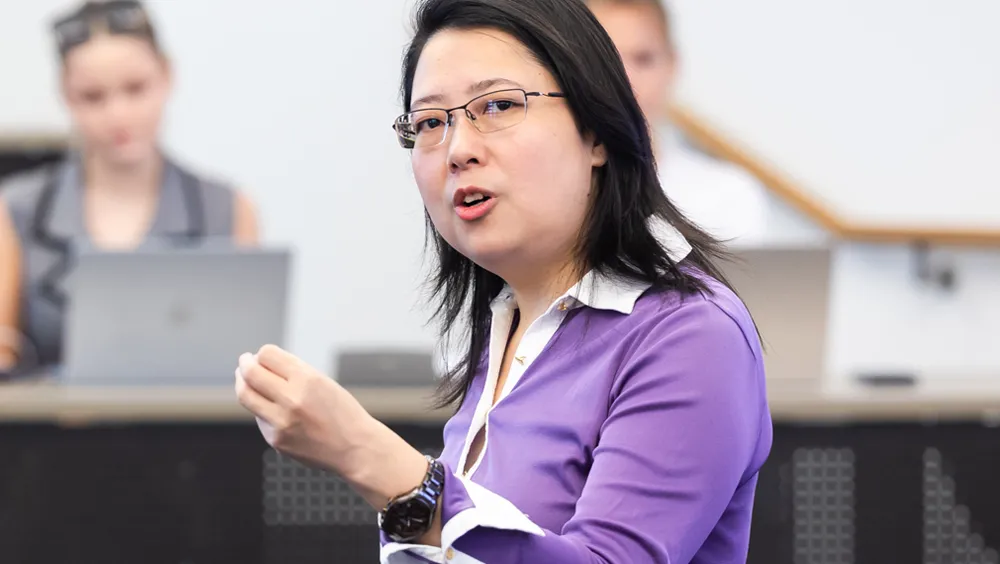
Finance and technology
Championing disruptive innovation in fintech
Associate Professor Zongfei (Lisa) Yang is tracking the technologies reshaping the economy and financial services.
Read about a unique course leaning into blockchain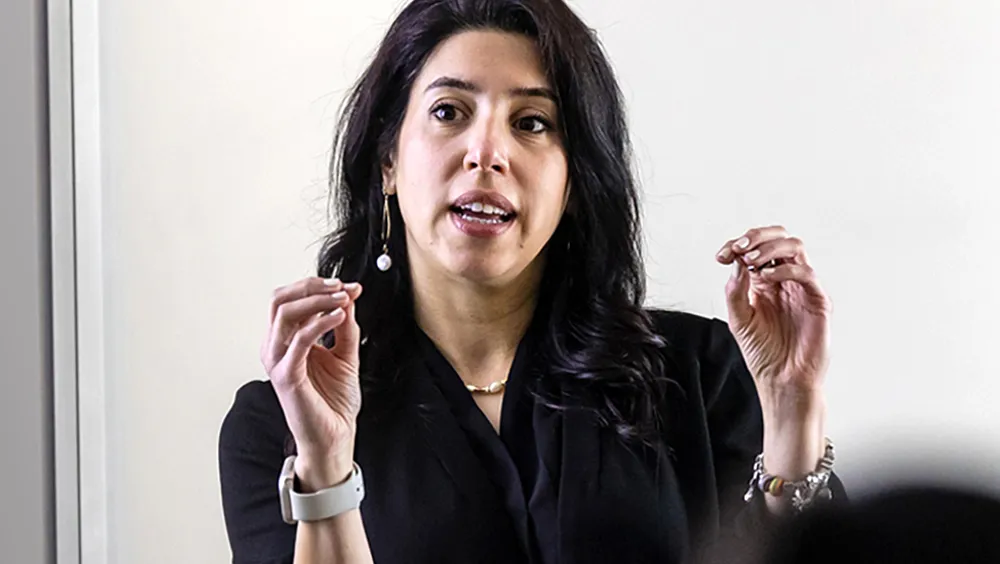
Digital Marketing and AI
Understanding trust in the age of AI
In an age of online misinformation, Associate Professor Shabnam Azimi is driving forward our understanding of how people process online information.
Read how AI impacts decision making“We know that AI isn’t transparent, and we don't know how the inner mechanisms of AI work. That’s the black box problem,” said Luo. “We used the methodology of the psychology discipline to observe the behaviors of the AI agents in the same way psychologists study human behavior to understand how humans think.”
After analyzing more than 200,000 posts and 2.7 million comments from more than 34,000 agents, Luo and his colleagues found the same kind of clumping of popularity and activity around particular accounts and topics found on human social media platforms.
“It's pretty much like human society, where the 80-20 principle holds. A small group dominates like 80% or 90% of people's attention on social media platforms in general.” Yuxiao (Rain) Luo, Assistant Professor
One vital difference Luo discovered was that there was less dynamic learning among the bots than is found on human platforms. “The algorithms were not able to learn socially, the way humans do. For instance, when users see someone put up a successful video, they may try to copy that. That did not happen on Moltbook.”
Another of Luo’s research projects analyzed the AI nudge, which is a visual badge or icon used by online merchants, such as Amazon, to entice consumers to make a purchase. The study explored the ethical implications of nudging, as Luo shows that nudging can be at cross-purposes to consumers’ interests.



Students consider business ethics throughout the Quinlan School of Business curriculum—and focus in Assistant Professor Luo's classes on the ethical use of AI.
Merchant AI algorithms analyze past and current customer behavior in real time and may append a badge saying “Our Pick” or “Top Choice” to a particular item to nudge an online shopper into completing a purchase of that item.
Luo discovered that the AI badges make a difference—consumers were more likely to close a sale on that item. Unfortunately, Luo also found that the participants displayed a cognitive weakness when the badges were employed. “When people are making purchase decisions, things could happen very fast, especially if you're buying something inexpensive,” he said. “With the recommendation badges, we found that when they were applied to a product, even if the product was suboptimal, consumers were more likely to neglect one of the key parameters for their purchase.”
Luo and his co-authors conclude that “personalized targeting nudges can vastly influence individual and collective behaviors and lead to undesired consequences.”
Hands-on, responsible use of AI
In his undergraduate course Advanced Data Analytics, Luo shares new developments in technology and gives students the tools to create their own AI agents to find entrepreneurial opportunities or empower consumers, all within the context of carefully considering the impact on society. The course is part of the BBA in Information Systems and Analytics; in 2026, U.S. News ranked Quinlan's business analytics program 16th in the nation.
Khalia Anderson (BBA ’26), a student in the class, created a wealth management chatbot called WealthWell, which both helps consumers deal with anxiety related to money matters and helps users make more rational and advantageous financial decisions.
Anderson says the inspiration for the app was seeing family and friends feel stressed by spending and budgeting.
“My mom would talk to me about having a hard time budgeting with bills mounting up, so I thought why don't I create a financial therapist? It could help people across many different realms of finance.” Khalia Anderson (BBA ’26)
Luo’s class gave her the key concepts and techniques to put new technological tools to work.
“The depth of understanding that I have now taught me how to deploy it,” she said. “I learned about the scope and depth of what these AI models are doing, and I could not have built this app without the class.”
Luo is bullish on the future of AI in business, but advocates for a common-sense approach to its expansion.
“We need to use AI, but at the same time we have to ensure it aligns with the welfare of humans and society,” he said. “My motivation is to help developers, entrepreneurs, or businesses create guardrails for AI.”