

Story - Shabnam Azimi
Understanding trust in the age of AI
A Quinlan professor is integrating human behavior and marketing in the age of AI.
With the proliferation of misinformation online and in society increasing at an alarming rate, Shabnam Azimi, an associate professor of marketing at Loyola University Chicago’s Quinlan School of Business, is creating foundational data on the dynamics and psychology of how we process online information.
“It’s important to understand why we make the decisions that we do in this information environment,” she said.
Azimi then takes it a step further and explores how to ground the use of AI and new technologies in the human cognition fundamentals that her research is uncovering. This research will help people and businesses better understand the dynamics of a new and at times unpredictable or manipulative information environment.
“In my research, I work to understand the cognitive processes behind our biases and vulnerability. In my classroom, I help students understand how that applies to their work as ethical marketers, including in the context of AI.” Shabnam Azimi, Associate Professor
Exploring trust online
In one recent research project, Azimi examined online reviews to gain insights into how trust operates online, where disinformation can proliferate.
“We asked, how does the content of those reviews affect our buying decision, and ultimately, how do we make judgements based on them?” Azimi said. “One thing we learned, for instance, is that consumers are more vulnerable to negative information.”
When customers read a negative review, they are less likely to think it is fake and more likely to rely on that information in making a decision. This could lead to the purchase of a product or service based on deception.
Azimi has also tested trust issues with AI-generated content. She found that when people read an AI-generated summary of reviews for a product like a vacuum cleaner, they often see it as promotional rather than informative, especially if it focuses mostly on positive features. Interestingly, when the exact same AI-generated summary is presented as written by a human expert, study participants think it is authentic. More balanced AI-generated summaries also tend to feel more trustworthy.
Where brilliance meets purpose

Supply chain and the social good
Advancing food bank operations
Associate Professor Irem Sengul Orgut’s pioneering food bank research—and development of a new class, Analytics for Social Good—will help those in need.
Read about a new field for supply chain
Finance and technology
Championing disruptive innovation in fintech
Associate Professor Zongfei (Lisa) Yang is tracking the technologies reshaping the economy and financial services.
Read about a unique course leaning into blockchain
Analytics and AI
At the intersection of AI and society
Assistant Professor Yuxiao (Rain) Luo is helping create guardrails for AI to benefit society through his research and courses.
Read about where data analytics meets ethics“This is very relevant at the moment,” said Azimi. “On people's go-to platforms, whether a search engine like Google or a shopping site like Amazon, people rely heavily on the AI summary rather than engaging with the actual search results or customer reviews beneath it.”
Her findings have direct implications for how platforms design AI summary features and how much consumers can actually trust what they see at the top of a page.
Combining human behavior and technical literacy
Azimi brings her research right into the classroom. Her students gain an understanding of the foundations of human behavior and online processing, and can adapt and thrive when today’s hot marketing platforms are inevitably supplanted by newcomers.
“For instance, students all use social media, so they think they are experts—and in a way they are. But instead of simply coming up with a new TikTok campaign in class, I want them to think about why they use social media and put themselves in the shoes of their audience,” she said.
“What are their motivations? What are the emotions they have? Why do they pause on a piece of content, and how does that piece of content affect them? And then most importantly, how can you measure your performance on social media? That's the skill many marketers underestimate.”
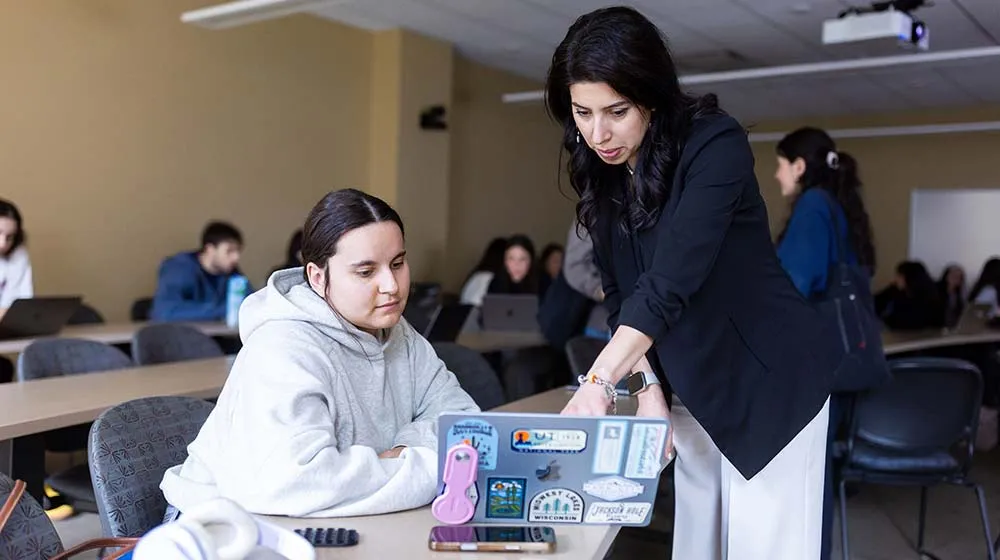
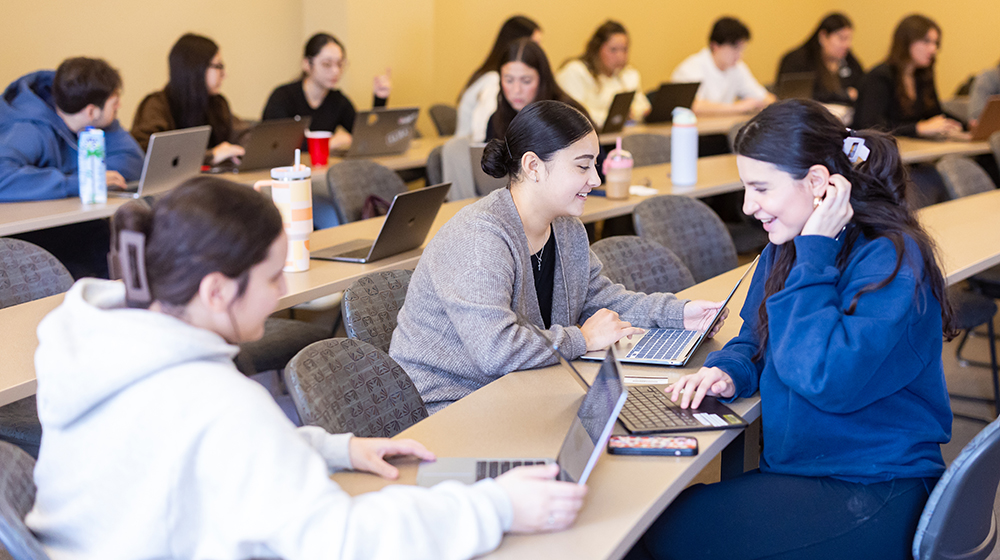

Quinlan professors are integrating the ethical use of AI across the curriculum, including in Associate Professor Azimi's marketing classes.
Azimi also focuses on methods and projects that provide students the technological literacy needed to engage thoughtfully with AI and other emerging technologies.
As part of Azimi’s Digital Marketing class in Quinlan’s undergraduate marketing program—which was ranked No. 22 nationally by U.S. News (2026)—students consult with Chicago small businesses on comprehensive digital marketing plans, from strategy development to campaign optimization. “We make the student experience very hands-on,” she said.
“Marketing is a dynamic field that’s constantly changing, so we have to stay nimble in our teaching.” Shabnam Azimi, Associate Professor
Azimi teaches her students to think strategically before turning to AI by first analyzing the unique needs and goals of each business. Rather than blindly following AI-generated recommendations, students learn to critically evaluate them and use AI as a tool to support a strong marketing strategy.
“We want the students to learn how to analyze the needs of each business, and exercise more granular control to improve results,” she said.
“The hands-on teamwork, brainstorming, and independent thinking that go into solving real-world problems are the training ground for navigating a world where AI is everywhere, but human judgment still matters most.” Shabnam Azimi, Associate Professor
Integrating AI in the curriculum
Azimi’s thoughtful approach to AI in the classroom caught the attention of Quinlan’s dean, Michael Behnam, who asked Azimi to chair a Quinlan task force charged with developing recommendations for AI integration into Quinlan pedagogy and curriculum. Azimi and her colleagues are working to ensure that the school prepares students to capture the vast capabilities of AI in ways that also enhance the well-being of individuals and society. “We're looking at AI at Quinlan holistically, starting at the basic level all the way up to our researchers who are doing the most sophisticated and advanced research,” she said.
That balance, says Azimi, is key. “Our students are graduating with skills that are going to be very helpful for them, with AI training based on strategic thinking,” she said. “The idea is that students stay in control of the technology, and focus on human creativity, judgment, and critical thinking.”