
Dr. Reddon: Indigenous Literature and the joys of a good horror novel.
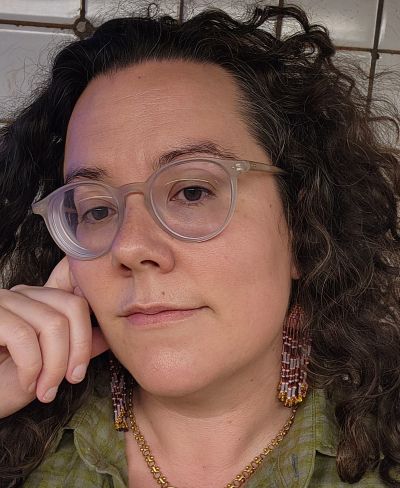
Dr. Madeleine Reddon
This month I sat down with Associate Professor Dr. Madeleine Reddon. As a member of the Métis Nation of Alberta she has channeled her life experiences into the teaching of 20th and 21st century Indigenous literature.
Dr. Reddon didn't start out with the goal of becoming an educator, it was something that seemed to come along naturally. "I was always interested in literature, since I was a kid. I did not have grand schemes to become a professor, I really just pursued graduate work because it brought me pleasure. I became interested in indigenous literature because it's so rich with politics and that allowed me to think differently about my life and my family's experiences."
For Dr. Reddon, the position at Loyola seemed to be an open opportunity to help lay the foundation for students to build a strong liberal education. "[When touring and interviewing for the position] I was thrilled that there seemed to be a community of people who were interested in providing a great liberal education to undergrads. I know, in today's world it seems sort of silly to be idealistic about it, but I really valued that the department was like, 'We're gonna give them a great humanities education.' I thought that was wonderful. I want to be with people who aren’t cynics."
As she has set roots down, Dr. Reddon has come to enjoy the role of educator, much more than she initially believed. "I like the freedom that I have to teach what I want to teach. The fact that I can teach a broad range of subjects and not just my research focus is really wonderful. I think our students are really strong, and they come from really interesting, diverse backgrounds. And they're energetic and interesting. Our students are just a joy to teach really. I feel very lucky to have landed here."
As she works with graduate students, Dr. Reddon has learned that much of her work is helping students engage with and puzzle through heavy texts and then taking that work and creating tools for themselves. "[For grad students] it's about trying to get over the hurdle of feeling intimidated by what is really intimidating work. It's about teaching them ways into that material and to get them excited about doing that because it can be really fun. I think theory is often like a puzzle, and if you realize that, you can have fun solving it as a puzzle."
When working with undergraduates her goal is laying the groundwork that helps build confidence in writing. "I am constantly just trying to get [my undergraduates] to understand that their opinion matters and that they have more skills than they think they do. High school made them feel like that don’t know how to write, but that’s just not true. High school teaches them to write to a form rather than teaching them how to express themselves, and so part of my work is to enable them to express themselves and then give them strategies for trying to fit into the forms that we want them to, like academic forms. I provide a little bit of a safe space so that they can feel okay with developing skills again."
Helping students build strong skillsets and being able to leave her classroom with a toolkit of those skills is a strong focus for Dr. Reddon. That focus has meant pulling all forms of technology from the class. "With AI I'm just not even interested in having the argument. I have chosen to not even try to get my students to buy into it. I've recently gone tech-less in my classroom, and so I'm hoping that [my students] will be convinced of the value by just doing the work in the class with me. I just know that giving them the skills will allow them to thrive in the world. Access to AI is really open right now, but in the future it might not be. Like, subscription models are proliferate. So what happens if you rely on this and suddenly it's monetized and you don't have the skills outside of it. That's a really scary thing. And so why would you pay to get an education with a blank piece of paper to have this future confront you where you basically have no alternatives."
Building curious and strong minds means fostering experimentalism and literary growth. Dr. Reddon tries to open her students' minds by introducing new genres and radical types of literature. "I try to teach them there's a wide variety of genres available and that literature is really exciting because it's messy and weird, and it does weird things. Sometimes they're like, 'Oh, I didn't really know that people did that with art.' I want them to try to think about more experimental things because they don't get much of that in high school. They don't get exposed."
Fostering creativity doesn't start and stop at the literature her students read, Dr. Reddon also seeks alternative art forms for the classroom to help broaden the scope of expression. "Usually I like to bring in art. In my UCLR class last week we looked at surrealist paintings. I wanted my students to think about 'What can we say about these?' And surrealist art is really fun because, there is no answer. It's not like, 'Oh yes, the key to this surrealist painting is that it means this'. It's saying a lot of different things and it's up to your interpretation. I have also taught film before in my Indigenous pop class. I showed some horror films, including Rhymes for Young Ghouls." The movie is a 2013 Canadian independent drama film and the feature-film debut of writer-director Jeff Barnaby. It tells the fictional story of a teenager and her plot for revenge, it is based on the history of abuse of indigenous people by government agents, including a large number of reported cases of the mental and physical abuse of residential school children. It is presented from the perspective of a teenage girl. "It's scary in the first 10 minutes and then after that, it's kind of a slow burn. There's supernatural elements and it's a great movie and it's really fun to talk with my students about."
Dr. Reddon noted that Indigenous literature has a lot of supernatural elements by nature. "I would say that there's a lot of supernatural and horror elements in a lot of Indigenous literature, even the stuff that's more realist. The hard thing about Indigenous literature is that it tries to deal with social problems that are pretty dire. So it can be kind of bleak reading sometimes. It is hard because you have to teach about stereotypes and sometimes the texts are interested in talking about social phenomenon that lend to stereotypes."
Moving forward, Dr. Reddon says her goals are two-pronged. "One, I have colleagues in theology who are trying to start an indigenous studies program. To help build more visibility for our indigenous students. And my second goal is that I'd really like our grad students to be a little bit more self-organizing. I would really love to see them organize talks or go to conferences together. I would just like to see more post-candidacy socializing for the grad students. They tend to just go off into the ether once they're done coursework, and it would be great to, to not have that."
Outside of juggling student skillsets and indigenous visibility, Dr. Reddon is also hard at work on a new book. (She recently co-edited the creative writing anthology, Carving Space: The Indigenous Voices Awards, with Jordan Abel and Carleigh Baker.) "My book is called Enigmatic Inheritances; that's the working title. And it is about, 20th and 21st century experiences of the intergenerational experience of dispossession. [The book is] asking what does it mean to inherit a certain set of political conditions that then becomes defining for your life? I look at four case studies of that experience. I'm tracking a figure in all of those different case studies that I think says something about how colonialism reproduces itself, as a condition."
As a recreational reader, Dr. Reddon's taste runs the gamut. "I will read anything. I'm reading the Stephen Graham Jones trilogy--he has a slasher trilogy--and I'm reading the second book. The first one's called My Heart Is a Chainsaw. The second one is called Don’t Fear the Reaper. The books are his take on the slasher horror movie." As a reader horror has always been a favorite of Dr. Reddon's. "I was obsessed with watching horror movies in high school. It's also been a side interest in my intellectual work. I started writing about it because, I was asked to write a chapter on indigenous horror films, and so I started working on it and I found that besides just loving to read it that, 'Oh, I actually have lots to say about this'."