
'It's about our responsibility as a school'
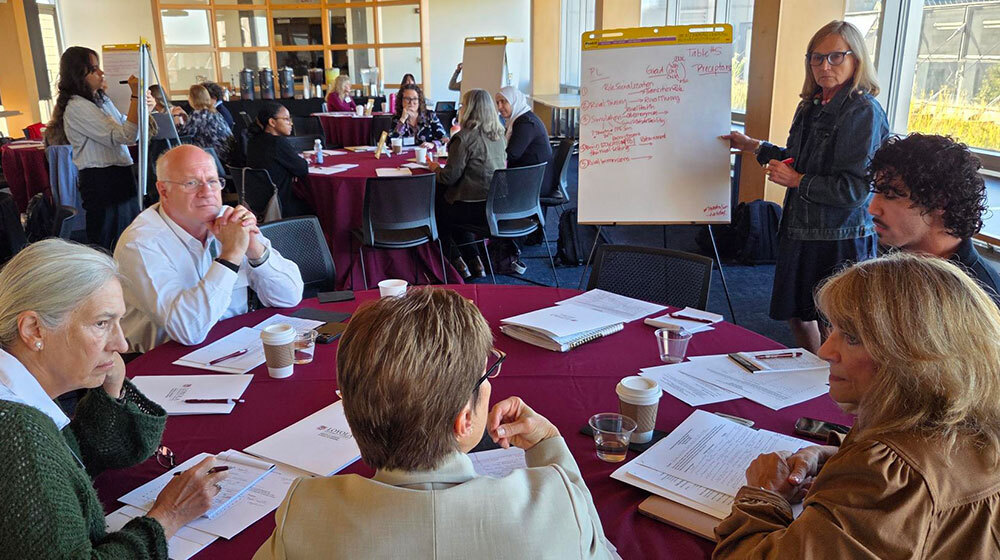
Loyola Nursing faculty discuss topics presented by a visiting speaker at the school's Invitational Conference on Rural Health Care and Nursing.
By Ashley Rowland
Oct. 13, 2026
How does an urban university prepare nurses to work in rural communities, where they might be running clinics on their own and caring for patients miles from the nearest hospital?
The Marcella Niehoff School of Nursing took a significant step forward this month in building its new rural education program, hosting a conference that brought national experts to campus as faculty begin developing rural health-focused curricula for undergraduate and graduate students.
Several dozen Loyola Nursing faculty, students, and clinical partners from across the Midwest attended the invitational conference, held Oct. 5 and 6 at Loyola's Lake Shore Campus. Among them were undergraduates in the school's first cohort of the Rural Health Care Nursing Scholars program, which provides specialized training in rural acute and long-term care.
The conference is one of the first tangible outputs of the school's rural health initiative, launched with a $3.8 million Health Resources and Services Administration (HRSA) grant the school received last year to prepare more students to work in rural areas.
"The HRSA grant has allowed us to take what began with those experiences and ask a much bigger question: How do we intentionally prepare nurses who understand rural health?" Dean Lorna Finnegan said. "And perhaps equally important: How do we help students see rural nursing as a place where they could build a career and make a difference?"
Preparing students to practice in underserved rural environments "is very much in keeping with who we are at Loyola, with our commitment to service, social justice, and improving health care for communities that have too often experienced barriers to care," she added. "It's about our responsibility as a school of nursing to prepare nurses to care for people, wherever they are living."
Professor P. Ann Solari-Twadell, conference organizer and HRSA grant lead, said the conference builds on Loyola Nursing's longstanding immersion program in South Dakota and Nebraska, where students learn about rural health care firsthand at a critical access hospital and the Pine Ridge Indian Reservation.
The spring break experience exposes students to new career possibilities at a time when demand for nurses in hard-to-fill rural practices is growing.
"Rural health is its own specialty," she said. “If nursing schools aren’t including content about rural health or clinical experiences in rural areas, how are students even going to consider this as an area of practice?”
The HRSA grant provides funding for Loyola Nursing to pilot-test its rural nursing education program, which faculty envision being replicated nationwide. As part of the grant, the school is expanding its clinical partnerships to more sites in rural Illinois, Michigan, Wisconsin, Indiana, and South Dakota.
Associate Professor Nicole Rouhana, director of graduate programs at Decker College of Nursing and Health Sciences and a certified nurse midwife, spoke on the unique challenges nurses encounter in geographically isolated environments.
She recounted her own experience delivering a breech baby in a rural area without the help of a specialist. It was an example, she said, of how rural health nurses may have to direct care in high-pressure situations, far from larger, well-equipped health care facilities and support from other health care professionals.
By providing specialized education in rural health, she said, nursing schools can help students develop the knowledge base and self-assurance they need to work in remote positions.
"As nursing educators, it's important to give them the competencies and overall confidence to be rural health care providers," Rouhana said.
Other presenters at the Invitational Conference on Rural Health Care and Nursing, and their topics, were:
- Carolyn Kerns, independent scholar from Sinking Spring, Pennsylvania, “Issues in Acute and Long-term Care in Rural Health”
- Carolyn Rutledge, founding member of the Center for Telehealth Innovation, Education, and Research (C-TIER) and executive director of faculty practice and clinical scholarship at the Ellmer School of Nursing, Old Dominion University, “Electronic-assisted Care/Telehealth”
- Professor Carolyn Turvy, vice president of psychiatry research at the Carver College of Medicine, University of Iowa, “Trauma-informed Care: Violence, Substance Use and Abuse”
- Associate Professor Ellie Schildwachter McConnell, Duke University School of Nursing, “Aging Population, Palliative Care, and Long-term Care”
- Jacquelyn Alvarado, Maternal Fetal Focus program director at the Texas A&M Rural and Community Health Institute, “Mother, Baby, and Pediatric Issues in Rural Health”