
Community - Shared spaces
Shared spaces, shared success
In the ignatian tradition, Loyola’s School of Education prioritizes community engagement. By connecting with schools, primary-care learning centers, community organizations, cultural institutions, and other neighbors, School of Education faculty, staff, and students gain a richer understanding of the world around them—the realities of local environments, the lives of youth, and quality-of-life barriers.
Such community engagement fuels empathy. It enables Loyola students, staff, and faculty to identify needs. It spawns innovative solutions to improve access and advance learning. It stirs collaboration, inviting Loyola and its neighbors to be colearners and coteachers in shared spaces. And it spurs a genuine commitment to service and uplifting communities.
Through community engagement, the School of Education becomes a catalyst for change, unlocking knowledge, fostering optimism, and driving results.
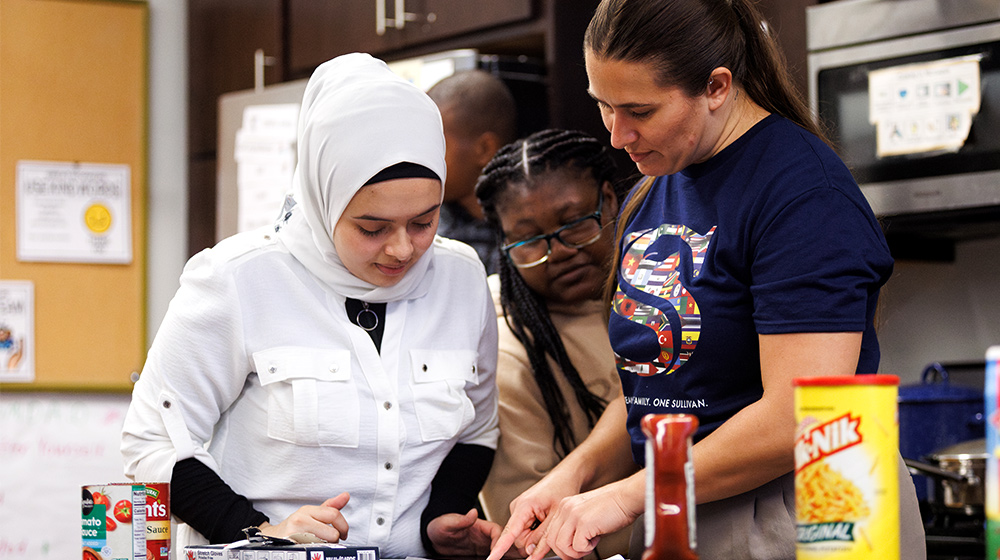
Living Loyola’s mission at Sullivan High School
Inspired by Loyola University Chicago’s social justice mission—to seek God in all things and expand knowledge in the service of humanity through learning, justice, and faith—Loyola’s School of Education has worked to become an active ally of Sullivan High, one of Chicago’s most diverse public high schools.
Over the last decade, the School of Education has spearheaded numerous efforts to positively impact students at the 600-student high school in Rogers
Park. By closing gaps in the public education system with its community-minded, social justice–oriented ethos, Loyola supports the growth of Sullivan students and delivers added resources to an in-need community.
For example, School of Education clinical faculty member Ambareen Nasir worked with Sullivan staff to revamp the school’s English language curriculum. Nasir steered the infusion of social-emotional supports into the curriculum to better serve the high number of students arriving at Sullivan from various global backgrounds.
"At the School of Education, we have people with expertise in issues relevant to public education, a motivated group of socially conscious university students, and resources and partners we can call upon to strengthen the community.” Mitch Hendrickson, Director of School and Community Partnerships, School of Education
Each semester, meanwhile, about a half dozen School of Education students provide academic support to Sullivan students across the content spectrum, from math to science to writing. Leveraging partnerships with campus partners, the School of Education also regularly facilitates the placement of interns at Sullivan from Loyola’s School of Social Work—as many as six interns each semester—as well as students from the Marcella Neihoff School of Nursing, the Quinlan School of Business, and the School of Communication who provide additional services and programming.
In 2018, School of Education leadership successfully secured funds to install a full-time resource coordinator at Sullivan. From academic tutoring to a summer Chicago discovery project to clubs covering the fine arts, cooking, and sports, the Loyola-employed staff member leads programming for about 200 Sullivan students each year. The work of community resource coordinators has helped sustain after-school spaces for Sullivan students to pursue their academic goals, explore hobbies, practice social-emotional skills, and develop friendships.
Shared spaces, shared success
In the ignatian tradition, Loyola’s School of Education prioritizes community engagement. By connecting with schools, primary-care learning centers, community organizations, cultural institutions, and other neighbors, School of Education faculty, staff, and students gain a richer understanding of the world around them—the realities of local environments, the lives of youth, and quality-of-life barriers.
Such community engagement fuels empathy. It enables Loyola students, staff, and faculty to identify needs. It spawns innovative solutions to improve access and advance learning. It stirs collaboration, inviting Loyola and its neighbors to be colearners and coteachers in shared spaces. And it spurs a genuine commitment to service and uplifting communities.
Through community engagement, the School of Education becomes a catalyst for change, unlocking knowledge, fostering optimism, and driving results.
Living Loyola’s mission at Sullivan High School
Inspired by Loyola University Chicago’s social justice mission—to seek God in all things and expand knowledge in the service of humanity through learning, justice, and faith—Loyola’s School of Education has worked to become an active ally of Sullivan High, one of Chicago’s most diverse public high schools.
Over the last decade, the School of Education has spearheaded numerous efforts to positively impact students at the 600-student high school in Rogers
Park. By closing gaps in the public education system with its community-minded, social justice–oriented ethos, Loyola supports the growth of Sullivan students and delivers added resources to an in-need community.
For example, School of Education clinical faculty member Ambareen Nasir worked with Sullivan staff to revamp the school’s English language curriculum. Nasir steered the infusion of social-emotional supports into the curriculum to better serve the high number of students arriving at Sullivan from various global backgrounds.
Each semester, meanwhile, about a half dozen School of Education students provide academic support to Sullivan students across the content spectrum, from math to science to writing. Leveraging partnerships with campus partners, the School of Education also regularly facilitates the placement of interns at Sullivan from Loyola’s School of Social Work—as many as six interns each semester—as well as students from the Marcella Neihoff School of Nursing, the Quinlan School of Business, and the School of Communication who provide additional services and programming.
In 2018, School of Education leadership successfully secured funds to install a full-time resource coordinator at Sullivan. From academic tutoring to a summer Chicago discovery project to clubs covering the fine arts, cooking, and sports, the Loyola-employed staff member leads programming for about 200 Sullivan students each year. The work of community resource coordinators has helped sustain after-school spaces for Sullivan students to pursue their academic goals, explore hobbies, practice social-emotional skills, and develop friendships.