
Cutrofello Book
Cutrofello: Where Philosophy Meets Poetry
New Book Published by Northwestern University Press
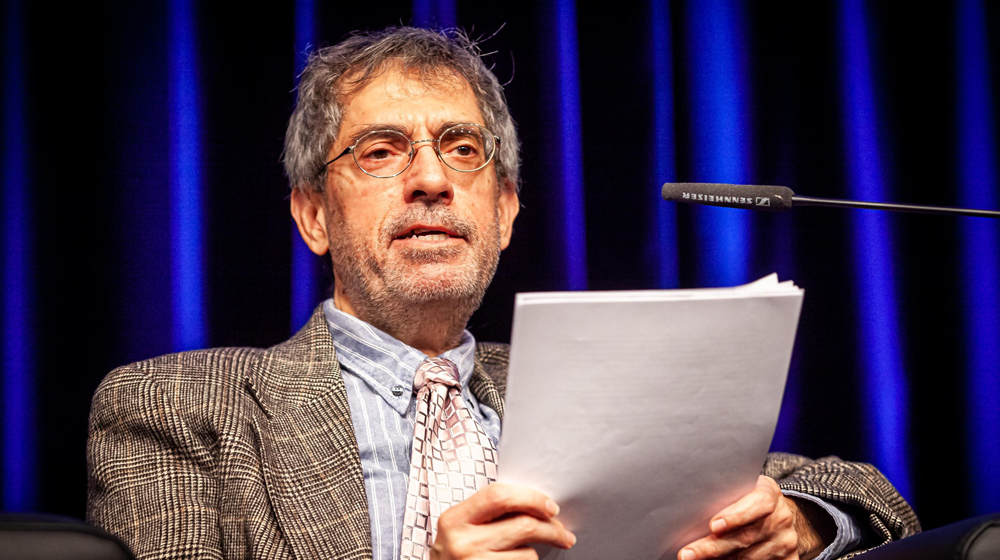
Andrew Cutrofello, PhD, professor of philosophy in Loyola University Chicago’s College of Arts and Sciences, is the author of The One and the Others: Metaphysics, Poetry, and the Antinomies of Plato’s “Parmenides,” published by Northwestern University Press.
Alfred North Whitehead famously said that the history of Western philosophy is a series of footnotes to Plato. In The One and the Others, Cutrofello is more specific. According to him, the history of Western metaphysics is a series of footnotes to Plato’s Parmenides. In support of this thesis, he presents strikingly original interpretations of the philosophies of Kant and Hegel. On his reading, Kant’s Copernican hypothesis extends the dialectical exercise of Plato’s dialogue, while Hegel’s dialectical refutation of Kant completes it.
Besides Kant and Hegel, Cutrofello discusses the analytic philosopher Graham Priest and the continental philosopher Alain Badiou. In each chapter, he pairs the philosopher in question with a poet: Priest and Dante, Badiou and Susan Howe, Kant and William Blake, Hegel and William Wordsworth.
Cutrofello, whose previous books include All for Nothing, a monograph that explains why philosophers identify with Hamlet, is most proud of his demonstration that Shakespeare’s Troilus and Cressida mimics Plato’s labyrinthine dialogue. He hopes that The One and the Others will be read by philosophers and literary critics alike. As he said in an interview, “I love metaphysics and I love poetry. Although my book is not a work of auto-nonfiction, it reaches out to readers with similar passions.”
“Dr. Cutrofello’s scholarship shows how philosophical questions can continue to shape how we understand the world today,” said Peter J. Schraeder, PhD, Dean of the College of Arts and Sciences. “By intersecting philosophy and poetry into dialogue, this book invites readers to engage deeply with ideas that have challenged thinkers for centuries and still resonate in everyday ways of thinking.”
The book has earned praise from scholars.
“The One and the Others is an impressive, lively retelling of the history of Western philosophy as a series of attempts to resolve the paradoxes identified in Plato’s Parmenides,” said Mark Alznauer, an associate professor of philosophy at Northwestern University. “Cutrofello provides a sympathetic and original examination of an extraordinary range of figures, both philosophical and literary, connecting each figure with one of the hypotheses Parmenides explores with the young Socrates in that dialogue. This book leaves us with an exciting, if dizzying picture of the history of metaphysics as a never-ending oscillation between a fixed number of intrinsically unstable positions.”
Cutrofello has taught at Loyola since 1994. His research and teaching focus on three interconnected areas: the nature and significance of Kant’s critical philosophy, the origins and implications of the analytic–continental divide, and the relationship between philosophy and poetry.
Learn more about Cutrofello and his book.
About the College of Arts and Sciences
Founded in 1870, the College of Arts and Sciences is the oldest and largest of Loyola University Chicago’s 13 schools and colleges, serving as the academic home for nearly 8,000 students (roughly 50 percent of Loyola’s total student population). It is academically diverse with twenty academic departments that span an array of intellectual pursuits, ranging from the natural sciences and computational sciences to the humanities, the social sciences, and the fine and performing arts. It is also highly interdisciplinary with thirty-one interdisciplinary programs and seven interdisciplinary centers, including the mission-centric Jesuit Heritage Research Center and the Hank Center for the Catholic Intellectual Heritage. The College is home to over 450 full-time, award-winning faculty, who are committed to teaching and research excellence. They teach nearly 2,000 classes each semester, including 88 percent of all Core Curriculum classes taken by undergraduate students across the university. They also contribute to eleven doctoral programs whose graduates have helped propel Loyola starting in 2025 to R-1 research status (the highest research status a university can achieve). Our students and faculty are engaged internationally at Loyola Rome in Italy, as well as at dozens of university-sponsored study abroad and research sites around the world. Home to the departments that anchor the university’s Core Curriculum, the College seeks to prepare all of Loyola’s students to think critically, to engage the world of the 21st century at ever-deepening levels, and to become caring and compassionate individuals. Our faculty, staff, and students view service to others not just as one option among many, but as a constitutive dimension of their very being. In the truest sense of the Jesuit ideal, our graduates strive to be “individuals for others.”