
Putonti NIH
NIH Grant Expands Undergraduate Research Opportunities at Loyola
Putonti's LUAD Program is Training the Next Generation of Scientists
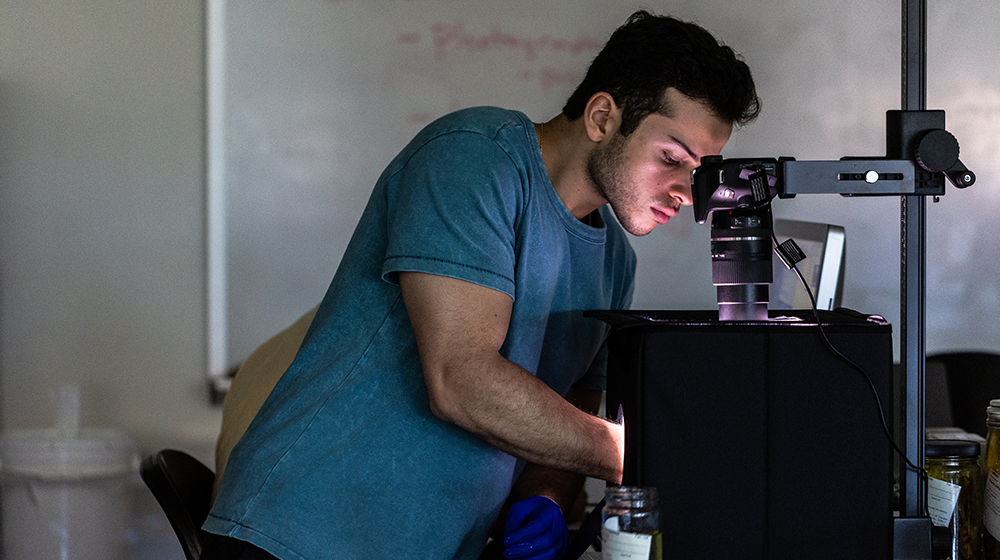
Catherine Putonti, PhD, bioinformatics professor and Associate Dean of Interdisciplinary Initiatives & Academic Innovation in Loyola University Chicago’s College of Arts and Sciences, has received a five-year renewal of a National Institutes of Health (NIH) undergraduate training grant that supports student research at the intersection of urology and bioinformatics.
The $540,000 award funds the continuation and expansion of Loyola Adventures in Urobiome Data (LAUD), an undergraduate training program that provides hands-on research in emerging areas of biomedical science. The original grant was awarded in 2021.
The program brings together faculty and researchers from across Loyola, including collaborators in the Stritch School of Medicine, as part of the Loyola Urinary Education and Research Collaborative (LUEREC). This interdisciplinary partnership connects expertise in urology, microbiology, and computational science to better understand human health and disease.
“Dr. Putonti’s leadership of this NIH-funded program reflects the strength of interdisciplinary research and teaching that take place each and every day in the College by our dedicated faculty,” said Peter J. Schraeder, PhD, Dean of the College of Arts and Sciences. “By bringing together these disciplines, this program provides students with meaningful, hands-on research experiences that prepare them to address complex challenges in human health.”
“This program introduces students to research with real impact,” said Putonti. “Many of our participants go on to present nationally and publish their work. By addressing urinary health, a topic that touches nearly everyone, students are driven by both purpose and relevance.”
The LAUD program focuses on emerging research in urologic health, including the growing understanding of the urinary microbiome and its role in human health. Through the program, undergraduate students apply data science tools to real research questions, working alongside faculty and clinical collaborators.
The program is open to Loyola and non-Loyola undergraduate students, where the cohort works in small teams, collaborating with faculty mentors and clinical researchers to design and carry out hypothesis-driven projects over an eight-month period. Along the way, students develop skills in data analysis, scientific communication, and interdisciplinary research.
With the renewal, Putonti weaved in a way for the program to create opportunities for students in the College of Arts and Sciences’ Center for Data Science and Consulting to serve as paid consultants, supporting research teams and gaining valuable applied experience.
Through hands-on training and mentorship, LAUD prepares students for future careers in medicine, research, and data science. Participants gain experience presenting their work through written reports, oral presentations, and research posters, which helps build a strong foundation for graduate or professional study.
Putonti and her collaborators are passionate about education and mentorship. They designed the program to be accessible to students nationwide, expanding opportunities in bioinformatics and health informatics and helping to advance biomedical research and patient care.
Learn more about Putonti the LAUD program.
About the College of Arts and Sciences
Founded in 1870, the College of Arts and Sciences is the oldest and largest of Loyola University Chicago’s 13 schools and colleges, serving as the academic home for nearly 8,000 students (roughly 50 percent of Loyola’s total student population). It is academically diverse with twenty academic departments that span an array of intellectual pursuits, ranging from the natural sciences and computational sciences to the humanities, the social sciences, and the fine and performing arts. It is also highly interdisciplinary with thirty-one interdisciplinary programs and seven interdisciplinary centers, including the mission-centric Jesuit Heritage Research Center and the Hank Center for the Catholic Intellectual Heritage. The College is home to over 450 full-time, award-winning faculty, who are committed to teaching and research excellence. They teach nearly 2,000 classes each semester, including 88 percent of all Core Curriculum classes taken by undergraduate students across the university. They also contribute to eleven doctoral programs whose graduates have helped propel Loyola starting in 2025 to R-1 research status (the highest research status a university can achieve). Our students and faculty are engaged internationally at Loyola Rome in Italy, as well as at dozens of university-sponsored study abroad and research sites around the world. Home to the departments that anchor the university’s Core Curriculum, the College seeks to prepare all of Loyola’s students to think critically, to engage the world of the 21st century at ever-deepening levels, and to become caring and compassionate individuals. Our faculty, staff, and students view service to others not just as one option among many, but as a constitutive dimension of their very being. In the truest sense of the Jesuit ideal, our graduates strive to be “individuals for others.”