
Mission Integration
Loyola University Chicago's commitment to sustainability is deeply rooted in our Catholic, Jesuit identity and our responsibility to care for people and the planet. Guided by the principles of social justice and Ignatian spirituality, Loyola approaches sustainability as both an environmental responsibility and a moral commitment.
Pope Francis' 2015 encyclical, Laudato Si': On Care for Our Common Home, reinforces this commitment by calling for an integrated response to environmental degradation, climate change, and social inequality. Its vision of integral ecology, which recognizes the interconnectedness of environmental, social, economic, and spiritual well-being, helps guide Loyola's sustainability efforts across academics, operations, and campus life.
Laudato Si' at Loyola
In 2021, Loyola joined the Laudato Si’ 7 Year Challenge, committing to advance ecological sustainability through education, research, community engagement, and institutional action.
This commitment brings together students, faculty, staff, and community partners to address the interconnected environmental and social challenges facing our world. Guided by Laudato Si' and Pope Francis' subsequent apostolic exhortation, Laudate Deum, Loyola continues to integrate care for our common home into its mission and daily operations.
Loyola's efforts are informed by the seven Laudato Si' goals:
- Response to the Cry of the Earth
- Response to the Cry of the Poor
- Ecological Economics
- Adoption of Sustainable Lifestyles
- Ecological Education
- Ecological Spirituality
- Community Resilience and Empowerment
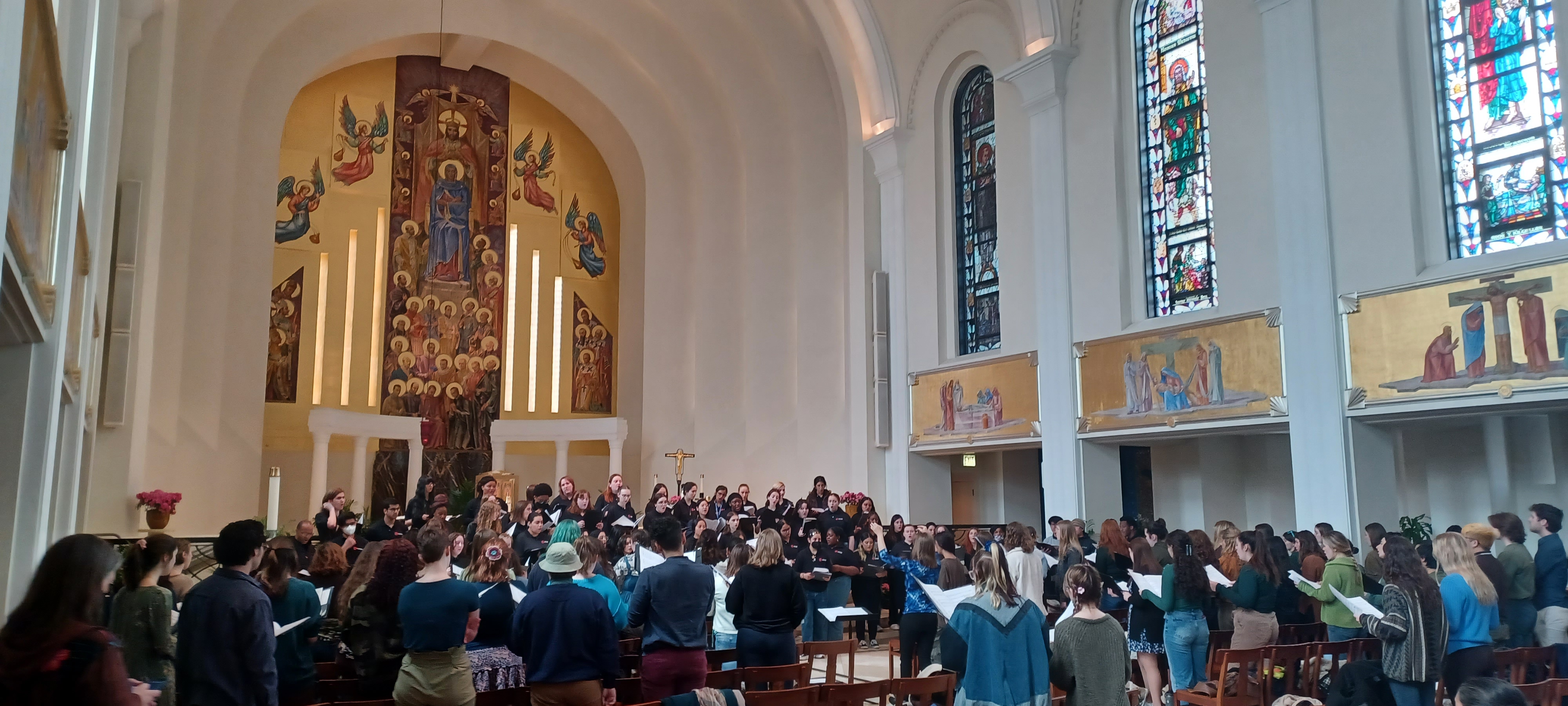
Mission-Driven Sustainability Across Loyola
Advancing sustainability as an expression of Loyola's mission requires collaboration across the University. Academic departments, mission-centered programs, and campus partners work together to connect environmental stewardship with education, spirituality, and social justice.
Mission Integration
Loyola’s commitment to mission is led by the Division of Mission Integration and its units, including Ignatian Spirituality, Community Service and Action, and Campus Ministries (Lakeside and Health Sciences). Mission Integration supports Pope Francis’ concept of “Integral Ecology” and emphasizes the University’s enduring value to “Care for Our World.” Mission Integration works to develop the whole University’s self-understanding in sustainability through student, faculty and staff development programs, such as Loyola 201: Partners in Mission, New Student Orientation, the All Things Ignatian Staff Seminar, and Ignatian Heritage Month. Mission Integration also hosts its own initiatives related to Integral Ecology, such All Things Ignatian Staff Seminar, the Thea Institute, and the LEAF retreat.
Jesuit Community
Loyola is home to one of the largest Jesuit communities in North America and an important point during Jesuit formation for many young men as one of the three “First Studies” programs for the Jesuit Conference of Canada and the United States. Our Jesuit community is not just a resource to our staff, faculty and students but leaders in advancing a more sustainable Loyola. They serve as faculty, chaplains, and academics advancing our understanding of an Integral Ecology and our own ecospirituality. The community owns and resides at multiple buildings at Loyola’s Lake Shore Campus and has undertaken its own carbon footprint audit and climate action planning process leading to energy efficiency upgrades and the purchase of electric vehicles for the community’s shared use.
The Hank Center for Catholic Intellectual Heritage
The Joan and Bill Hank Center for Catholic Intellectual Heritage is a venue for faculty, students, and staff to learn about, and investigate Roman Catholic thought and its links to all academic disciplines. The Hank Center has been a leader on-campus in facilitating dialogue on the Catholic connections to sustainability topics and they hosted the Caring for Our Common Home event where Loyola announced its Climate Action Plan in 2015. Recent efforts include the collaboration with Creighton University and the Catholic Climate Covenant for the Common Home Corps, collaborations with Department of Fine and Performing Arts, and their support for faculty scholarship around Laudato Si’.
School of Environmental Sustainability
Loyola’s School of Environmental Sustainability has led mission-driven sustainability at Loyola for over 15 years. The School of Environmental Sustainability is an interdisciplinary School with faculty from the sciences, social sciences, humanities, business, economics, health, policy and law. The work to deepen the School’s work on Integral Ecology extends particularly to collaborations with the humanities, theology, and pastoral studies as well as the schools of business, communications, law and public health. Some recent examples of addressing Pope Francis’s Laudato Si’ call for action include hiring Jesuit faculty and developing an ecospirituality course, designing and teaching the THEA Institute in collaboration with Campus Ministry, implementing the Common Home Corps in collaboration with the Hank Center, hosting the annual Climate Change Conference, joint faculty hire with Theology, an Integral Ecology course for Jesuit First Studies men, hosting a teaching workshop for a new Jesuit University in Burkina Faso, Africa and hosting Integral Ecology programs such as the Jesuit Magis Program for Global Citizenship, Healing Earth and the International Jesuit Ecology Project.
Faculty Center for Ignatian Pedagogy
The Faculty Center for Ignatian Pedagogy provides Loyola educators with the opportunity to engage in the continual development of their perspectives, skills, and strategies in the service of Magis (or excellence) in teaching and learning and Cura Personalis (or care for the whole person). As an aspect of developing an anti-oppressive pedagogy for faculty, FCIP is supporting the creation of an Environmental Justice pedagogy that explores teaching methodologies addressing the inequitable impacts of the ecological and climate crises.
Additional Campus Partners
Mission-driven sustainability is also supported through collaborations with the Baumhart Center for Social Enterprise and Responsibility, Loyola Rome, the Parkinson School's Center for Health Innovation and Entrepreneurship, the Institute of Pastoral Studies, the Center for Engaged Learning, Teaching, and Scholarship, and the Neiswanger Institute for Bioethics.
Sustainability Leadership & Engagement
Loyola provides opportunities for students, faculty, and staff to connect sustainability with service, leadership, and the University's Jesuit mission.
Spirit of Laudato Si' Student Sustainability Leadership Awards
Each year, Loyola recognizes undergraduate and graduate students who demonstrate outstanding sustainability leadership through service and learning. Presented through collaboration among the University Sustainability Committee, Office of Sustainability, and Division of Student Development, these awards celebrate students putting Loyola's mission into action.
AJCU Sustainability Network
As a member of the Association of Jesuit Colleges and Universities (AJCU), Loyola participates in a network of institutions working to advance sustainability through Jesuit higher education.
Faculty and staff collaborate with peers across the network to share resources, exchange ideas, and strengthen mission-driven sustainability initiatives.
Explore Additional Resources
Learn more about the connections between Catholic teaching, Ignatian spirituality, environmental justice, and sustainability through the following resources.
Catholic and Jesuit Perspectives
Education, Research & Engagement
- THEA Institute
- International Jesuit Ecology Project
- Ignatian Pedagogy for Sustainability: An Overview
- 7 Years After "Laudato Si'": How Catholic Universities Are Amplifying Pope Francis' Call to Heal Our Common Home
- AJCU Eco-Social Engagement Inventory
- Association of Jesuit Colleges and Universities – Facilities, Public Safety & Sustainability Network
- Common Home Corps – Catholic Climate Covenant