
Immigration and Human Rights Clinic
About Us
The Immigration and Human Rights Clinic (IHRC) represents and advocates for the rights of children, youth, and families who are confronting the U.S. immigration system in their pursuit of safety, stability, and family unity. IHRC faculty and students work on a variety of immigration matters, collaborating with community-based organizations to respond to the rapidly shifting immigration landscape and defending clients before the immigration courts and the various immigration agencies within the executive. To facilitate systemic and normative change, the IHRC faculty and students also appeal to international human rights mechanisms on issues of migration and migrants’ rights.
The IHRC is situated within the Holistic Immigration Hub (HIH). Through the HIH, students enrolled in IHRC courses and the Immigration Law Lab, as well as those contributing to the Immigration Innovation Incubator, learn and work collaboratively with faculty and students from Loyola University Chicago graduate school partners, including the Stritch School of Medicine (Stritch), the Parkinson School of Health Sciences & Public Health (Parkinson), and the Schools of Education (SOE) and Social Work (SOSW). By cross-training and fostering partnerships between immigration attorneys, social workers, educators, and health practitioners, the IHRC engages a novel, interdisciplinary approach to serving our immigrant neighbors that addresses the complexity and breadth of their needs. This approach enables the IHRC to provide truly holistic legal services to our clients, in addition to shaping and informing broader advocacy efforts that center the dignity and humanity of all migrants.
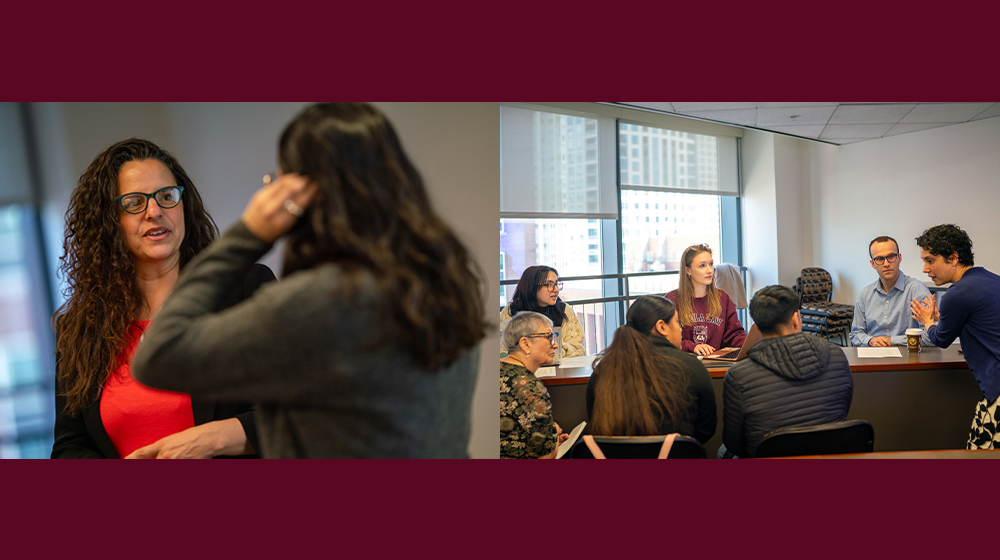
The IHRC offers clinical learning opportunities that involve direct representation of immigrant clients using innovative and trauma-informed legal services models. Students enrolled in IHRC courses learn critical lawyering skills and gain invaluable hands-on experience representing immigrant clients and working alongside experienced practitioners, while also contributing to the IHRC’s work to advance the fundamental rights of all immigrant children, youth, and families here in the United States. Through a combination of seminar classes, reflective case supervision, and interdisciplinary collaboration, the IHRC is developing the next generation of immigration advocates.
Course Descriptions
Immigration & Human Rights Clinic
In the course of their representational work, students enrolled in the Immigration & Human Rights Clinic course conduct intakes and screenings to assess avenues for legal status and relief from deportation, research relevant legal issues and counsel clients on options and decisions involved in their immigration cases, and engage in written and oral advocacy before administrative agencies and/or courts and with government and other stakeholders. Students also collaborate with HIH partners, including the School of Social Work and Stritch School of Medicine, to develop creative, interdisciplinary strategies, evidence, and legal arguments for their clients’ cases. Students also advance the rights of migrants using international law strategies and mechanisms.
Students enrolled in the IHRC course work together on teams to represent their clients. As a student representative, you will work on at least one direct services case throughout the course of the semester, under the supervision of one or more members of the IHRC faculty. You will also work on at least one international human rights law project that could involve documenting and analyzing human rights violations and/or legal research and writing for IHRC submissions to international human rights mechanisms or other adjudicative bodies.
The clinical course includes a weekly seminar during which IHRC faculty and guest lecturers who are experts in their fields will cover U.S. immigration law, international human rights law, and critical, trauma-informed lawyering skills, among other relevant practice areas. Specific practice areas within immigration and human rights law vary by semester given the volatility of U.S. immigration law and depending on the needs presented by IHRC clients and partners. The IHRC course offering is currently available for students in their 2L, 3L, or 4L years and is worth 4 LCE course credits.
This course requires students to apply and obtain IHRC faculty permission prior to enrolling. Enrollment in the IHRC course is limited to 16 students per semester.
Participation in the Clinic requires both a significant time commitment and flexibility in your schedule. All students are expected to attend seminars, weekly team meetings, and client meetings throughout the semester and to address any other client business during regular work hours. Students working full-time, or students who have concerns about their ability to maintain a flexible schedule, should speak with one of the members of the IHRC faculty before applying/enrolling in the class. Additionally, to avoid conflicts of interest, students may not participate in the Clinic while working for federal immigration agencies.
Advanced Immigration & Human Rights Clinic
The Advanced Immigration & Human Rights Clinic course is a progression from the core IHRC course described directly above. Students who have completed the IHRC course are eligible to apply for enrollment in the advanced IHRC course. Student representatives in the advanced clinic focus on provision of direct legal services to IHRC clients utilizing the interdisciplinary models and applying the trauma-informed legal skills they learned during their first semester in the IHRC.
As a student representative in the advanced IHRC course, you will continue direct service and human rights work conducted the previous semester. The advanced clinical course also includes weekly or biweekly guided case rounds and weekly or biweekly case supervision meetings with IHRC faculty. Specific practice areas within immigration and human rights law vary by semester given the volatility of U.S. immigration law and depending on the needs presented by IHRC clients and partners. The advanced IHRC course offering is currently available to students who will have completed a semester in the IHRC course before the advanced course begins, meaning students in their second semester of 2L year, and those in their 3L or 4L years, are eligible. The advanced IHRC course is worth 4 LCE course credits.
This course requires students to apply and obtain IHRC faculty permission prior to enrolling. Enrollment in the advanced IHRC course is limited to 8 students per semester.
Participation in the Clinic requires both a significant time commitment and flexibility in your schedule. All students are expected to attend seminars, weekly team meetings, and client meetings throughout the semester and to address any other client business during regular work hours. Students working full-time, or students who have concerns about their ability to maintain a flexible schedule, should speak with one of the members of the IHRC faculty before applying/enrolling in the class. Additionally, to avoid conflicts of interest, students may not participate in the Clinic while working for federal immigration agencies.
Immigration Law Lab
The Immigration Law Lab is a unique opportunity for students to learn immigration law, policy, and practice while supporting the emergent, short-term needs of the Chicago immigrant community and beyond. As a student in the Immigration Law Lab course, you will participate in critical volunteer roles with immigrant-serving organizations to support their work. Examples of volunteer roles include in-person and virtual options, such as assisting during workshops to prepare a variety of immigration benefit applications (asylum, adjustment of status, temporary protected status, and naturalization) and country conditions research to support such applications. The Lab offers law student volunteer programming in connection with a weekly seminar component during which you will learn the context and skills you need to prepare for your volunteer role.
Students in the Law Lab will receive 2 course credits, in addition to accumulating volunteer hours. Specific practice areas within immigration law vary by semester given the volatility of U.S. immigration law and depending on the needs presented by organizational partners. The Immigration Law Lab course offering is currently available for students in their 1L, 2L, 3L, or 4L years.
The Immigration Law Lab is open to Loyola law students as well as students from HIH partner graduate schools and will soon be available to students from other local law schools. Enrollment in the Immigration Law Lab is limited to 25 students per semester.
Participation in the Law Lab requires both a significant time commitment and flexibility in your schedule. All students are expected to attend class and complete 20 volunteer hours independently throughout the course of the semester, under the supervision of attorneys from organizations for which they volunteer. Students working full-time, or students who have concerns about their ability to maintain a flexible schedule, should speak with one of the members of the IHRC faculty before enrolling in the class. Additionally, to avoid conflicts of interest, students may not participate in the Law Lab while working for federal immigration agencies.
Immigration Innovation Incubator
The Immigration Innovation Incubator is a first-of-its-kind offering for students, in their third year of law school, to become involved in complex, interdisciplinary immigration research and publications for our community partners. Students interested in developing innovation incubator projects should reach out to Prof. Sarah Diaz at sdiaz10@luc.edu to learn more about opportunities.
The Immigration Innovation Incubator brings together a select cohort of students in their final years of graduate study to complete capstone projects in furtherance of immigration advocacy and human rights issues that are central to the work of the HIH and its partners. HIH faculty, partners, and students in the Incubator work together to respond to requests for innovative technical, interdisciplinary research and resources from legal services organizations and practitioners in the field. Projects within the Incubator are developed and implemented with the overarching goal of advancing systemic change in immigration law and policy utilizing interdisciplinary expertise and a holistic approach.
To join the Immigration Innovation Incubator, law students must apply and obtain faculty permission prior to enrolling. Priority is given first to students in their final year of law school. Contact Professor Sarah Diaz (sdiaz10@luc.edu) to learn more.
For additional information on the Immigration Innovation Incubator, visit the Loyola University Chicago School of Law’s Holistic Immigration Hub.
Contact Us
Sarah Diaz, Director of the IHRC, Co-Director of the Holistic Immigration Hub, Associate Director of the Center for the Human Rights of Children
sdiaz10@luc.edu
Raya Stoicheva, Senior Staff Attorney, Supervising Attorney with the IHRC
rstoicheva@luc.edu
Marie Silver, Staff Attorney, Supervising Attorney with the IHRC
msilver@luc.edu
Immigration and Human Rights Clinic, Holistic Immigration Hub
Loyola University Chicago School of Law
Philip H. Corboy Law Center
25 E. Pearson St., Suite 717
Chicago, IL 60611
Phone: 312.915.6654
E-mail: ihrc@luc.edu