
Dr. Abbasi shares about work on IceCube
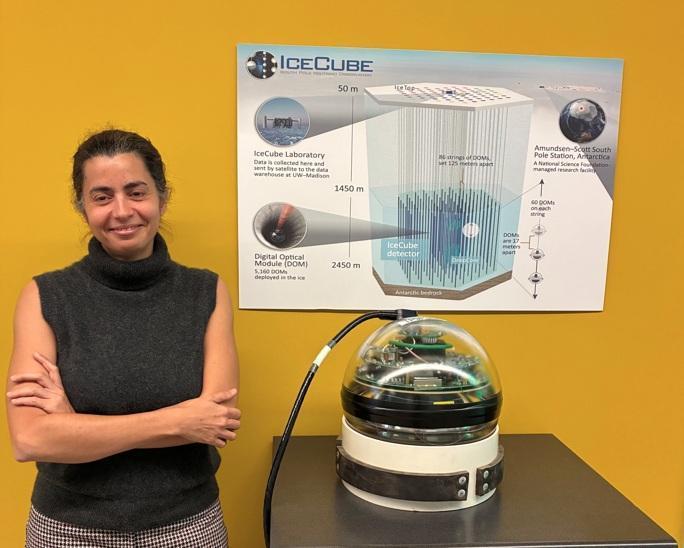
The 2026 Nobel Prize in Physics was awarded to Dr. Francis Halzen for his leadership of the IceCube Neutrino Observatory located in Antarctica. This telescope facility is credited with the discovery of high-energy cosmic neutrinos and numerous contributions to the study of cosmic rays and dark matter. Dr. Rasha Abbasi, an associate professor in the Department of Physics, has been a long-time collaborator on this international project. Here is an interview about the news and her experiences with this project.
You just attended the first meeting for the IceCube Collaboration with Dr. Halzen since he won the Nobel Prize. What was that like?
It was very special. The whole collaboration felt proud to be part of this historic moment. Francis was very gracious and kept reminding us that the prize was for all of us. He even encouraged us to add it to our CVs. I was involved in the early stages of IceCube, so the pride I feel in the success of this experiment is overwhelming.
What exactly is a neutrino and where do they come from?
Neutrinos are tiny subatomic particles often called “ghost particles” because they rarely interact with matter and are very difficult to detect. They are produced in many places, including the Sun, Earth’s atmosphere, and distant objects and events in the universe, such as exploding stars. In fact, enormous numbers of neutrinos pass through us all the time without us noticing.
Because neutrinos have no electric charge and interact so weakly, they can travel through dense matter and across vast distances, carrying information from places that are otherwise difficult to study. This makes them precious messengers that can help us learn about some of the most energetic and extreme environments in the universe.
What is IceCube and how does it detect neutrinos?
IceCube is a neutrino detector built deep within the Antarctic ice at the South Pole. While other neutrino detectors use bodies of water, such as lakes and seas, IceCube uses ice as its detection medium.
When a neutrino interacts in or near the ice, it can produce a charged particle that travels through the ice and creates a faint flash of light. Thousands of light sensors embedded in the ice detect this light, allowing us to reconstruct the particle’s path and learn about neutrinos.
Building a detector in the Antarctic ice was a great adventure, and it paid off. IceCube first showed that it could detect neutrinos produced in Earth’s atmosphere. Then came one of IceCube’s biggest discoveries: high-energy extraterrestrial neutrinos.
How did you become involved with IceCube?
I first joined IceCube as a postdoctoral researcher early in my career. After working on several other research projects, I rejoined the collaboration as an assistant professor at Loyola University Chicago, where I study cosmic rays. I was excited to return to IceCube and continue studying cosmic rays with the collaboration.
What has been your role with IceCube?
My main focus within IceCube has been analyzing cosmic rays observed by both the in-ice detector and IceTop, the part of the detector at the surface. I was part of the collaboration when we first reported a large-scale anisotropy in cosmic rays in the Southern Hemisphere at energies around the teraelectronvolt (TeV) scale. This means that cosmic rays do not arrive equally from every direction in the sky. The result attracted significant attention and was covered by many news outlets at the time.
We continue this research today using data from the completed detector, which gives us a much larger number of events to study. We also combine IceCube data with measurements from experiments in the Northern Hemisphere, allowing us to study cosmic-ray arrival directions across the full sky.
Do you have any undergraduate students at Loyola involved in your work with IceCube?
Yes. Undergraduate students at Loyola have been involved in analyzing cosmic-ray anisotropy data since I joined the university. They have contributed to multiple publications and conference proceedings, and many have gone on to graduate school, where they are doing very well.