
Hazard Safety/Biosafety (IBC)
Institutional Biosafety Committee (IBC)Institutional Biosafety Committee (IBC)
Loyola University of Chicago takes very seriously its obligation to oversee research and instruction that involves biohazardous materials and/or recombinant DNA.
Before initiating any work involving biohazardous materials and/or recombinant DNA, whether or not supported by external funding, principal investigators are required to have their protocol reviewed and approved by the Biosafety Safety Office (BSO) and/or Institutional Biosafety Committee (IBC).
Cayuse Submission Resources
ORS is now using Cayuse, a new and enhanced research protocol management system, which impacts how Hazard Safety protocols are submitted and managed at Loyola.
Hazard Safety Video-New Applications
Hazard Safety Manual-New Applications
If you have questions or would like additional support, please do not hesitate to reach out to the ORS Compliance Team. It is our pleasure to meet with you and answer any questions you may have.
IBC Protocol Submission and Review Process
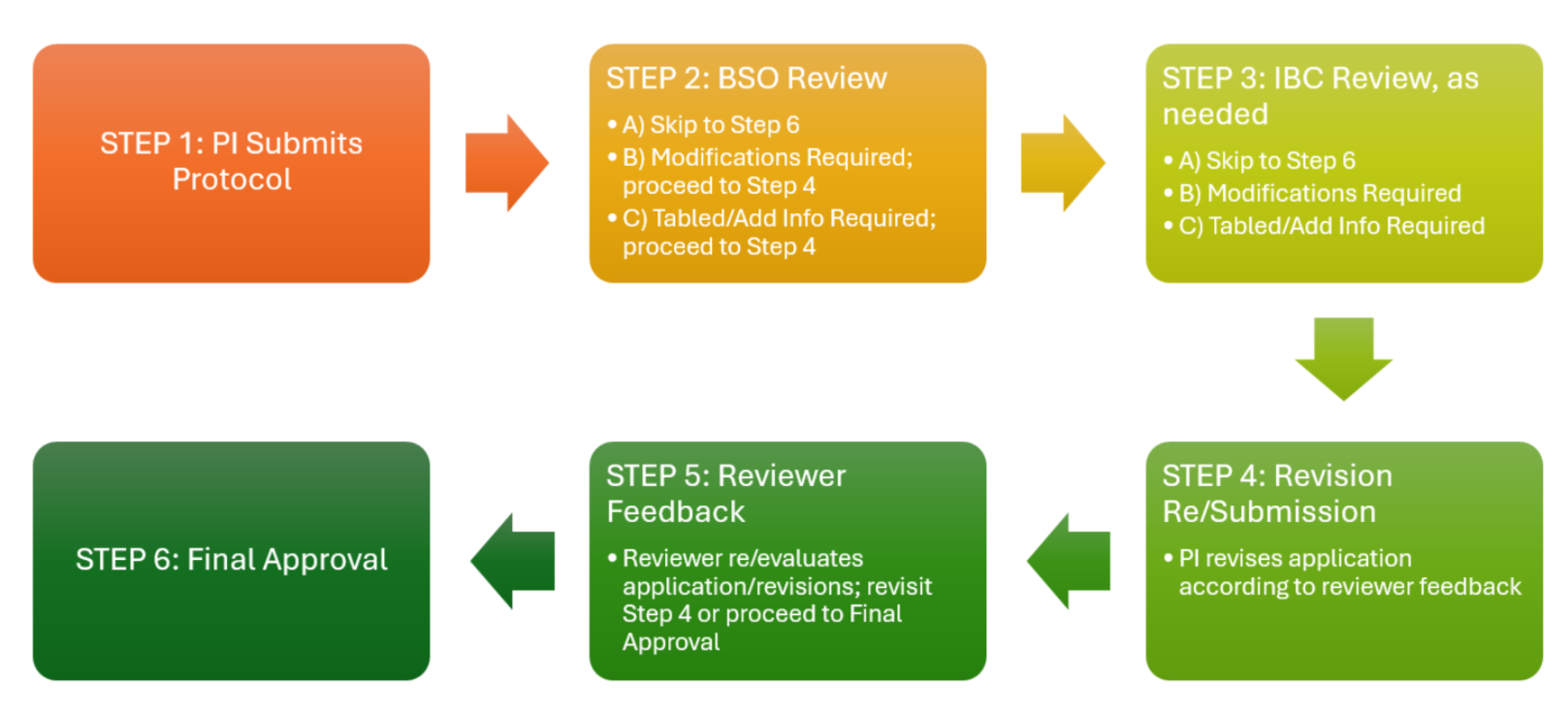
1. Protocol Submission
The Principal Investigator (PI) submits the protocol in Cayuse.
Whenever possible, each laboratory should maintain one comprehensive hazardous-substances protocol covering all applicable work conducted under the PI’s oversight. The protocol should clearly identify the materials, procedures, personnel, locations, and safety measures associated with the proposed activities.
2. Biosafety Review
The protocol is first reviewed by the Biological Safety Officer (BSO), with the Institutional Biosafety Committee (IBC) Chair serving as a secondary reviewer.
Following this review, the protocol will receive one of the following determinations:
- Approved: The protocol may proceed to final approval.
- Modifications Required: The PI must revise the protocol and respond to the reviewers’ comments.
- IBC Review Required: The protocol must be reviewed at a convened IBC meeting. This is required for research involving non-exempt recombinant or synthetic nucleic acid molecules and may be required for other activities that warrant committee review.
3. IBC Meeting Review, if Required
Protocols requiring committee review are placed on the agenda for an upcoming IBC meeting. The IBC may issue one of the following determinations:
- Approved: The protocol may proceed to final approval.
- Modifications Required: The PI must revise the protocol or provide clarification before approval can be granted.
- Tabled/Additional Information Required: The committee requires substantive additional information before it can complete its review. The protocol will return to the committee after the requested information is provided.
4. RevisionRe/Submission
If revisions or additional information are required, the PI will receive a change request describing the items that must be addressed.
The PI should respond to each reviewer comment within Cayuse and revise the protocol accordingly. Providing complete, point-by-point responses will help avoid delays in the review process.
5. Reviewer Feedback
The protocol then returns to the appropriate reviewer or the IBC for further evaluation.
More than one revision cycle may be necessary before all review requirements are satisfied.
6. Final Approval
Once all required revisions have been completed and the protocol has received the appropriate BSO, IBC Chair, and/or committee approval, the Office of Research Services will update the protocol’s status and issue the final approval.
Research activities covered by the protocol may not begin until the PI has received formal approval. NOTE: All comments and responses must be logged within the relevant Cayuse submission and section (i.e., not via email or other communications)
ORS Compliance Virtual Office Hours
Need Assistance?
Join the Office of Research Services staff during our open office hours using the links below;
Biosafety Resources
- Biosafety in Microbiological and Biomedical Laboratories (BMBL) 6th Edition (see Appendix A for information on Primary Containment for Biohazards)
Hazard Safety Policies
Hazard Safety Policy for Initial Review of Ongoing Recombinant DNA Research by Faculty
- All faculty currently conducting recombinant DNA research or teaching courses involving recombinant DNA techniques will submit descriptions of their procedures to the IBC for review within 60 days following October 16, 2006. The Hazard Safety has announced it will formally begin reviewing recombinant DNA research on this date.
- Ongoing research that has been submitted for review by the IBC will be initially evaluated by the IBC (IBC Chair or Chair designate) as to whether the research is exempt or must undergo full committee review.
- Research that is declared exempt by the Hazard Safety Chair or Chair's designate may continue without further oversight by the IBC unless changes are made to the protocol which would require further IBC review.
- Investigators that have submitted ongoing research that requires full Hazard Safety review will have 90 days to address any contingencies that have been identified by the Hazard Safety. Research will be permitted to proceed during the 90 days. Ongoing research may continue during the actual review of the research by the Hazard Safety.
- After the initial submission of the protocol to the Hazard Safety, laboratory surveys must be completed by Hazard Safety Chair or BSO prior to action by Hazard Safety on individual faculty applications. Surveys will be performed once the Hazard Safety Chair or Biosafety Officer assigns an appropriate Biosafety Level to the research program.
Review Policies and Outcomes for Submitted Proposals
- Initial protocol submissions to Hazard Safety will be classified as:
-
- Exempt Submissions- The Hazard Safety Chair will review all Exempt submissions to make a determination of Exemption. The outcomes of this review will be one of the following:
- Approval
- Conditional Approval - conditions must be satisfied in order for the protocol to be approved as Exempt.
- Not Exempt - The protocol is determined to not qualify for Exempt status and will be referred to the full Hazard Safety for review.
- Full Hazard Safety Review Submissions- Submissions requiring full committee review will have one of the following outcomes:
- Approval - The committee has determined that the protocol adheres to the NIH Guidelines on Recombinant DNA Research and the research may proceed.
- Conditional Approval - Conditions must be satisfied in order for the protocol to be approved.
- Disapproval - The committee has determined that the protocol does not conform to the NIH Guidelines on Recombinant DNA Research and is therefore unacceptable. The investigator will be informed of the reasons for disapproval.
Periodic Review - All approved protocols will be subject to review every three years. Investigators will be required to submit a renewal/update form for active procedures. When work has ceased on a protocol, investigators will be required to submit a "Request to Terminate a Protocol" form. If the NIH guidelines on Recombinant DNA Research change, amendments to existing protocols may be required.
- Exempt Submissions- The Hazard Safety Chair will review all Exempt submissions to make a determination of Exemption. The outcomes of this review will be one of the following:
Policy for Submission of Hazard Safety Protocols for New Grant Applications
Hazard Safety recognizes the level of effort necessary for an investigator to submit a new grant application, and wants to assure timely review of procedures for biosafety compliance. To this end, the following policies have been established:
-
-
- Some funding agencies require prior Hazard Safety approval before they will review a grant application. For applications to such agencies, investigators must submit their protocols early enough that IBC has time to review and approve the protocols before the grant submission deadlines. For applications to such agencies, the following Hazard Safety deadlines apply:
- For those protocols requiring Full Committee Review, the submission deadline to Hazard Safety will be a minimum of 30 days before the submission deadline for the grant itself. This time period is necessary for the processing and review of the protocol by Hazard Safety and to allow the investigator to satisfy any conditions the committee may impose.
- For those protocols requiring Exempt Review, the submission deadline to Hazard Safety will be a minimum of 21 days before the submission deadline for that grant itself. This time period will allow for the processing of the application, review by the Hazard Safety Chair, and for the investigator to satisfy any conditions the Hazard Safety Chair may impose.
- For applications to agencies that do not require prior Hazard Safety approval before they will review a grant application (those following "just in time" procedures, e.g., N.S.F., N.I.H.), the following IBC deadlines apply:
- For those protocols requiring Full Committee Review, the submission deadline to Hazard Safety will be a minimum of 30 days before funding begins. This time period is necessary for the processing and review of the protocol by Hazard Safety and to allow the investigator to satisfy any conditions the committee may impose.
- For those protocols requiring Exempt Review, the submission deadline to Hazard Safety will be a minimum of 21 days before funding begins. This time period will allow for the processing of the application, review by the Hazard Safety Chair, and for the investigator to satisfy any conditions the Hazard Safety Chair may impose.
- Some funding agencies require prior Hazard Safety approval before they will review a grant application. For applications to such agencies, investigators must submit their protocols early enough that IBC has time to review and approve the protocols before the grant submission deadlines. For applications to such agencies, the following Hazard Safety deadlines apply:
-
Investigators should consult the Hazard Safety Meeting Schedule on the Loyola Hazard Safety Website for dates of meetings and submission deadlines to ensure that timely review of protocols will be possible.
- Policy for the Use of Personal Protective Equipment in the Research Laboratory
Proper laboratory safety procedures use personal protective equipment (PPE) as a protective barrier between laboratory personnel and hazardous agents with which they may come into contact. Therefore, it is mandatory that all laboratory personnel will use appropriate PPE when working with hazardous chemicals, DNA, or micro-organisms. PPE will not be worn by laboratory personnel outside the hazardous areas of the laboratory.
Principal Investigators will use their discretion in determining the use of PPE at times other than when laboratory personnel are working with the above agents.
IBC Meeting Date for the Semester
- For a protocol to be put on the meeting agenda for Full IBC review, it must be submitted to the IBC a minimum of 2 weeks before the scheduled meeting date. Protocols submitted for Full IBC review after the 2-week deadline will be reviewed at the next scheduled IBC meeting.
- In accordance with the IBC review policy for Ongoing Faculty Research, the 60-day deadline in this policy refers to the submission of the protocol for De Novo review via the Cayuse platform.
IBC Meeting Minutes
Biosafety Training
Biosafety training is an important part of the Loyola University Chicago Biosafety Program. The IBC has established two online training courses that must be completed to certify that laboratory personnel, working with recombinant DNA or biohazardous organisms, are appropriately trained for this type of work. One training course covers general biosafety practices and the other covers the proper uses and handling of UV radiation for sterilization purposes. All investigators and laboratory personnel must complete these courses as a requirement of IBC approval of research protocols. This policy took effect on January 1, 2007.
Please contact the ORS Director for Research Compliance for information on how to access the online training courses and take the quizzes.
A passing grade of 80% must be obtained in order to obtain certification for these courses. The final quizzes may be attempted until a grade of 80% is obtained and submitted to the IBC in the Office of Research Services.
The online course that will be used for general biosafety practices has been prepared for a clinical lab setting but the practices and principles that are taught in this course apply to research laboratories performing recombinant DNA research or research with biohazardous organisms at Loyola University Chicago. When viewing this online course, please disregard the one section that is specific for phlebotomists.