
Graduate Program Director Handbook
OVERVIEW OF POSITION
Position of Graduate Program Director
Graduate Program Directors (GPDs) are central to the success of Loyola University Chicago’s graduate programs. They serve as unique liaisons among the graduate student body, the graduate faculty, department/program/school leadership, and the Graduate School. GPDs are responsible to their department or program chair/school Dean and to the Dean of the Graduate School. They possess the authority to speak for the department or program on any matter relating to graduate programs. The work of the GPD includes leadership, enrollment management, curriculum development, academic affairs for graduate programs, graduate student affairs, administration, and planning, among others.
Serving as a Graduate Program Director is a 12-month, secondary administrative appointment, as reflected in your faculty appointment letter, that is effective July 1 through June 30 of the following year.
GPD Responsibilities
A Graduate Program Director is responsible for overseeing the administration of their graduate program(s) throughout the academic year and the summer term, although the summer workload is generally lighter, as described below.
Key responsibilities include:
- Attending an orientation session(s) for Graduate Program Directors (if new to the role).
Communications
- Communicating relevant updates from the Graduate School and other university units to department/program/school faculty, staff, and leadership.
- Responding in a timely manner to inquiries from the program(s) prospective admits, admits, and students, faculty, and staff, GPEM, the Graduate School, and other university offices.
- Maintaining, updating, and posting the Graduate Student Handbook for the program(s).
Curriculum Management
- Managing program(s) curriculum, including submitting new or modified course and/or new program intent, new program, or program modification proposals.
- Engaging in analysis of the program(s)’ outcomes and submitting reports as requested, including an annual report to the Graduate School.
- With faculty, collecting career outcome information from alumni of the graduate program(s).
Enrollment Management
- Overseeing enrollment management for their respective graduate program(s), including the AMP
- Attending online and/or in-person program information sessions organized by GPEM.
Finances and Funding
- As applicable, coordinating the assignment of students to assistantships, guiding faculty supervisors, implementing Graduate School GA policy, and serving as the primary contact for assistantship-related concerns.
Governance
- Attending regularly scheduled Lakeside or HSC GPD meetings throughout the academic year.
- Representing the program(s) on the Council of Graduate School Programs and actively participating in its initiatives.
Student Affairs
- Ensuring the orientation and onboarding of new students across all entry terms.
- Nominating or overseeing nomination of graduate student(s) to internal and external opportunities (e.g. fellowships, internships, etc.).
- Monitoring and supporting students’ academic progress, including management of students’ probationary admission, probation, and/or dismissal when necessary, in collaboration with the Associate Dean of Student Academic Services (Lakeside) and the Associate Dean, Graduate Education (HSC).
- Completing degree audits for graduating students.
- Serving as the faculty advisor for the program/s’ graduate student association(s) and ensuring faculty advisors are assigned to all of the program’s graduate students. For Lakeside Campus GPDs, overseeing the allocation of student development fees in coordination with other unit staff and students (as appropriate).
Other Duties
- Summer responsibilities include continued oversight of admissions, recruitment, and yield, supporting students for Fall registration, preparing the program’s orientation/onboarding communications for new students, and finalizing CA/RA/TA assignments (if applicable), among others.
- Performing other duties as essential to the success of the graduate program(s) and students.
- Depending on the role, GPDs may be assigned other responsibilities from the leadership of their department, program, and/or school.
Appointment, Supervision, Reporting, and Evaluation
Appointment of the GPD varies by the school in which the graduate program is located but generally is the responsibility of either the Dean of the Graduate School or the Dean of the school/Chair of the department in which the GPD’s respective program is located. A GPD’s engagement in areas of listed responsibility above, along with other duties that may be assigned by the School’s Dean, will be a key factor in decisions regarding the renewal or discontinuation of the secondary administrative appointment.
Compensation for the GPD role is determined by the Dean of the program’s respective school. For GPDs in programs in the College of Arts & Sciences, compensation for the GPD role is determined by program enrollment size in an academic year’s fall semester. Compensation is given as a combination of administrative stipend and, for programs that enroll more than ten students, a course release. GPDs for qualified programs determine whether they wish for their compensation to include both a stipend and course release, or a slightly higher stipend with no course release. Compensation for GPDs of other TGS graduate programs (Health Sciences Campus, and Schools of Communication, Education, Nursing, and Social Work) is determined by their School’s Dean.
For all GPDs, a letter of appointment and terms will be provided annually by the Office of Faculty Affairs and the relevant Dean will annually provide a letter detailing responsibilities. This administrative appointment is distinct from the GPD’s faculty role and may be terminated by the GPD or the University at any time. If the responsibilities of a faculty member as Graduate Program Director conclude for any reason, the associated administrative stipend will also end, and the compensation will be adjusted accordingly.
Governance Bodies
The GPD engages with several other governance bodies, including the Laskeside or HSC GPDs, the Council of Graduate School Programs, and the Graduate School.
Lakeside and HSC GPDs
By campus, GPDs have regular meetings and attendance is expected. There are Lakeside Campuses (all graduate programs in the College of the Arts & Sciences, School of Communications, School of Education, School of Nursing, and School of Social Work) and Health Sciences Campus GPD meetings that occur on a monthly basis, which are occasionally cancelled if there are no agenda items. Managed by the Graduate School, these meetings are where discussion occurs related to funding, admissions along with curricular matters, student-centered programming, and concerns that are specific to each campus.
Council of Graduate School Programs
Each Graduate Program Director represents their program as a member of the Council of Graduate School Programs (CGSP, sometimes referred to as Grad Council), which is led by an elected Executive Committee. Managed by the Executive Committee, the primary function of the CGSP is regular meetings to discuss and formulate the aims, purposes, and quality standards for master's and doctoral programs under the auspices of The Graduate School at Loyola University Chicago. As described in the CGSP Bylaws, the Council has jurisdiction over all academic matters delegated and makes policy recommendations in such areas as: admissions, curriculum, qualifying exams or projects, theses and dissertations, and overall objectives. CGSP’s standing committees include curriculum committees: one for Lakeside campuses and one for the Health Sciences campus, among others.
The Graduate School
The faculty and staff of the Graduate School on the LSC and HSC campuses oversee academic policies, student affairs, curriculum management, enrollment management, and data collection/analysis for graduate programs. It also represents graduate programs, faculty, and students with other university units and advocates for their needs.
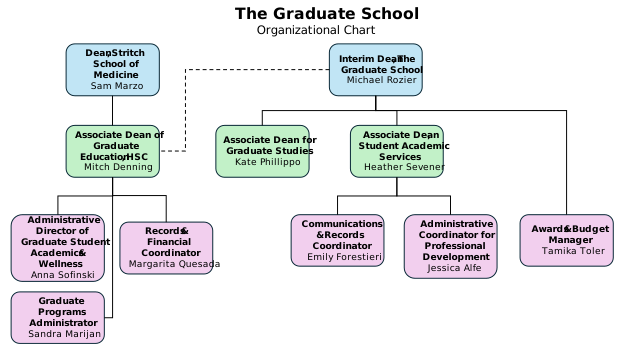
Additional GPD Resources
Other resources available to GPDs include the Graduate School Faculty Handbook, TGS communications, and websites that outline relevant policies and procedures for graduate programs and graduate students.
Graduate School Graduate Faculty Handbook
Along with the university’s Faculty Handbook, the Graduate School Faculty Handbook is an important resource for GPDs and Graduate Faculty in the Graduate School and contains university policies regarding both faculty status and student progress. Topics include descriptions of Full and Associate Graduate Faculty Status and Teaching/Research Affiliate Status, Emeritus appointments, procedures for appointment and reappointment, graduate faculty responsibilities and privileges, information on dissertation and thesis committees, and a description of the Council of Graduate School Programs.
TGS Communication
The Graduate School regularly communicates time-sensitive announcements and updates to GPDs and graduate students.
Friday GPD Emails
Every Friday during the academic year, the Graduate School shares announcements with Graduate Program Directors. Please look for these as they often include action items for GPDs that are time sensitive.
Graduate School Announcements
Graduate School Announcements (GSA) is a weekly newsletter sent to students of The Graduate School, Graduate Program Directors, and Graduate Faculty updating them on the most current university news, including key dates and deadlines within the graduate school, fellowship and employment opportunities, upcoming events, and other academic opportunities based on LUC campuses. Students in The Graduate School and Graduate Program Directors are automatically added to the mailing list, but others who wish to be added may do so here. Previous newsletters can be accessed through the Graduate School Announcements Archive.
Frequently Used Websites for GPDs
Sakai: There are four Sakai websites for GPDs. The Graduate School hosts a site for all GPDs. In addition, the Lakeside Campus GPDs Sakai Site and the HSC GPDs (GSC) Sakai Site include numerous documents and links pertaining to GPDs’ work, and also is where meeting agendas, minutes and supporting documentation are posted. CGSP also hosts a site where meeting agendas, minutes, and supporting documents are posted.
The International Students and Scholars Services (ISSS) office is the primary clearinghouse for policy and guidance related to our international applicants and students’ unique needs.
The Graduate School’s Academic Policies All student-facing policies in areas such as thesis and dissertation, incomplete grades, leaves of absences, and appeals, among others.
The Graduate School’s Academic Catalog page: Gateway to all TGS-affiliated programs’ Academic Catalog pages)
Graduate Student Progress System: system for management of student merit awards, travel and research funds, milestone tracking, transfer credit approval, leave of absence requests, etc.
LUC’s Division of Academic Affairs maintains a webpage with all necessary links and initial guidance to support Curriculum Inventory Management (CIM) submissions.
Slate login page for the review of student applications
The webpage for the Office of Graduate and Professional Enrollment Management for a list of graduate programs and webpages for some graduate programs
LOCUS information page for students
Registration and Records resources and information page for students: provides links to numerous sites within LUC website for information (e.g., immunization requirements) and procedures (how to request a diploma, how to submit a name change).
ENROLLMENT MANAGEMENT
Along with the Office of Graduate & Professional Enrollment Management and the Graduate School, Graduate Program Directors oversee and coordinate enrollment management for their program(s), including program development and modification, recruitment and marketing, inquiries, admissions, and yield. In all cases, the GPD will wish to consult GPEM’s A Guide to Working with GPEM and reach out to their GPEM representative and/or the Graduate School with any questions. The GPEM Guide outlines the respective responsibilities of the GPD at each stage of the enrollment funnel. Additional Graduate School policies and processes for GPDs at each stage of the enrollment funnel are below.
Program Development, Modification, and Closure
The GPD is responsible for ensuring that graduate program(s) for their academic unit(s) best align with prospective student interest (“market demand”), academic strengths, and alumni success. Working with other university units (e.g. Enrollment Systems, Research and Reporting (ESRR), the Provost’s Office’s Academic Program Review process, and the Graduate School), the Graduate Program Director should use these criteria to periodically review their existing graduate program(s) to ensure optimal curriculum content and program delivery modality, as well as considering possible new program offerings. The GPD is also tasked with reviewing existing programs to consider whether enrollment trends warrant the continued offering of the program. If not, the GPD should consult with stakeholders to determine if the program should be sunset. In all cases, the GPD should follow the procedure for so doing as specified in the Academic Chart of Approvals and using CIM.
Recruitment and Marketing
The primary responsibility for the marketing of graduate programs falls with Graduate Program Enrollment Marketing. (GPEM) The GPD is expected to be a proactive partner with other university offices in the marketing and recruitment of its graduate program(s). The GPD should identify each program’s specific strengths and share that information on their department webpage (as relevant), with GPEM and the Graduate School, with Loyola undergraduate students, with prospective students, and via communications by Graduate Faculty when engaging external partners (e.g. conferences). If a graduate program wishes to hold a webinar or event for interested students and/or applicants, the GPD should reach out to GPEM for support.
In order to market their program, the GPD should share important updates about their program (e.g. a graduate student’s receipt of an external fellowship or award, notable alumni job placement, or Graduate Faculty teaching/mentorship award) with prospective students and applicants as well as sharing with GPEM and the Graduate School.
Inquiries
The GPD is also charged with responding promptly to any inquiries from possible students about the graduate program and connecting them with relevant faculty, students, or university offices. The GPD also is charged with directing prospective applicants to complete a GPEM request for information form, which makes them a prospective student with GPEM. Once that occurs, it is the responsibility of GPEM staff to conduct outreach to these prospective students to encourage them to apply for admission.
Admissions
For certificates, Accelerated Masters Pathway (AMP) programs, and master’s programs, the GPD is responsible for checking and making sure GPEM's program-specific website is up to date with current information on the program's admission process. If not, GPDs can submit a program page review form as a means to change that information.
Doctoral program webpages are maintained by the program’s host department. Accordingly, the GPD is responsible for ensuring that the department’s website is up to date with current information on the program’s admission process.
Once a prospective student begins the application process, it is the role of GPEM staff to work with them to ensure a complete application and to address any questions or concerns, with the role of the GPD and Graduate Program Coordinator to support this work.
Once an application has begun, the GPD is responsible for review of applications, following the policies and procedures of the graduate program(s), the Graduate School, and the university governing application and admission.
Graduate Program Admissions Requirements
With oversight by the GPD, each TGS program, including certificates, AMPs, master’s, and doctoral degrees, determines its own:
- Admission requirements, subject to TGS policy
- Procedures, including necessary prerequisites and application materials
- Entry term(s), e.g. Fall, Spring, and/or Summer semester(s), for enrollment
- Application and application review deadlines
A GPD also is responsible for sharing that information with prospective applicants, either through submission of this information to GPEM for master’s programs (with the exception of HSC programs) or through posting of this information on their own department webpage (for certificates and/or doctoral programs.
In line with the university’s commitment to diversity and inclusion, graduate programs are not permitted to include standardized assessments (e.g. GRE) as an application requirement without approval from the Dean of the Graduate School. University policy on the approval process and timeline for changing one or more admissions requirements guides any admissions requirement changes.
University Admissions Requirements
The university possesses its own set of admissions requirements both for domestic and international applicants. Graduate programs are not permitted to waive those requirements for admission except as noted below. Any questions concerning university admissions requirements should be directed to your GPEM representative.
Communication of Admissions Requirements
Loyola operates a two-tier system for the communication of admissions requirements of its graduate programs. GPEM manages the webpages for all AMP and master’s programs (except for Health Science Campus programs), including the listing of admissions requirements. For certificates and doctoral programs, the department/program/school is responsible for managing its website to include comprehensive and updated information on admissions requirements. An academic unit with an AMP and or master’s program also may choose to create its own webpage but should link to the Slate webpage where official admissions information is listed.
Setting Timing and Type of Admission Review
The GPD is responsible for implementingand communicating the program’s timeline for review of applications (rolling or cohort-based) for admission. The timeline for review of applications should be shared with the program’s GPEM representative, Graduate Faculty, and potential students and applicants.
Review of Applications
The GPD is responsible for ensuring the timely and accurate review of applications, either by their own review of applications or by coordinating the effort of an admissions committee.
For graduate programs that employ rolling admissions, the university expects admissions decisions (admission, waitlist, or rejection) within 7 days of application completion.
For graduate programs that employ a cohort-based model of admissions, the university expects admissions decisions (including admission, waitlist, or rejection) in a timely fashion.
Graduate programs are expected to engage in holistic admissions of applications, including use of the optional essay detailing applicants’ life challenges. Further information on holistic admissions can be found in the Graduate School GPD Sakai website.
After reviewing applications, the GPD is responsible for entering admissions decisions into Slate, along with funding information, if applicable. Entry of admissions decisions into Slate will result in the university’s formal communication of an offer of admission to an applicant. Until the formal offer of admission is made via Slate, the GPD is not permitted to independently share the offer of admission with the applicant. The GPD is encouraged to set up a notification of admission in Slate.
Those overseeing the admissions decision should take into consideration the following policies concerning applications.
Incomplete Applications and Waiver of Application Materials
Application material may be grouped into two categories: those materials required for admission by the university (with differing requirements for domestic and international applicants) and those materials required for consideration of admission by the graduate program. Please see the table for further information.
|
|
GPD Oversight |
University Policy |
|
Domestic Applicants |
|
|
|
Transcripts |
With unofficial transcript, GPDs can make a conditional offer of admission based on submission of official transcript. |
Official transcript is not required for conditional admission, but transcript submission is required by the end of the first semester of enrollment. |
|
All other application material |
GPD may waive at own discretion |
N/A |
|
International Applicants |
|
|
|
Transcript |
N/A |
Official Transcript(s) required. These can be submitted separately, or the applicant can request the transcript be sent by the agency conducting transcript evaluation. |
|
Transcript Evaluation |
For qualified PhD students, GPD can request waiver from TGS (Please see TGS Policies, Procedures and Guidelines) |
Required for Admission unless applicant has US bachelor's or master's degree |
|
English Language Proficiency |
N/A |
Required for admission from some countries as outlined in the university's requirements for international applicants. |
|
All other application material |
GPD may waive at own discretion. |
N/A |
Following university policy, GPEM categorizes an application as complete if all university-required material has been submitted (see above for list). Only complete applications may be reviewed for admission, with some exceptions. GPDs are not authorized to waive the following university required application material in consideration of admission: official transcripts, transcript evaluation for international students, and English proficiency documentation for students from non-English speaking countries (please see further specifics on English proficiency requirements from GPEM). However, a GPD has the authority to make admission decisions on “incomplete applications” if it involves waiving a missing application requirement specified by the program, such as forms orletter(s) of recommendation, statement of purpose, writing sample, and/or resume/CV. A doctoral program may be able to waive the transcript evaluation for a highly qualified applicant and the GPD should reach out to the Graduate School Dean to learn more.
GPEM may be able to waive the transcript evaluation requirement if the applicant holds a U.S. bachelor's or U.S. master's degree, along with any other international degrees, in which instances the applicant would still be required to submit an official transcript from any of their international degree-granting institutions.
Admission of Unfunded PhD Students
A PhD program is not permitted to admit a student who is not receiving any form of institutional funding without permission of the Dean of the Graduate School.
Conditional Admission
Programs may admit students conditionally if they await an official transcript (for domestic applicants only) or if an international applicant’s English language exam scores are below LUC’s requirement. The GPEM’s A Guide to Working with GPEM provides more detail on these processes.
Admission on Probation
A program’s decision to offer admission on probation is subject to TGS policy and process as outlined in the Academic Catalog.
Admission after Deadline with Incomplete Application
While all TGS programs publicize an application deadline, applicants to a doctoral program who have an active application may submit materials after the deadline and the program will determine whether to consider applications with material submitted after the deadline.
Deadline for Offers of Admission
Offers of admission may be made until the start of the entry term. If the student is unable to start during the desired entry term, they can request a deferral if applicable. The program has the authority to grant or deny a deferral.
Admission with an Offer of Funding
Please see the information in the “Funding and Resources” section below.
Acceptance Deadline for Offers of Admission with Funding
For offers of admission accompanied by an assistantship or fellowship, TGS follows the Council of Graduate Schools April 15 Resolution, which states that “acceptance of an offer of financial support (such as a graduate scholarship, fellowship, traineeship, or assistantship) by a prospective or enrolled graduate student for the next academic year completes an agreement that both student and graduate school expect to honor. In that context, the conditions affecting such offers and their acceptance must be defined carefully and understood by all parties,” and that “students are under no obligation to respond to offers of financial support prior to April 15; earlier deadlines for acceptance of such offers violate the intent of this Resolution.”
We include information about the April 15th deadline of a funded offer of admission in our admission letter.
If programs would like, they can communicate separately to admitted students that — after April 15th — their funding offer will be rescinded if the admitted student does not accept it in writing. If a Graduate School program wishes to be able to rescind offers not accepted by April 15, the following wording MUST be used in an email to admitted students with funding:
As outlined in your offer of admission, please inform me in writing of your decision to either accept or decline this offer no later than April 15, 2025 and note your decision in Slate as well (as directed in your letter of admission). Although you are under no obligation to accept this offer prior to April 15, I would appreciate if you could please let me know as soon as you have made a decision so that we may extend offers to other prospective students if possible. In addition, in accordance with the Council of Graduate Schools’ (CGS) resolution, we will honor this offer of funded admission until the April 15 deadline, after which point it will be rescinded unless you are informed in writing that the deadline for a decision has been extended.
If the program sends an email out by March 28th to any admitted students with outstanding funded offers of admission, they would then be free to rescind the offer of funding after April 15th and to make a new funded offer of admission to another applicant and/or already admitted student. The GPD would need to inform Tamika Toler in the Graduate School of that decision and process the necessary paperwork as with the first round of funded offers of admission.
Deferral of Admission
Policy on deferral for students admitted to a master’s or doctoral program can be found in the Academic Catalog.
Policy prohibiting deferral for students admitted to an Accelerated Master’s Pathway can be found on the website of the Office of the Provost.
Yield and Recruitment of Admitted Students
Along with the work of GPEM, the GPD oversees efforts to encourage enrollment by admitted students (yield).
GPDs are not permitted to convey an offer of admission prior to the university’s communication of an offer of admission via the admitted student portal. Unless GPDs request notification (see below), GPDs are not informed when an admit letter is released. To be alerted when a letter of admission is released, PhD and Health Sciences programs should reach out to ESRR. For all other Graduate School graduate programs, the GPD can contact the GPEM Associate Director.
Once the official notice of admission has been communicated, expected yield efforts by GPDs include an immediate welcome communication, including an invitation to visit campus, meet with the GPD, faculty, and students (either online or in person) and share information regarding registration, program and Graduate School orientation (and other required orientations), as well as promptly answering questions from admitted students. GPDs are also encouraged to host a Welcome Day for admitted students and to connect admitted students with current students and graduate faculty who share similar interests. Further guidance on yield optimization can be found in Sakai.
Recruitment Funding
Funding may be available to support a graduate program in the recruitment of students. Please see details below in the “Funding and Resources” section.
FUNDING AND RESOURCES
Tuition and Billing Overview
GPDs may be asked to assist graduate students with billing questions and concerns.
Tuition and mandatory fees at Loyola University Chicago vary by school, college, and academic program. In addition to direct tuition and fees, students incur indirect expenses that collectively comprise the Cost of Attendance. Please keep in mind fees are the student’s responsibility.
Current tuition and fee schedules are available by academic year and school and can be referenced here.
Graduate financial aid is disbursed up to ten (10) days prior to the start of the academic term. Students may view disbursement activity and timing through their Financial Aid award in LOCUS. Following the initial disbursement, financial aid is processed daily on business days, excluding recognized University holidays.
Billing Schedule
Electronic billing statements (e-bills) for full semester tuition and fees are generated according to the following schedule through LOCUS:
Fall Term: July 15
Spring Term: December 15
Billing due dates follow the schedule below:
Fall Term: August 5
Spring Term: January 5
More details can be found here.
GPD Responsibilities:
- Ensure all tuition scholarship information is submitted to the Awards & Budget Manager by the annual deadlines communicated each year.
- Confirm that all tuition and funding distributions comply with the LUC Graduate Funding Policy.
- Communicate any changes to student funding in a timely manner to the Awards & Budget Manager to avoid billing or disbursement issues.
Student Health Insurance
In accordance with the Loyola Chicago Board of Trustees policy, all graduate and professional students who meet one or more of the following criteria are required to maintain health insurance:
- Enrollment in eight (8) or more credit hours, or
- Registration for Thesis or Dissertation, at the start of Fall and Spring terms.
Health insurance may be provided as part of a student’s funding package (e.g. assistantship or fellowship) that also includes tuition and stipend support. Eligible students are automatically billed for the University-sponsored health insurance plan unless a waiver is approved.
Additional details regarding student health insurance coverage can be found here.
Insurance Options
Waive Out of Loyola’s Insurance
Students who have comparable external health insurance coverage may waive the Loyola-sponsored plan through LOCUS by the deadlines below:
Fall Term Waiver Deadline: October 1
Spring Term Waiver Deadline: February 28
Failure to submit a waiver by the deadline will result in the insurance charge remaining on the student’s account.
Fast-Track Into Loyola’s Insurance
Fast-Tracking within LOCUS confirms a student’s acceptance of Loyola’s health insurance plan. This process:
- Activates enrollment
- Allows an insurance card to be generated, and
- Triggers the addition of the insurance award to the student’s financial aid package.
GPD Responsibilities
- Inquire whether students wish to receive health insurance coverage and document this on the annual budget worksheet.
- Confirm all insurance-related funding complies with the LUC Graduate Funding Policy.
- Promptly communicate any changes to the Awards & Budget Manager.
Chicago Transit Authority (CTA U-Pass)
The CTA U-Pass provides unlimited, discounted access to CTA buses and trains during enrolled academic terms.
Graduate and professional students enrolled in six (6) or more graduate credit hours during the Fall semester are automatically enrolled in the program and billed accordingly.
Students who wish to decline participation must formally opt out. Opt-out periods are announced approximately two weeks prior to the start of each semester. Additional details are provided here.
GPD Responsibilities
- Share U-Pass information with students as needed.
GPDs also are responsible for coordinating and communicating two types of funding: institutional and external funding to support students’ enrollment and institutional funding to support graduate student programming and activities.
Graduate Student Funding
Graduate students may receive one or more types of institutional funding (assistantship, fellowship, tuition scholarship, including Fulbright funding, financial loan, and/or hourly paid work). Graduate students’ receipt of institutional funding must be in accordance with university and academic unit policies as outlined in the Loyola University Chicago Policy on Institutional Funding for Graduate Students linked in Sakai. Further information on the forms of funding available to graduate students can be found here.
Graduate Assistantships
The Graduate School provides a limited number of assistantships each year to students in some graduate programs. A graduate assistantship consists of a stipend, tuition scholarship, and health/dental/vision insurance. GPDs oversee and coordinate each Graduate School program’s graduate assistantships as well as graduate assistants provided by other institutional actors. More information on the role of the GPD in overseeing graduate assistantships for their program(s) can be found below in the “Student Affairs” section.
Graduate Assistantships may only be distributed to students on a semester, academic year, or 12-month long period. The constituent parts of the funding package (e.g. stipend, tuition, and health insurance) must be distributed together to a single student and unspent dollars (e.g. tuition scholarship credits) may not be distributed to another student.
For LSC students, a merit award consists of a stipend of either 9 months: ($18,000 for master’s and $28,000 for PhD students) or 12 months: ($24,000 for master’s -- Biology and $34,000 for PhD students as relevant); tuition scholarship up to 24 credits and health, dental, and vision insurance. The LSC campus of the Graduate School does not provide 12-month stipends to PhD students. A master’s student may receive a merit award for a semester.
The stipend payment begins 9/15 (for the start date of the student 8/15) and both payment and student activity ends 5/15.
A summer stipend may be provided to a PhD student on a 9 month stipend. A summer stipend is $6,000 for 20 hrs/week and recipients are not permitted to hold another stipend or fellowship or hold an hourly position at Loyola. The Graduate School will also provide up to 6 credit hours of tuition in the summer. There are no fringe rates charged to faculty grants that hire a graduate student only for the summer.
The following policies govern the Graduate School’s provision of merit awards to PhD students in PhD programs in the College of Arts & Sciences, School of Education, and School of Nursing, and Social Work. Policy governing PhD students with merit awards provided by the Health Sciences Campus is set by that school. HSC PhD students receive 12-month stipend awards and full tuition scholarships. HSC MS students do not in general receive a stipend or tuition scholarship from the Graduate School.
Students must be enrolled full-time to receive their merit award (see details below on provision of health insurance based on part/full-time status). The enrollment status of students on merit awards should be checked after the add/drop date. Exceptions may be approved by the Graduate School based on communication with the GPD. It should be encouraged that students enroll in a study or supervision course to become full-time status.
Audit Courses
The Graduate School does not cover the cost of audited courses for students with assistantships or tuition scholarships. A student must register for the course and obtain the necessary approval.
Doctoral Study and Thesis Dissertation Courses (600 and 610)
The Graduate School will provide tuition credit to students enrolled in 600 or 610 coursework as long as they are making satisfactory academic progress and are in Years 1-5 in CAS and Years 1-3 in SOWK and SOE.
Students in the 600 and 610 course are considered full time for purposes of insurance and also for purposes of visa status (as long as they are coded as full time in LOCUS).
Length of Funding
When funded by the Graduate School, PhD students are admitted with a guarantee of a certain number of years of funding on admission, pending full-time enrollment and continued good academic standing. The Graduate School covers five years for all PhD students in CAS, two years for SOE (and tuition scholarship and health insurance for PhD students in Years 3, coupled with SOE funding of the stipend), and three years for SOWK. At the HSC, the Graduate School covers 21 months of stipend for PhD students, nine months for PhD students with prior MS from Loyola University Chicago. MD/PhD students receive 20 months of stipend from the School of Medicine during their PhD training.
Master’s students are not guaranteed a particular number of years of funding because they may be part-time. The length of funding for master’ students is at the discretion of the GPD.
Please see the document entitled Assistantship Slots in Sharepoint for an outline of current funding permitted by graduate program.
Tuition Credit
As part of an assistantship or fellowship, the Graduate School provides the amount of tuition credit required for a PhD student to complete coursework required for degree completion during the years of guaranteed funding by a merit award; this tuition credit will continue to be provided on an annual basis until the completion of required coursework and degree progress (up to five years of funding) contingent upon the PhD student’s good academic standing.
- The Graduate School will cover up to 24 credits per year.
- If a student does not use all their tuition hours in a given academic year, tuition credits do not roll over to the next year for the student.
- If a student is provided with additional tuition credits in an academic year based on enrollment in courses approved by the GPD for degree completion, the student will still receive the standard amount of tuition credit in the following year.
- If a student has completed all required coursework, the GPD can request additional tuition credit for approval by the Associate Dean, TGS, if the course/s is needed in the opinion of the GPD for the student’s degree completion (for example, a specialized methods course).
- Tuition credits cannot be used to pay for course enrollment required for certificate programs that do not count towards the student’s completion of their degree program.
- As a rule, the Graduate School will not provide tuition for courses that are not needed to meet degree requirements.
- Gift and endowment accounts that are designated for tuition scholarships must be used to replace the Graduate School’s commitment to provide tuition scholarships for assistantships or fellowships from its operating budget.
Health, Dental and Vision Insurance
A merit award includes stipend, tuition scholarship, and health, dental and vision insurance. However, University rules regarding the conditions of the provision of health insurance require The Graduate School to determine its provision of funding for health insurance according to the following guidelines.
|
8 credits or more 500/510/600/610 |
Less than 8 credits (starting semester) |
|
|---|---|---|
| One semester or more of merid award for year | Yes | No unless in approved graduate program |
| 1/4 semester of merit award for year | Yes | No |
| Tuition only | No | No |
Admitting Graduate Students with Graduate School Assistantships
This section outlines the required procedure for submitting admission decisions through Slate for applicants who are being offered merit-based awards (assistants and fellowships) from The Graduate School (TGS). Slate ensures that all merit award details are accurately captured and communicated in the student’s official admission letter. When submitting an admission decision in Slate to admit a student who will receive a merit-based award, the admitting department is required to complete the Graduate School Scholarship Form selecting all the appropriate drop downs for individual students. Incomplete or inaccurate entries may delay issuance of the letter. Slate can be accessed here.
GPD Responsibilities
- Submit admission decisions in Slate for all applicants being offered merit-based awards.
- Complete the required Graduate School Scholarship Form for each admitted student, ensuring all dropdowns and fields are accurately selected.
- Review submissions for completeness to avoid delays in issuing official admission and award letters.
Annual LSC Graduate School Assistantship Budget Coordination
The budget distribution process ensures equitable allocation of resources, accurate recordkeeping, and compliance with Loyola University Chicago’s policies governing institutional funding for graduate students.
Graduate School budgets are released annually by the Office of the Provost each Fall for the upcoming academic year. Following the budget release, the Graduate School collaborates with each Graduate Program Director with assigned assistant funding to plan and distribute available funding to eligible students in two phases.
For LSC programs with assistantship funding, each academic program is required to complete an Anticipated Award Sheet, which outlines how the program intends to distribute its allocated funding across new and continuing student cohorts. GPDs of HSC programs should consult with their Associate Dean to learn more about the process.
Phase One: Anticipated Award Planning focuses on documenting funding for continuing students.
- Anticipated Award Sheets are distributed by The Graduate School following the Provost’s release of budgets.
- Each Graduate Program Director must complete the Anticipated Award Sheet, detailing projected funding distributions for current and prospective students.
- After the Council of Graduate Schools (CGS) national decision date, the award sheet should be updated to include confirmed details for both current and new incoming students.
Phase Two: Award Creation in GSPS focuses on finalizing and communicating to students
- Upon review and confirmation of anticipated awards, programs must create formal student awards in the Graduate Student Progress System (GSPS) linked here.
- Award data entered in GSPS must align with the information submitted on the Anticipated Award Sheet.
- The award form in GSPS serves two essential functions:
- Tracking: It enables centralized tracking and reporting of merit award details.
- Communication: The entered data is used to generate the student’s official award letter, issued only after final approval by both the Graduate Program Director and The Graduate School.
Lakeshore Campus GPD Responsibilities
- Complete the program’s Anticipated Award Sheet, detailing projected funding allocations for new and continuing students.
- Update the Anticipated Award Sheet after the CGS national decision date, finalizing funding plans for all award recipients.
- Create all student awards in GSPS once anticipated awards are approved.
- Ensure that award information entered in GSPS aligns with the approved Anticipated Award Sheet.
Graduate Assistant Employment Eligibility Verification (I-9) Policy
All newly hired Graduate Assistants must complete the federal Form I-9, Employment Eligibility Verification, and provide acceptable documentation verifying their identity and authorization to work in the United States before they can receive a paycheck from the University.
In accordance with federal law, the University cannot issue payment or allow any individual to begin paid duties until a valid I-9 form and supporting documentation have been verified and approved. If there are circumstances beyond the students’ control, these must be communicated to the Graduate Schools Awards & Budget Manager for further guidance.
GPD Responsibilities
- Ensure newly appointed Graduate Assistants are aware of the I-9 process during the recruitment process.
- Notify the Awards & Budget Manager on their campus immediately if a student encounters barriers or delays in completing I-9 requirements or arriving to the state.
Graduate Assistant Employment Verification/Letter of Support Requests
All requests for employment or merit award verification concerning students employed as Graduate Assistants must be directed to the Graduates Schools Awards and Budget Manager for verification purposes. To maintain the confidentiality of student employment records and ensure consistent communication, no other employee or supervisor should provide employment verification information directly unless authorized to do so.
Confidentiality and Compliance:
- Employment verification information will only be released in accordance with university policy, the Family Educational Rights and Privacy Act (FERPA), and any other applicable regulations.
- No information will be disclosed without proper authorization or written consent from the student, when required.
GPD Responsibilities
- Direct all inquiries regarding employment verification, student funding status, or assistantship confirmation to the LSC Awards & Budget Manager.
- Refrain from issuing independent employment verification letters unless explicitly authorized.
Graduate Assistantships and Leaves
Any request for a Leave of Absence for a graduate student with a Graduate School assistantship or fellowship should be communicated to the LSC Awards & Budget Manager or the HSC Records & Financial Coordinator as a courtesy prior to the leave. Official long-term leaves of absence are intended for students who wish to discontinue temporarily their graduate studies due to special circumstances (e.g., medical, personal or professional reasons). Students who are on a long-term leave of absence may not use University resources, including faculty time. A long-term leave of absence postpones all deadlines concerning completion of degree requirements for the duration of the leave of absence.
A student with an assistantship who takes a leave of absence will have the remaining years of their committed funding available to them on their return. For example, a PhD student with an assistantship with a funding commitment of 5 years who takes a Leave of Absence for their third year will have their fourth and fifth year of funding on their return to their program.
During the time of a Leave of Absence for a student with an assistantship, the Graduate Program Director is able to distribute that funding to another qualified, unfunded student in their program.
The Leave of Absence request form is available through the Graduate Student Progress System (GSPS). Please log in to create this form for approval.
There are additional Personal Illness, Parental Leave, and Short-Term Leave policies for students with assistantships that can be found in the Graduate Assistant Handbook. Please note that the Parental Leave process can be complicated by timing in the academic year, and it is strongly advised that you schedule a meeting between GPD, student, and the campus’ relevant Associate Dean as soon as possible upon learning a leave will be necessary.
GPD Responsibilities
- Encourage students to notify the LSC Awards & Budget Manager or the HSC Records & Financial Coordinator when considering a leave of absence.
- Ensure that students submit official Leave of Absence requests through GSPS and understand the implications for degree timelines and funding.
Assistants, Good Academic Standing, and Probation
A degree-seeking student is in good academic standing in the Graduate School if they: 1) meets the standards of quality of their academic program and the Graduate School; 2) makes satisfactory progress toward completion of degree requirements within the established time limit; 3) fulfills the Graduate School's requirement regarding continuous registration; and 4) fulfills the Graduate School's requirement regarding grade-point average. Students who are not in good academic standing are not eligible to receive a degree and cannot hold an award.
GPD Responsibilities
- Communicate with students who are on probation or are not in good academic standing. Associate Dean of Student Academic Services will alert GPD to student probationary status on a quarterly basis after grades are posted for the previous term, and students are required to meet with their GPD about improving performance.
- Ensure that only students in good academic standing or on probation receive or continue to receive institutional funding.
Other possible sources of institutional funding for graduate students include fellowships, faculty-funded Research Assistantships, Fulbright scholarships, hourly paid work, and loans.
Fellowships
The Graduate School offers a number of fellowships to graduate students. A GPD is required to support students in their graduate program in their application to these fellowships by ensuring they are communicated to all eligible students, providing any required evaluation as part of application, and submitting application materials by published deadline. Students are responsible for initiating the application process and meeting published deadlines for submission to the department. Note that fellowships are provided to students by the Office of Financial Aid and are subject to different processing and distribution methods. The Graduate School recommends that the GPD identify a faculty committee within the department to assist in selecting students to forward for fellowship consideration to avoid bias.
Faculty-Funded Research Assistantships
Some graduate students may serve as Research Assistantships with funding from a faculty grant(s). In these cases, the cost of the assistantship is typically shared by the grant (stipend and fringe for tuition scholarship and health insurance) with the Graduate School providing the remainder of assistantship costs. When faculty are interested in placing a graduate student on a grant as a Research Assistant, but the grant will not cover the expected fringe benefit rates, the faculty should reach out to the Graduate School to learn more.
External Fellowships for Graduate Students
The GPD is expected to encourage graduate students to apply for external fellowships, by collecting and sharing a list of possible fellowships with students; assisting students in the fellowship application process as needed; and sharing events and resources that may assist students in obtaining fellowships (e.g. workshops offered by the Graduate School, directing students to the Fellowship Office and the Office of Research Services). GPDs are also expected to assist students and faculty (as PI) with the receipt of external fellowship funding, as needed.
If a graduate student is the recipient of a fellowship provided by an external grantor, the process for application and receipt of funding depends on if the student will receive the funding directly from the grantor or if the university is responsible for processing funds. In the latter case, the student must work with a faculty as PI and the Office of Research Services to submit the grant application. The fellowship dollars will be distributed by the Office of Financial Aid: students should be aware that the fellowship may impact their receipt of an institutional loan(s) and will be distributed via a separate system from that used by the Office of Human Resources to distribute an assistantship stipend.
If a doctoral student who is receiving a merit award receives an internal or external fellowship at some point during the years they are guaranteed funding, they cannot “bank” the award. The GPD may decide to use the funds for that student for an unfunded continuing student during the time the original student is funded by the fellowship. That period cannot exceed the time the original student would have been funded so if the original student had two years left on their award prior to receiving the fellowship, the unfunded student could not get more than 2 years of the transferred funding.
For LSC students, if a student receives an external fellowship within their years of guaranteed funding, the Graduate School will supplement the grant amount up to the TGS 9-month stipend amount and provide tuition and scholarship.
For LSC master’s and PhD students outside of their years of guaranteed funding, an external fellowship must be at least half of the Graduate School stipend amount in order for the Graduate School to provide tuition scholarship and health insurance and to supplement up to the full stipend amount.
Fulbright Scholars
Upon admission, the Graduate School provides tuition scholarship for Fulbright scholars in all graduate programs on the Lakeside campuses.
Hourly Positions
Graduate students may be qualified to hold an hourly position on campus. During the academic year, graduate students cannot hold assistantships or fellowships and hold an hourly position. These positions are limited to 19.5 hours per week during the academic year. The Graduate School also distributes a listserv that features job, fellowship, and internship offerings for Graduate School students and alumni across a wide range of industries. Further information can be found at the Graduate School website.
Loans
Graduate students may apply for loans. Graduate students must meet the university’s criteria for Satisfactory Academic Progress (distinct from the Graduate School’s criteria for good academic standing) for continued receipt of an institutional loan. Please note that a graduate student’s receipt of an institutional fellowship is classified as a type of financial aid and may impact their receipt of an institutional loan. Further information is available from the Financial Aid Office.
Program Funding
Depending on the campus of their graduate program(s), GPDs may be responsible for overseeing two sources of program funding: recruitment funding and student development fees. On the Lakeside campuses, GPDs are also responsible for assisting graduate students in applying for research and travel awards from the Graduate School on the Lakeside campuses.
Lakeside Campuses Recruitment Funding
Master’s Students: Contingent on the master’s program, the Office of Graduate, Professional, and Enrollment Management may reimburse the cost of recruitment for master’s programs. Interested GPDs should reach out to GPEM to learn more.
PhD Students: On the Health Sciences Campus, GPDs should reach out to their Associate Dean to learn more about the process of recruitment.
On the Lakeside campuses, the Graduate School will reimburse the cost of travel, lodging and food for a prospective PhD student who is visiting Loyola up to $500 per student or more upon special consideration (please contact Tamika Toler, the Awards & Budget Manager). The total reimbursement allowed for each PhD program is $2,000. Reimbursements can be issued through ProCard purchase or reimbursement directly to the prospective student. All requests, receipts, and student information should be submitted to Tamika Toler via email (ttoler@luc.edu). Should there be any questions regarding the process please feel free to reach out to Tamika Toler via email ttoler@luc.edu.
ProCard Purchase: The program is responsible for submitting each student’s reimbursement request to LSC’s Awards & Budget Manager. Requests should include student name and email, a brief description and total expenses via email. You will use your department AU with the 4-digit accounting code 6314 to expense the transactions to reconcile financials. Last, a PDF of receipts for the expense should be submitted upon completion of the transaction.
Student Reimbursement: Students who decide to make purchases themselves and seek reimbursement should submit an expense reimbursement form linked here with receipts to the program directly. The program should forward those receipts to the LSC’s Awards & Budget Manager in PDF format. Requests should include student name and a personal email for the student as a W9 form will need to be sent to the student’s independent email. Keep in mind reimbursements through accounts payables take 5 to 10 business days typically but may take longer for international students.
Lakeside GPD Responsibilities
- Coordinate prospective student recruitment travel, ensuring requests are submitted with required documentation.
- Work with the Awards & Budget Manager to initiate ProCard purchases or student reimbursements within the annual $2,000 program limit.
Student Development Fees
All graduate students pay student development fees for each semester of enrollment. The amount of these fees is available from the Bursar’s Office and varies by school. Student Development Fees must be used exclusively to support activities and resources that directly benefit all graduate students within the affiliated graduate programs. These funds are intended to enhance students’ social engagement, academic development, and professional growth. Use of these funds for any other purpose, including expenses that benefit faculty, staff, or other constituencies, is not permitted. Funding for program-specific programming or resources for graduate students is distributed by the university to schools with graduate and/or professional programs based on the partial return of the fees paid by students each semester. All graduate students must have equitable access to Student Development Funds. Funding opportunities should be communicated broadly and made available to all students within the program.
Student development funds may be used for activities and resources that primarily support graduate students, including but not limited to:
- Graduate student social events (e.g., potluck gatherings, holiday events, start- or end-of-year celebrations)
- Graduate student matriculation or commencement activities
- Academic or professional development events open to all graduate students
- Supplemental research or conference travel support available to all graduate students
- Brown bag discussions or workshops tailored to graduate student needs
Because these funds originate from graduate student fees, it is strongly recommended that graduate students have a voice in how the funds are allocated. Departments are encouraged to involve their graduate student association—or an equivalent representative student group—in the decision-making process regarding the use of Student Development Funds.
For CAS graduate programs, TGS distributes these funds proportionally, according to each program’s ten-day enrollment. TGS-affiliated professional schools distribute these funds to their respective programs. For graduate programs in CAS, student development budgets will be distributed by The Graduate School after a plan is submitted to LSC TGS to distribute the funds. A Lakeside GPD will work with program/department leadership to charge expenses to their budget and will use the program/department AU with the 4-digit accounting code 6314 to expense the transactions to reconcile financials. For other graduate programs, the GPD should contact their school leadership to learn more about the method for distribution of these funds.
Lakeside GPD Responsibilities
- Submit a plan to The Graduate School for the distribution of funds provided by the Associate Dean of the Graduate School.
- Ensure all spending complies with the policy.
- Communicate funding opportunities to all graduate students.
- Maintain expenditure records.
Lakeside Campus Research Awards
Graduate School students who are approved in advance for a Research Funding Request may receive reimbursement of up to $500 for expenses related to the research and preparation of a dissertation, thesis, or major research paper if applicable. The Graduate School will only grant one research funding award per student, and reimbursement for the funds must be claimed within the same academic year. To apply, students must submit a request through GSPS and submit a Research Funding Request Form directly to the Graduate Schools Awards & Budget Manager.
Lakeside GPD Responsibilities
- Advise students on the availability and eligibility criteria for Graduate School research funding.
- Confirm that students submit Research Funding Request Forms through GSPS for Graduate Program Director approval and graduate school approval prior to making any research-related purchases.
Lakeside Campus Travel Awards
Lakeside GPDs are expected to review and, if appropriate, approve Travel Award application requests in GSPS.
The Graduate School encourages students to present their work at conferences throughout the United States and abroad. Students may apply for up to $750 (per fiscal year – July 1 through June 30) in travel costs associated with presenting at a conference. To be considered for funding, students must apply on GSPS before their conference takes place. Students will be reimbursed for their travel expenses after travel is completed. For GPDs in schools other than the College of Arts and Sciences, please communicate with the Graduate School concerning students who are applying for travel funds from both the Graduate School and another school.
Detailed information about travel award eligibility, application and reimbursement instructions can be found on the Graduate School’s website under Conference Travel Awards.
CURRICULUM MANAGEMENT
GPDs are the main contact for the Graduate School and their departmental/school colleagues for curriculum development for their graduate programs. LUC’s curriculum review process is overseen by the Vice Provost for Academic Programs and Planning and receives input from many actors in the spirit of shared governance. Programs and departments retain decision-making power over course content such as readings, assignments, and program content.
To be included in the following academic year’s fall, spring or summer semester’s Academic Catalog, curriculum proposals must be through all necessary reviews by March 31. This requirement typically necessitates completion of approval through the level of the Dean by February 1.
Minor changes to each program’s Academic Catalog page, such as typo corrections to overview material, can be made by persons with editing access such as program coordinators and department chairpersons and do not require the curriculum review process as specified above. The editing cycle for such changes for the following academic year opens in early September and closes on March 31. Please contact CourseCatalog@luc.edu if you are not sure of the person in your department with the permissions needed.
Guidance and necessary links for curriculum management for Graduate School programs can be found on our Graduate Faculty Resources webpage.
ACADEMIC POLICIES
Academic policies governing graduate education in the Graduate School hold for all graduate students and programs. Graduate programs are not able to supersede these policies, but they may add additional policies.
GPD Responsibilities
- Maintain a working knowledge of these policies
- Enact academic policies in their oversight of the program, and share these policies with students, faculty, and staff of their graduate program(s). Graduate Program Directors should reach out to the Graduate School with any questions or concerns.
- Communicate to the Graduate School allegations of student academic misconduct
- Provide complete, compiled information in the event of academic appeals
- Ensure, at minimum, annual student progress reviews by department faculty
Below please find guidance for Graduate Program Directors as to their role in ensuring implementation of academic policies.
Probation and Dismissal
Academic Probation
A student is placed on Academic Probation with the Graduate School if their cumulative GPA falls below a 3.00 or if they receive an NP grade in a study or supervision course signifying lack of sufficient progress in their post-coursework academic studies. The purpose of the probation process is to alert students to their poor performance and its potential consequences. Students sometimes need an extra nudge to take action on their own behalf, which is why we require them to seek counsel from their program faculty. The Graduate School sees Academic Probation as an important intervention in our efforts to support graduate students, and our approach is designed to be equitable and student-centered. We always seek to avoid the need for dismissals whenever possible.
The probation process is described in brief here. Any questions should be directed to the Associate Dean for Student Academic Services.
Probation due to GPA below 3.00
All student files are reviewed after each semester’s grades are posted (in some cases several weeks after due to late grade submissions).
All students with cumulative GPAs below 3.00 for the first time are put on Probation 1. They are sent a letter, CC’ed to GPD, explaining that they have two semesters to raise their cumulative GPA before being reviewed for dismissal. A registration hold is placed on their account until they meet with their GPD about resources for improving their performance.
Students who have a cumulative GPA below 3.00 for a second consecutive semester will be on Probation 2, and will be sent a letter, CC’ed to GPD, explaining that they have one more semester to raise their cumulative GPA above 3.00 before being reviewed for dismissal. A registration hold is placed on their account until they meet with their GPD.
In some cases, a student will need longer to raise their cumulative GPA above 3.00, depending on their quality point deficit. If their term GPA is above 3.00 they are making progress towards their goal. At the Graduate School’s discretion, we will permit students to continue on probation as long as their term GPAs remain above 3.00. If their term GPA falls below 3.00 once on continuing probation, they will be dismissed. Students on Continuing Probation are required to meet with their GPD quarterly.
Academic Progress Probation
Students who are past coursework and in the thesis/dissertation process and receive an NR or NP grade will be put on probation for lack of appropriate academic progress. At this point, the program will decide what their deadlines will be for improving their progress. If they receive an NR or NP following that, they will be considered for dismissal.
Dismissal
When students have reached a point where they are recommended for dismissal, the Associate Dean will contact the Graduate Program Director to let them know that dismissal is recommended. This process is intended to inform and to ensure that there is not confusion about why the student is being dismissed. Once that happens, the Associate Dean makes a recommendation to the Dean that the student be dismissed, with a brief summary of the reasoning and a copy of the dismissal letter draft. If the Dean approves, the student will receive their dismissal letter via email and hard copy to their mailing address, cc’ed to the GPD, and it will be uploaded to the student’s DocFinity file. Their status will be updated to Dismissed in LOCUS.
Dismissal Appeals
If students wish to appeal the dismissal decision made by the Graduate School, that process follows the Academic Policy on Academic Appeals. It may be appropriate for that process to skip the department level appeal and move directly to the Dean regarding a hearing.
Please note: This is not the time for a grade appeal. If a student receives a grade they believe was not awarded appropriately, they may appeal the grade according to procedures put in place by their department. This includes NP grades in supervision courses. Once a grade is awarded and available appeals have been exhausted or the time limit has lapsed, that grade is no longer able to be debated as part of the Dismissal Appeal process.
Graduate Student Progress System (GSPS)
Forms and Procedures for Student Progress
The Graduate Student Progress System (GSPS) is used by the Graduate School to manage the many processes and approvals necessary for student financial support (merit awards, fellowships, research and travel funding), milestones, committees, etc. The manual for GPDs is available in the Graduate Council Sakai site. Please note that GPDs will have a dual role as faculty and may need to toggle between those roles to use GSPS effectively.
Graduate Faculty in GSPS
According to our Graduate Faculty Status policy, at the time of appointment or promotion to a tenure-track or tenured position, each faculty member of the university is, by definition, automatically granted the status of Graduate Faculty by the Senior Academic Officer.
If a graduate faculty member or other Loyola affiliated faculty member needs to be added to GSPS so they can be appointed to a thesis or dissertation committee, GPDs or the department Chair can request this by emailing the Graduate School’s Communications and Records Coordinator. External faculty members are added to GSPS committees by the student when they create their committee form.
Leaves of Absence
The Graduate School’s Leave of Absence policy applies to all students in the Graduate School and can be found in the catalog. The Graduate School requires students to enroll continuously (excluding summer) unless a student has an approved leave of absence. There is no negative academic consequence to taking a leave of absence, but students should always confer with the Office of Financial Aid prior to taking a leave as it can impact loan repayment and distribution.
There are additional Personal Illness, Parental Leave, and Short-Term Leave policies for students with assistantships that can be found in the Graduate Assistant Handbook. Please note that the Parental Leave process can be complicated by timing in the academic year, and it is strongly advised that you schedule a meeting between GPD, student, and Associate Dean for Student Academic Services as soon as possible upon learning a leave will be necessary.
Time Limit and Extensions
The Graduate School’s policy on Time Limit for Completion of Degree Requirements can be found in the Catalog. Transfer credit and advanced standing will shorten a student’s time to degree. There is no alteration of the time limit for students who are working or consider themselves part-time.
The policy makes provision for extension requests. Please note that extensions require approval from the Graduate Schooland not all requests will be granted. Students who have not completed the dissertation or thesis proposal will not be granted extensions. The Graduate School requires that students provide a detailed timeline for completion of degree requirements within one year of a student reaching their time limit. Any approved leaves of absence will not count against a student’s time to degree.
Degree Conferral Process
Degree conferrals take place three times per year, in fall, spring and summer terms. A GPD’s main role in the degree conferral process is to review the list of applicants for a particular term and to create Degree Requirements Checklists in GSPS for each degree conferral applicant who will be graduating.
The basic degree conferral process is as follows:
- Student applies to graduate in LOCUS, adhering to the following deadlines.
Fall/December Conferral Deadline: August 1
Spring/May Conferral Deadline: December 1
Summer/August Conferral Deadline: February 1
- At least 6 weeks before degree conferrals are due, the Graduate School’s Communications & Records Coordinator will email GPDs a list of students who have applied to graduate for that term, along with detailed instructions for creating Degree Requirements Checklists in GSPS. GPDs should review this list and identify students who are not ready to graduate or who still need to be added to the graduation list.
- GPDs will create Degree Requirement Checklists in GSPS for students who are ready to graduate. Detailed instructions will be emailed each term to GPDs by the Graduate School’s Communications & Records Coordinator. GPDs will approve the Degree Requirements Checklist if the student has met all degree requirements. If all requirements are not met, communicate to Communications & Records Coordinator about change of conferral term.
- Communications & Records Coordinator will perform a final review of degree requirements and will approve Degree Requirements Checklists if the student is ready to graduate.
- Communications & Records Coordinator will process degree conferrals in LOCUS and communicate degree status updates to the student.
- Communications & Records Coordinator will update student degree status in GSPS.
Program Analysis and Reporting
GPDs are tasked with analysis of the well-being of their graduate programs and with reporting.
Time to Degree and Completion Rate for Programs
GPDs are expected to consider general trends in students’ time to degree and completion rate and to identify and address issues and concerns. This information is available in PowerBI.
Power BI provides a comprehensive suite of tools for visualizing and analyzing data and enhancing decision-making. It is a valuable asset for Loyola used in many areas, including academic support for students.
Newly appointed GPDs will be granted access to various Power BI enrollment and completion reports for their program(s).
Annual Report
At the end of the academic year, the Graduate School asks each GPD to complete a short annual report. The Graduate School reviews the reports in order to note program achievements and developments as well as to flag shared issues of concern.
On occasion, the Graduate School or another university unit may ask for additional information from GPDs.
GRADUATE STUDENT AFFAIRS
Loyola University Chicago is committed to ensuring that graduate students have access to tailored and comprehensive wrap-around support and service to ensure their academic, professional and personal success. The task of the GPD is to familiarize themselves with and ensure that graduate students and faculty are familiar with the university offices that provide support and resources. The GPD is also charged with advocating to the Graduate School for additional programming to address unmet graduate student needs and developing additional programing specific to the needs of students in their graduate program(s).
Orientation
The Graduate School
The Graduate School organizes two on-campus events as part of its orientation every year.
Graduate School New Student Orientation
New Student Orientation takes place on the Monday before classes begin, and we require that all new students attend (including those who completed an undergraduate degree here, such as Accelerated Master’s Pathway students). Please assume the event will take place all day, and do not plan other orientation activities on that day.
New Graduate Assistant Workshop
The New Graduate Assistant Workshop takes place the Tuesday after orientation and before classes begin. This program provides an overview of the policies governing TGS assistantships, as well as training from the Dean of Students office about helping students in distress and from the Office for Equity and Compliance about their responsibilities with regard to bias and reporting as leaders and mentors in teaching and research settings. This program is a half day. Please do not schedule any programming to occur before 2pm.
We put all materials on the Graduate School Orientation page 7-10 days after these events so students can refer back to presentations and notes. This is not designed to stand in for attendance at orientation.
The Department/Program/School
We require each department or program to provide its own orientation for its graduate program for each entry term in which new students enroll. This can take place during the week prior to classes, during week one, or over the course of the first semester, depending on what is deemed in the best interest of students. Programs which award assistantships must also provide sufficient training on processes related to supervision, evaluation, support/mentoring, and roles in the classroom and research setting to the student that are specific to the department.
Graduate Program Handbook
The Graduate Program Director is responsible for ensuring that the department has a Graduate Handbook that is available publicly to all graduate students, faculty, and staff and that provides comprehensive information, including all relevant policies, support, services, and resources for their graduate students.
Resources on Advising and Supporting Students
The Graduate Program Director should be familiar with policies, procedures, and offices related to graduate students’ academic, professional, and personal well-being and should share this information with graduate students as needed. The Graduate School serves as a support for GPDs.
The GPD is often a student’s first point of contact when something goes awry during their graduate studies. The Graduate School has resources on the website for addressing various types of concerns they may have. Please note that the campus’ TGS office can always advise a GPD on the correct referral for a student.
Of special note, the Dean of Student’s team offers a one-stop website for reporting student concerns through the CURA Network. Please take the time to review this website at the start of each academic year. This site is the best place to start when a student is facing personal concerns (family problems, housing and food insecurity, etc.), exhibiting troubling behavior, or otherwise encountering difficulties. The CURA Network is unique in that all of the various partner offices are highly coordinated, and the process is designed to simplify referrals and limit the number of times a student gets bounced from one office to another. Note that when you refer a student it is not anonymous and you are unlikely to receive follow up once a referral is made- that does not mean the student has not been contacted.
Inclusive Excellence
The Graduate School at Loyola University Chicago values the diversity of its students and is committed to an inclusive environment for its graduate students. A diverse academic community is characterized by new perspectives and fresh methodological approaches to scientific, humanistic, and social science fields of study. It enhances the pursuit of knowledge and its contribution to our understanding of the world around us.
To enact this commitment to inclusive excellence in their graduate program(s), Graduate Program Directors should review resources and guidelines available to them in the TGS GPD Sakai folder, be familiar with the resources, support and community partners available to graduate students at Loyola, and reach out to their campus’ Associate Dean to learn more.
Research
The Graduate School provides strategic leadership, programming, and support to graduate programs in ensuring graduate students receive appropriate training and experience in conducting research. GPDs are expected to ensure the provision of tailored support for research for graduate students in their program(s).
As part of their degree requirements, graduate students are required to complete Responsible Conduct in Research and Scholarship training. For most Graduate School students, this is accomplished through a course organized 2-3 times per year by the Office for Research Services UNIV 370. Some programs have built this training into research methods coursework. GPDs are responsible for monitoring student progress and ensuring qualified students complete the program in a timely way. The Graduate School and Office for Research Services strongly recommend that students meet this requirement before engaging in any research on campus.
As part of their thesis or dissertation research, graduate students may be required to obtain approval of their research protocol from the IACUC, Biosafety, or Institutional Review Board. GPDs should remind students and faculty colleagues to monitor student compliance with this requirement.
Graduate Student Organizations
The GPD encourages the formation and ongoing success of a graduate student organization for graduate students in their graduate program(s) and/or related graduate programs as well as serving as the sponsor and liaison for that organization. The GPD should ensure that Student Development Fees are allocated to support the graduate student organization.
The GPD should also be familiar with the Graduate School’s Graduate Student Advisory Council (which is composed of one member from every graduate program) and the university’s Graduate, Professional and Adult Council and encourage student engagement with both entities.
A full list of all student organizations available to graduate students is available here.
Graduate Assistants
If relevant for their graduate program(s), GPDs are responsible for the management of TGS assistantships for their graduate program.
The Graduate Assistantship Handbook provides details regarding the purpose of assistantships, eligibility and relevant, student-facing assistantship policies, and outlines the responsibilities of faculty as supervisors. GPDs’ responsibilities in this area include the development of a plan by which students are assigned to assistantships in a careful manner over the course of their mulit-year funding to ensure their research, teaching, and professional development training; the assignment of graduate assistants to particular positions and supervising faculty; TGS-required documentation related to assistantships; and response to graduate assistantship concerns raised by students or supervising faculty. GPDs also ensure that faculty supervisors comply with assistantship parameters described in the Graduate Assistantship Handbook. Tenure-stream and full-time clinical faculty are eligible to serve as faculty supervisors for graduate assistantships.
Assistant Duties
- Teaching Assistants – duties must conform to Graduate School guidelines and students on merit awards who are teaching assistants can only TA for a maximum of two sections.
- Research Assistants – duties must conform to Graduate School guidelines.
- Primary Instructor: Students on merit awards who are PIs can only teach 1 course as an IR per semester. PIs must receive support and training in alignment with our policy and the assignment of students must align with university and Graduate School policies regarding qualifications. All assignments must comply with university policy and TGS policy governing graduate students serving in this role.
Commencement
GPDs do not have any specific requirements with regards to commencement (unless they will be hooding a graduating PhD student), but it can be helpful if GPDs understand some general information about the commencement process.
Commencement takes place once per year, in early May. Registration by the student begins early in the spring term.
Our annual May commencement ceremony includes students whose degrees were conferred in the previous year’s summer and fall terms and students who plan to have their degrees conferred in the current spring and summers terms (assuming they have met certain thesis/dissertation deadlines, which will be discussed below). For example, the May 2027 commencement ceremony will include students whose degrees were conferred in summer/August 2026 and fall/December 2026 and students who plan to graduate in spring/May 2027 and summer/August 2027, assuming those students have met the below deadline:
All PhD students who wish to participate in the Graduate School commencement ceremony must have their approved dissertation defense ballot on file in GSPS by April 22.
All master's degree students who plan on completing a thesis and who wish to participate in the Graduate School commencement ceremony must have an approved thesis proposal on file in GSPS by April 22.
Eligibility to register for commencement is determined by a student’s Degree Checkout Status in LOCUS. This requires students to apply for graduation in LOCUS for the appropriate term and before the posted deadlines. If a student’s Degree Checkout Status does not indicate they have had or will have their Degree Awarded in eligible terms or that they have Applied to Graduate in eligible terms, they will not be invited to attend commencement and will not be able to register.
If you have any questions regarding commencement, please reach out to the Communications & Records Administrator in the Graduate School.
The Graduate Program Director Handbook was last updated on June 18, 2026.